
Listen to this article
Download AudioHow a Halftime Show Became a Black History Class
By Darius Spearman (africanelements)
Support African Elements at patreon.com/africanelements and hear recent news in a single playlist. Additionally, you can gain early access to ad-free video content.
Black Professors Amplify Cultural Narratives
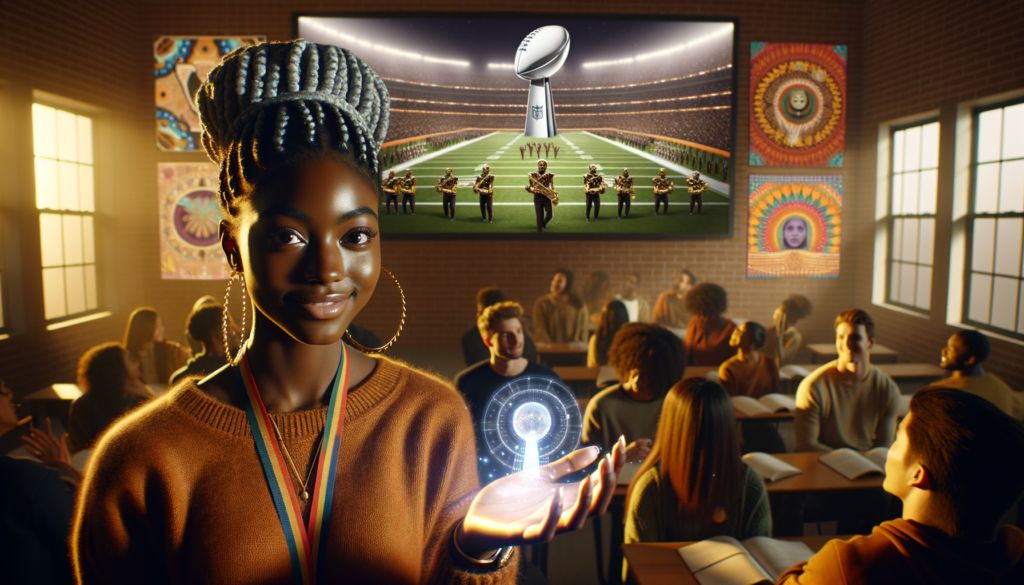
Kendrick Lamar’s Super Bowl halftime performance didn’t just entertain—it became curriculum. Black academics seized its imagery like a megaphone, dissecting themes often excluded from mainstream pedagogy. His choreography evoked historical defiance while costuming blended West African textiles with Compton streetwear, creating visual counter-narratives to standardized textbooks (The Pedagogy of Kendrick Lamar at the Super Bowl Halftime Show).
Antithetical to rote memorization, Lamar’s set critiqued anti-intellectualism through symbolic tableaux. One viral lesson plan asks students to analyze how the phrase “We gonna be alright” morphs from a hopeful protest chant to sarcastic lament when framed against police batons in the performance. This layered analysis builds critical frameworks rarely prioritized in STEM-dominant curricula obsessed with standardized metrics (Word In Black).
Super Bowl Halftime Show Analysis
Lamar turned football’s biggest stage into a didactic spectacle. Unlike typical halftime acts, which prioritize crowd-pleasing hits, his set intercut verses with audio from Malcolm X and Tupac. These choices demand historical literacy to unpack, showcasing music’s role as archival resistance. Teachers report using the performance to teach media bias—news outlets covering the event often omitted contextual references to mass incarceration or redlining (Josh Johnson’s Commentary).
The show’s staging weaponized Americana tropes. Black cheerleaders formed pyramids under a tilted flag, symbolizing both patriotic allegiance and systemic fracture. Such dualities exemplify what UCLA professor Dr. Cheryl Harris calls “the paradox of black inclusion”—participation in national rituals while critiquing their underlying inequities. Educators leverage these tensions to discuss intersectionality’s real-world applications (Brielle Plush/Substack Post).
Cultural Critique In Education Evolution
Lamar’s halftime pedagogy exposes a generational shift. Where prior activists fought for representation, today’s educators demand paradigm overthrow. Lesson plans dissecting his performance often pair Maya Angelou’s poetry with Black Twitter threads demonstrating canon expansion. Crucially, they reject false binaries between “high” and “pop” culture, which is a hierarchy rooted in colonial knowledge systems (The Pedagogy of Kendrick Lamar).
Resistance here isn’t just content—it’s method. Teachers adopting these materials emphasize process over product, letting student interpretations guide discussions. This mirrors Lamar’s lyrical density, where single lines invite multiple valid readings. One Bronx classroom debate unpacked whether his crown-of-thorns prop critiqued respectability politics or martyrdom fetishization—a conversation unimaginable under fill-in-the-blank test regimes.
ABOUT THE AUTHOR
Darius Spearman is a professor of Black Studies at San Diego City College where he has been teaching since 2007. He is the author of several books including Between The Color Lines: A History of African Americans on the California Frontier Through 1890. You can visit Darius online at africanelements.org.
