

Listen to this article
Download AudioUS Deportations to South Sudan Raise Human Rights Concerns
By Darius Spearman (africanelements)
Support African Elements at patreon.com/africanelements and hear recent news in a single playlist. Additionally, you can gain early access to ad-free video content.
The recent deportations from the United States to South Sudan have stirred widespread concern across different communities. People worry about fundamental human rights, judicial due process, and the direct impact on Black communities. This controversial issue makes us reflect on who dictates justice and how it affects our global family. It also brings into focus the complex relationship between national security and human dignity.
These actions illuminate the urgent need for clear ethical guidelines in immigration policy. Furthermore, they spark important discussions about international norms and the very definition of safety. For many in the African diaspora, this situation feels deeply personal, reminiscent of historical struggles for fairness and recognition. Understanding these events requires looking at multiple viewpoints, from legal experts to government officials.
A Dangerous Deportation Precedent
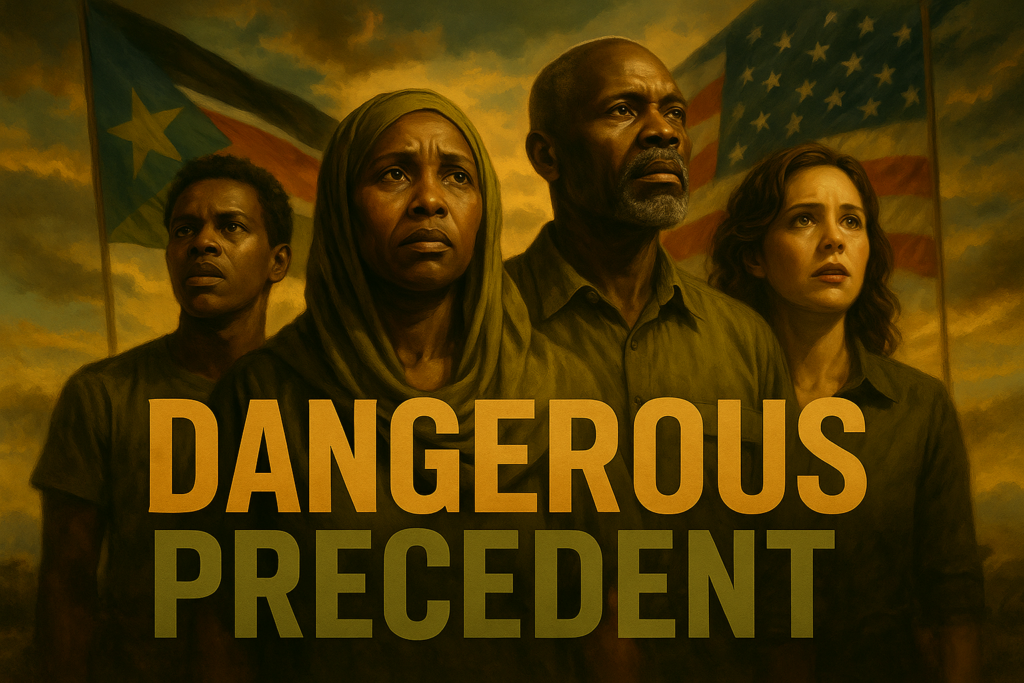
Experts are sounding alarms about the United States deporting immigrants to South Sudan. This complex issue has potential to establish a dangerous and unprecedented action in international deportation law (Africanews). South Sudan is a country still struggling with instability and conflict. Sending people there directly challenges established international norms of refugee protection.
These norms primarily stem from the 1951 Refugee Convention and its 1967 Protocol. These vital agreements outline refugee rights and state obligations to protect them (UNHCR – The 1951 Refugee Convention and its 1967 Protocol). For instance, the crucial principle of non-refoulement forbids returning refugees to places where their lives or freedom are under serious threat (UNHCR – Protecting Refugees). In this case, deportees received very little chance to object or obtain legal help before their forced removal. This action strikes many as hypocritical. It ignores broader humanitarian and legal risks involved in sending individuals back to a conflict-ridden nation. Such policies could set back decades of progress in international human rights.
Key Deportation Statistics
Rebuke from Judicial Oversight
A federal judge in Boston delivered a strong rebuke to the U.S. government. The ruling stated that deporting eight immigrants to South Sudan violated a court order (OPB). This was because the individuals were not given a meaningful chance to object. The judge noted that deportees received only hours’ notice before their forced removal. This short timeframe prevented them from contacting lawyers or fighting their expulsion in court. Such rapid removals, particularly for those facing legal challenges, can deeply undermine public trust.
The judge specifically labeled the government’s actions as “unquestionably in violation” of judicial orders. This statement highlighted the procedural unfairness and the potential danger faced by the immigrants. Government lawyers claimed previous interactions offered sufficient opportunity to express fears. Nevertheless, the judge found the process and timing completely inadequate. This dispute shows a deeply strained relationship between the judiciary and the executive branch regarding deportation methods. Administration officials have accused judges of activism aimed at releasing criminals. This reveals a tense conflict over who holds ultimate authority in these critical matters. For many in the African diaspora, this situation underscores ongoing struggles for due process and fair treatment under the law. Historically, Black communities have often faced disproportionate impacts from governmental procedures that lack transparency or proper oversight.
DHS Stance on Removals
The Department of Homeland Security (DHS) publicly defended the deportation flights to South Sudan. Officials emphasized that the individuals removed were among “the worst of the worst.” They cited histories of violent crimes, including murder, rape, and pedophilia (DHS). The department dismissed criticisms as mere “media frenzy.” Furthermore, they characterized judges opposing deportations as “activist judges” attempting to bring dangerous criminals back.
Named deportees included Enrique Arias-Hierro, convicted of homicide and kidnapping. Tuan Thanh Phan, convicted of first-degree murder and assault, was also on the list. He faced a 22-year sentence. These specific examples were used to justify the removals. DHS highlighted its core mission to protect American communities by permanently removing violent criminals. However, discussions about “violent criminals” often fail to consider the nuances of due process. For communities of color, the term “violent criminal” can carry heavy historical connotations. Furthermore, it raises questions about rehabilitation and equitable justice. Such labels, while powerful, must always be balanced with the right to fair legal proceedings. Preventing arbitrary designation or deportation is a cornerstone of justice. All individuals, regardless of their past, deserve proper legal procedure. This principle is especially vital to ensure that justice is applied fairly across all demographic groups.
“Activist Judges”: A Contested Term
South Sudan’s Ongoing Instability
South Sudan continues to be one of the most unstable nations around the globe. It faces persistent civil conflict, ethnic violence, and weak governmental institutions (BBC News – South Sudan conflict). Since gaining independence in 2011, the country has frequently experienced widespread violence. This includes a civil war that began in 2013 (United States Institute of Peace – South Sudan Overview). The government struggles deeply with factionalism. Additionally, it has limited capacity to provide basic security for its citizens.
Millions of people have been displaced within the country or now face severe food insecurity. The overall humanitarian situation remains dire (UN OCHA – South Sudan Humanitarian Needs). These continuous conflicts and severe instability make safe return and protection for deported individuals extremely difficult, if not impossible. Experts from organizations like Refugees International express deep concern over the risks faced by returnees (Refugees International – Risks of Return to South Sudan). The lack of clear public information about diplomatic or legal agreements between the U.S. and South Sudan regarding these deportations further complicates the situation. There is no confirmation of specific bilateral treaties authorizing such removals. This absence of explicit agreements can create legal uncertainty. Furthermore, it risks diplomatic tensions if the removals are challenged. Such a process highlights a significant ethical challenge when considering deportations to fragile states. It prompts questions regarding the balance between national enforcement interests and global humanitarian responsibilities.
Procedural Fairness: Core Principles
Impact on the Black Community and Social Justice
The policy of deporting individuals to South Sudan sparks significant concern within African diasporic and immigrant communities. This situation reflects broader social justice issues. It touches on systemic racism, as well as historical treatment of people of African descent within U.S. immigration enforcement (African Diaspora Policy Center). There is a critical need to examine how these deportations might disproportionately affect Black communities. Understanding these structural effects is crucial for advocating for equity. This issue reveals itself as another instance where Black populations face unique challenges due to immigration policies. These policies often have racial and social justice implications (NAACP – Immigration and Racial Justice).
The term “expelled” versus “deported” also sheds light on concerns about fairness. Deportation is a formal legal process with safeguards. Expulsion, conversely, often means immediate removal without proper proceedings. This immediate action can bypass necessary legal protections (UNHCR – Expulsion and Non-Refoulement). The lack of clarity on deportees’ immigration status also complicates the matter. It is unclear if they were refugees, asylum seekers, or legal immigrants (USCIS – Refugees and Asylum Seekers). Each status carries specific protections. Without this vital information, assessing whether due process and humanitarian norms were truly observed becomes challenging. This situation highlights how immigration enforcement can disproportionately affect people of color. It further underscores the urgent need for transparency and adherence to international human rights standards.
In conclusion, the United States’ deportations to South Sudan create a complex legal and ethical dilemma. Experts express serious warnings about setting dangerous international precedents. The judicial system has rebuked the government for not following due process. Meanwhile, DHS insists on its right to remove alleged “violent criminals.” This situation showcases a profound clash between governmental power, judicial oversight, and fundamental human rights. For the African diaspora, these events are particularly poignant. They evoke historical patterns of injustice and the ongoing fight for dignity and fair treatment within the justice system. It is a stark reminder that the principles of justice must apply to all, regardless of background or perceived status. A robust commitment to due process and humanitarian considerations remains paramount for a just society.
ABOUT THE AUTHOR
Darius Spearman has been a professor of Black Studies at San Diego City College since 2007. He is the author of several books, including Between The Color Lines: A History of African Americans on the California Frontier Through 1890. You can visit Darius online at africanelements.org.
