

Listen & Share
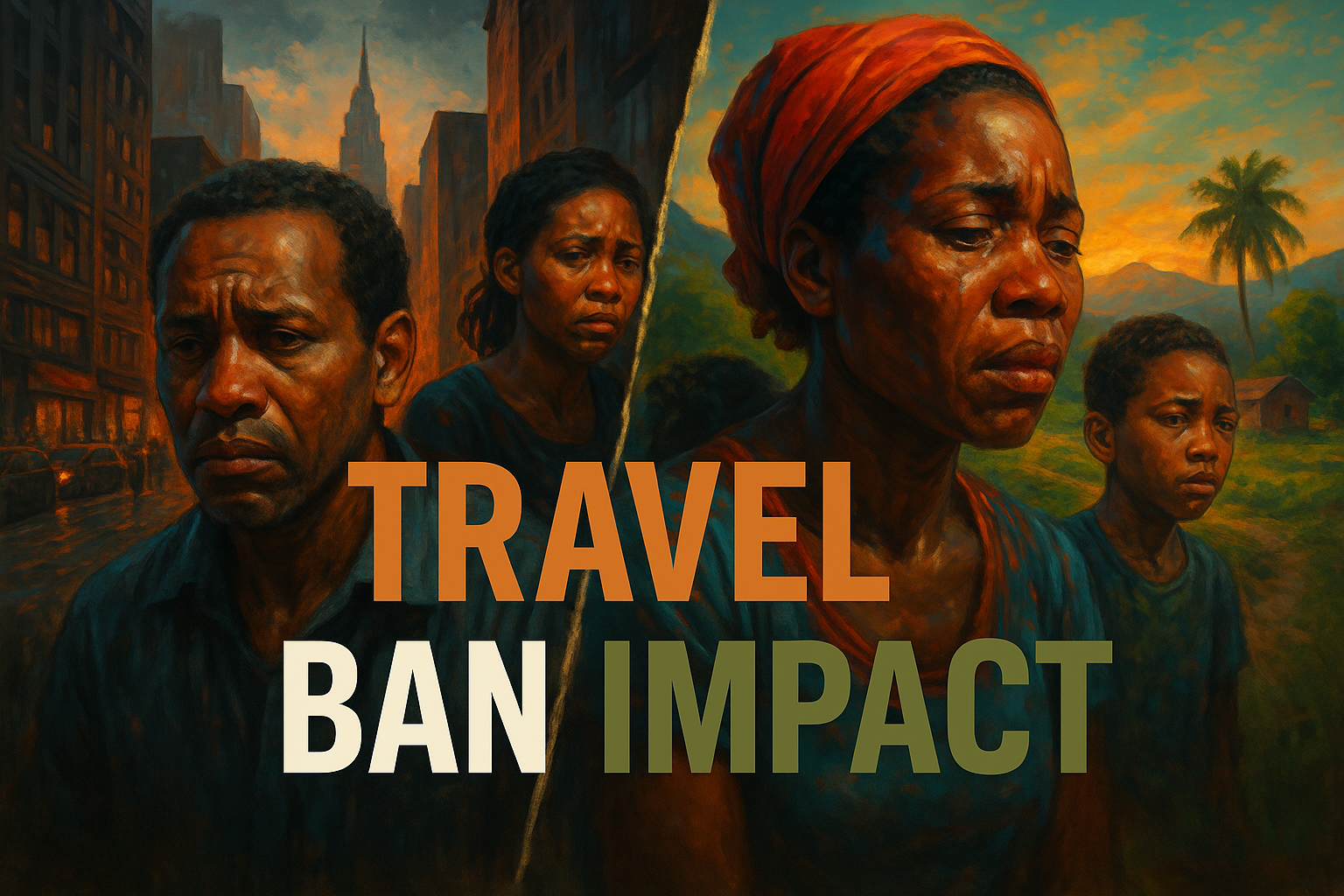
The 2025 Travel Ban’s Impact on Haitian Families
By Darius Spearman (africanelements)
Support African Elements at patreon.com/africanelements and hear recent news in a single playlist. Additionally, you can gain early access to ad-free video content.
Understanding the New Travel Restrictions
A significant new policy affecting international travel to the United States will begin on June 9, 2025. This travel ban, announced by the U.S. government, impacts nationals from 19 countries, including the sovereign nation of Haiti (Fact Sheet: President Donald J. Trump Restricts the Entry of Foreign Nationals to Protect the United States from Foreign Terrorists and Other National Security and Public Safety Threats); (Presidential Proclamation Orders Travel Bans on 19 Countries). Haitians face full restrictions on entry, meaning both immigrant and non-immigrant visas are suspended. Moreover, this sweeping measure fully restricts the entry of individuals from 12 countries, which includes Haiti, while imposing partial restrictions on seven other nations.
This policy means a profound shift for many. Indeed, the ban means that standard pathways for travel and immigration are largely closed for Haitian citizens (What You Need to Know About Trump’s June 2025 Travel Ban). There are specific exceptions, however. For instance, immediate family members of U.S. citizens and certain Special Immigrants may still be able to enter. Lawful permanent residents and individuals who already possess valid visas are also exempt from this new restriction (What is President Trump’s latest travel ban? | The IRC). The breadth of this ban marks a significant challenge for the Haitian diaspora and those aspiring to come to the U.S.
Overstay Rates and Policy Justification
The U.S. government points to visa overstay rates as a key motivator for this travel prohibition. Haiti exhibits specific overstay rates that the policy makers have noted (Fact Sheet: President Donald J. Trump Restricts the Entry of Foreign Nationals to Protect the United States from Foreign Terrorists and Other National Security and Public Safety Threats). For example, Haiti has a business and tourism visa overstay rate of 31.38 percent. Furthermore, the combined overstay rate for student and exchange visitor visas from Haiti stands at 25.05 percent.
These statistics highlight why certain nations like Haiti have been targeted. For context, a visa overstay occurs when an individual remains in the United States beyond the expiration date of their authorized stay. High overstay rates are often cited by immigration authorities as indications of potential challenges in ensuring compliance with immigration laws. This particular policy aims to address concerns regarding foreign nationals remaining in the country past their allowed time, an issue the government links to national security and public safety threats (Fact Sheet: President Donald J. Trump Restricts the Entry of Foreign Nationals to Protect the United States from Foreign Terrorists and Other National Security and Public Safety Threats). This measure is presented as a necessary step to maintain the integrity of the U.S. immigration system.
Haiti’s Visa Overstay Rates (2025)
The Human Cost on Haitian Families
The travel ban carries immense and profound human consequences, especially for the Haitian community. This policy will have far-reaching impacts on Haitian families, both in the United States and those residing abroad (Haitians in US and at home reeling from US travel ban that takes affect on Monday). Many individuals pursuing family reunification will face significant challenges. Family reunification efforts often rely on specific visa categories designed to allow relatives to join family members already present in the U.S. Denying these visas creates separation and distress for many.
Haiti’s unique vulnerability, stemming from a history of political instability and devastating natural disasters, makes this ban particularly harsh. For example, recent global conflicts, such as those in Ukraine and Sudan, have led to millions of displaced persons, underscoring the critical need for humanitarian considerations worldwide (What is President Trump’s latest travel ban? | The IRC). The absence of a waiver for urgent humanitarian circumstances within this ban raises serious concerns for those facing life-threatening situations or extreme hardship. Such restrictions compound existing challenges, placing an additional burden on an already struggling population seeking stability and safety.
Key Impacts of the Travel Ban on Haitians
Both immigrant and non-immigrant visas fully suspended for Haitian nationals.
Significant challenges for Haitian families seeking to reunite across borders.
No provisions for urgent humanitarian circumstances, increasing vulnerability.
Far-reaching effects on Haitian communities in the U.S. and abroad.
Navigating Visa Categories and Waivers
Understanding the different visa categories is crucial to grasping the full scope of this travel restriction. For instance, B1/B2 visas are specific. These are primarily designated for short-term visits related to business or tourism and do not grant permission for employment or academic studies in the U.S. (Directory of Visa Categories – Travel.gov). Other important categories include F, M, and J visas. F visas, like the F-1, are specifically for students pursuing full-time academic education, with F-2 visas for their dependents (J-1 vs. F-1: Which Status is Right For You?). M visas, such as the M-1, are designated for individuals seeking non-academic vocational or technical training (Directory of Visa Categories – Travel.gov). Additionally, J visas, particularly the J-1, support exchange visitors participating in educational and cultural programs (J-1 vs. F-1: What Visa is Right For You? – Boundless Immigration). The suspension of these types of visas for Haitians means a serious disruption to educational pursuits and cultural exchange initiatives.
The ban also speaks to the specific category of Special Immigrants. These individuals are often defined by their particular roles or family relationships, such as religious workers, diplomats, or spouses of U.S. citizens, granting them a distinct immigration status. However, a significant concern with this new travel policy centers on the absence of a humanitarian waiver. Unlike some immigration policies which allow for exceptions under urgent medical needs, asylum claims, or family emergencies, this ban lacks such a provision (What is President Trump’s latest travel ban? | The IRC). This omission could leave countless individuals in dire circumstances without recourse, compounding the human toll of the travel restrictions. Consequently, the determination of waivers usually depends on the severity of the situation and the availability of legal avenues for appeal, but these avenues appear limited here.
Affected Visa Categories Explained
B1/B2 Visas
For temporary business (B1) or tourism and pleasure (B2) visits to the U.S. These do not allow for employment or academic studies.
F Visas (F-1/F-2)
For students pursuing full-time academic education in the U.S. F-2 is for dependents of F-1 students.
M Visas (M-1)
For individuals seeking non-academic, vocational, or technical training in the U.S.
J Visas (J-1)
For exchange visitors participating in cultural and educational programs approved by the U.S. Department of State.
The Broader Implications for Global Communities
The impact of such a restrictive travel policy reaches far beyond simply denying entry. It sends a chilling message to global communities, particularly those in the African Diaspora. Historically, immigration policies have profound effects on the lives of Black people, shaping family structures and economic opportunities across continents. This ban, by fully suspending visas for Haitians, not only affects those directly attempting to travel but also reverberates through the established Haitian communities in the U.S., hindering their ability to sustain familial and cultural ties with their homeland.
Moreover, the stated justification for the ban, rooted in visa overstay rates, raises questions about proportionality and equitable treatment. The policy’s timing, amidst ongoing global conflicts and humanitarian crises, serves to deepen concerns among human rights advocates. Conflicts in places like Ukraine and Sudan have already created massive displacements, yet this ban appears to create additional barriers for vulnerable populations ( What is President Trump’s latest travel ban? | The IRC). Consequently, the decision to implement such a strict measure at this moment suggests a disregard for the global context of human suffering and the interconnectedness of world communities, leaving many to question the true purpose and long-term effects of this policy.
ABOUT THE AUTHOR
Darius Spearman has been a professor of Black Studies at San Diego City College since 2007. He is the author of several books, including Between The Color Lines: A History of African Americans on the California Frontier Through 1890. You can visit Darius online at africanelements.org.
