
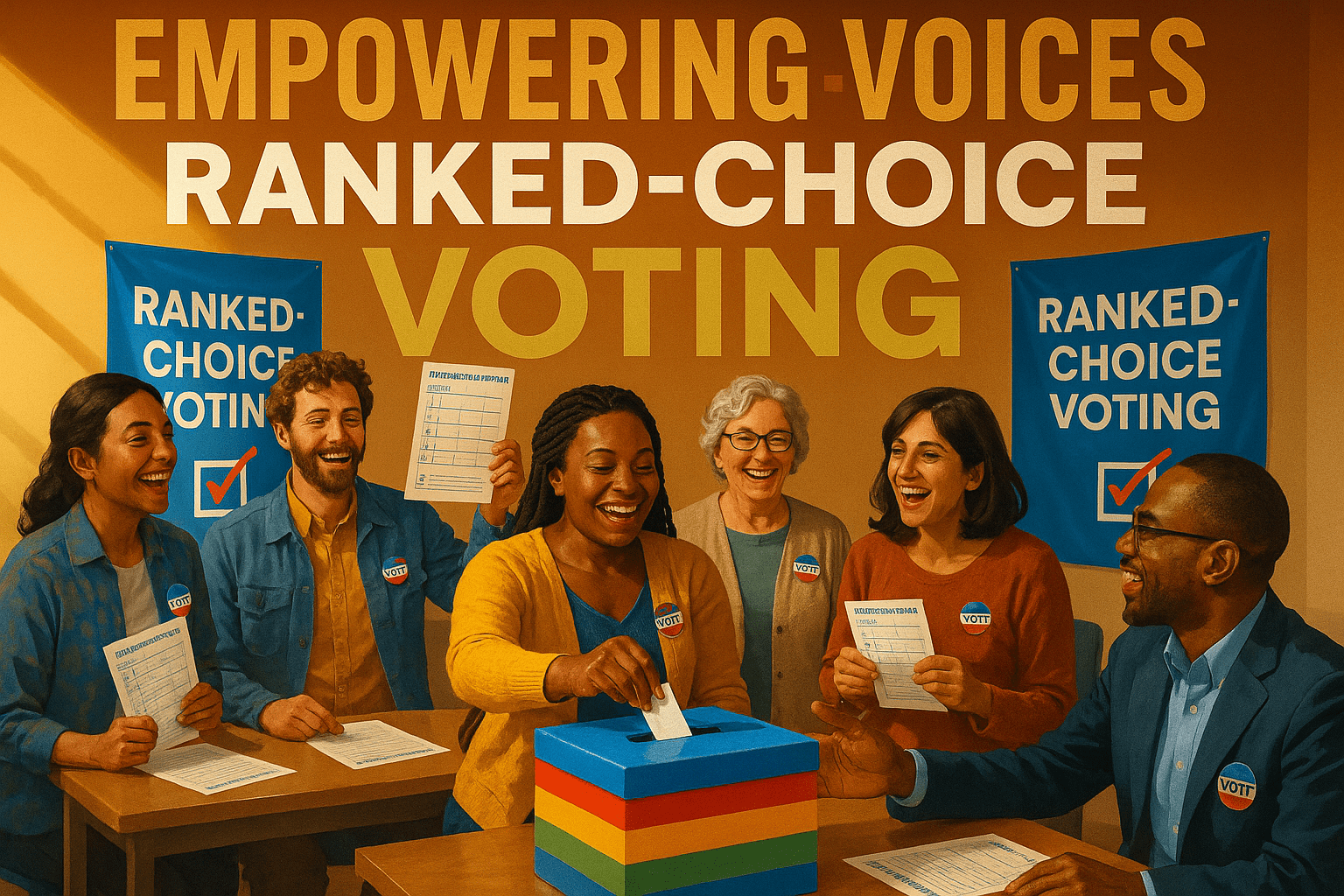
Empowering Voices: Ranked-Choice Voting in NYC
By Darius Spearman (africanelements)
Support African Elements at patreon.com/africanelements and hear recent news in a single playlist. Additionally, you can gain early access to ad-free video content.
New York City has embraced a new way for its residents to cast their votes, a system known as ranked-choice voting, or RCV. This innovative approach, first introduced in city elections in 2021, came about after a 2019 referendum where a strong 74% of New York voters chose to adopt it (Democracy Now!). RCV is now used in primary and special elections for key city offices, including mayor, public advocate, comptroller, borough president, and city council (Democracy Now!).
This system allows voters to rank up to five preferred candidates in order of preference (Democracy Now!). The goal is to give voters more choices and greater power in deciding who ultimately wins an election. RCV is gaining popularity across the United States, with its first implementation in San Francisco in 2004 (Democracy Now!). Today, it is used in approximately 40 cities and towns, such as Oakland, Boulder, Minneapolis, Burlington, and Takoma Park (Democracy Now!). Additionally, it is used statewide in Maine and Alaska (Democracy Now!).
Understanding Ranked-Choice Voting
Ranked-choice voting is different from traditional voting systems because it allows voters to rank candidates instead of picking just one. This method helps ensure that the winning candidate has support from a majority of voters (FairVote). The vote counting process happens in rounds, which helps to find a candidate with broad appeal.
Initially, all first-choice votes are counted. If no candidate receives more than 50% of these first-choice votes, the candidate with the fewest votes is eliminated (FairVote). The votes that went to the eliminated candidate are then given to the voters’ next ranked choice. This process continues until one candidate finally achieves a majority of the votes (FairVote). This system encourages candidates to build wider support, not just from their most loyal followers, but also from those who might rank them as a second or third choice.
How Ranked-Choice Voting Works
Addressing “Wasted” Votes
RCV aims to fix a common problem in traditional winner-take-all elections: “wasted” or “spoiled” votes (Democracy Now!). A “wasted” vote often means a vote for a candidate who has no real chance of winning, or a ballot marked incorrectly. These votes can be problematic because they do not help elect a viable candidate, which can lead to a winner who lacks widespread support. This situation can also make voters feel like their vote does not matter, discouraging them from participating in future elections.
A well-known example is the 2000 Florida election, where Green Party candidate Ralph Nader received 97,000 votes (Democracy Now!). Al Gore lost the presidency by only 537 votes in Florida (Democracy Now!). If RCV had been in place, Green Party supporters could have ranked Al Gore as their second choice (Democracy Now!). If Nader had been eliminated, those second-choice votes would have been reallocated to Gore. This reallocation could have potentially changed the outcome, showing broader support for Gore among voters whose first choice was a third-party candidate (FairVote). RCV allows voters to support their most preferred candidate while also making a second-choice selection for other liked candidates. This prevents a less desired candidate from winning if their top choice does not perform well (Democracy Now!).
Understanding “Wasted” Votes
NYC’s RCV Journey
New York City held its first citywide RCV elections in June 2021 for party primaries, including the mayoral race and other city offices (FairVote). The transition to RCV was managed following a 2019 ballot measure that 73% of voters supported (FairVote). While specific details on voter education campaigns are not fully available, there is strong evidence that voters learned how to complete their RCV ballots by following cues from candidates (FairVote).
The system has performed well in terms of voter engagement. Nearly nine out of ten voters, or 87%, ranked multiple candidates for mayor in the 2021 NYC primary (FairVote). This high percentage suggests that voters were comfortable with the new system and actively used its features. The New York State Assembly Elections Committee has even scheduled a hearing to review the RCV process in the 2021 New York City primary, indicating ongoing oversight and integration with state regulations (Citizens Union).
Impact on NYC Politics and Diversity
RCV has significantly influenced the political landscape in New York City. It encourages candidates to build broader coalitions and connect with a wider range of voters (FairVote). Candidates are rewarded for making positive connections with more voters, even if those voters rank them as a second or third choice (FairVote). This approach can lead to less negative campaigning, as candidates need to appeal to a broader base of support rather than just attacking opponents.
One of the most notable impacts of RCV in NYC has been on the diversity of elected officials. The 2021 primary elections, conducted under RCV, are expected to result in the most diverse NYC city council ever (FairVote). This includes a majority of women and more than two-thirds people of color (FairVote). This outcome is especially significant for African American and African Diaspora communities, as it suggests RCV can lead to more representative leadership that better reflects the city’s diverse population. The system has demonstrably led to more diverse winners, which is a positive step towards ensuring all voices are heard in city governance.
RCV’s Impact on Diversity in NYC City Council (2021)
The Indypendent’s Lens
The Indypendent, a New York-based publication, has been closely watching New York City elections and the effects of ranked-choice voting (Democracy Now!). The publication has covered various city council races, highlighting the diverse political landscape in New York primaries (indypendent.org). This includes candidates from different political backgrounds, such as democratic socialists, progressives, and more conventional candidates (indypendent.org).
The Indypendent has also featured candidates like Layla Law-Gisiko, who advocates for solutions to the affordable housing crisis beyond free-market ideas (indypendent.org). Their coverage also included the 2021 mayoral race, with interviews from candidates like Art Chang, who focused on the childcare crisis, and Cathy Rojas, who offered an alternative for working-class New Yorkers (indypendent.org, indypendent.org). The publication’s detailed reporting helps readers understand the practical effects of RCV on candidate strategies and election outcomes in NYC.
Challenges and the Path Forward
Despite its benefits, RCV in NYC has faced some criticisms. Concerns have been raised about whether it would be too confusing for voters, potentially leading to lower voter turnout (Citizens Union). There were also arguments that RCV might negatively affect communities of color that have traditionally held political power (Citizens Union). However, the 2021 primary results, with high voter engagement in ranking candidates and increased diversity in the City Council, suggest that many of these concerns have been addressed through practical experience.
The implementation of RCV in New York City for local primary elections fits within the broader framework of New York State election laws. The fact that it was adopted after a city charter commission’s proposal and a ballot measure indicates it operates within the legal boundaries for local elections (FairVote). As RCV continues to be used, its impact on voter behavior, candidate strategies, and the overall political landscape will be closely watched. The system offers a promising path toward more representative and inclusive elections, giving more power to the voices of all New Yorkers.
The journey of RCV in New York City shows how electoral systems can adapt to better serve the needs of a diverse population. It moves away from the old winner-take-all model, which often left many feeling unheard. Instead, RCV promotes a system where building broad support and appealing to a wider range of voters becomes essential for success. This shift can lead to more collaborative politics and a government that truly reflects the people it serves.
ABOUT THE AUTHOR
Darius Spearman has been a professor of Black Studies at San Diego City College since 2007. He is the author of several books, including Between The Color Lines: A History of African Americans on the California Frontier Through 1890. You can visit Darius online at africanelements.org.
