

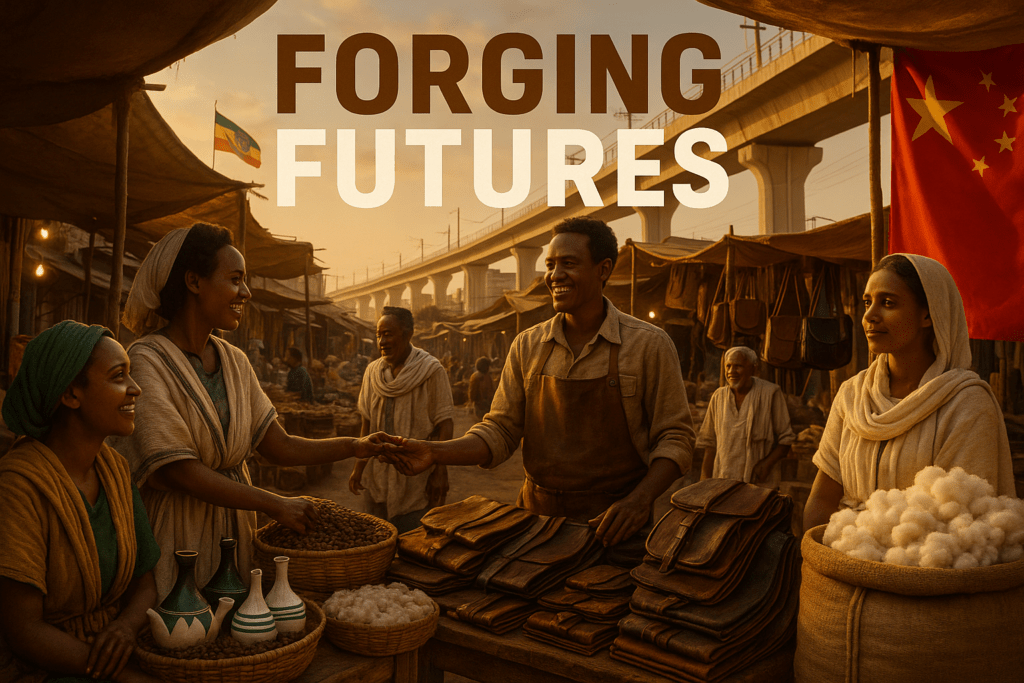
Forging Futures: China-Ethiopia Partnership Explored
By Darius Spearman (africanelements)
Support African Elements at patreon.com/africanelements and hear recent news in a single playlist. Additionally, you can gain early access to ad-free video content.
A Deep-Rooted Friendship
The relationship between China and Ethiopia stands as a powerful example of cooperation among nations of the Global South. For decades, these two countries have cultivated a bond built on mutual respect and shared aspirations for development. This partnership is not merely transactional; it is deeply rooted in political trust and a common vision for a more equitable global order. Leaders from both nations consistently affirm their commitment to expanding practical cooperation across various sectors, including economy, trade, and vital infrastructure (BRF2023).
Furthermore, this high level of political mutual trust means that China and Ethiopia firmly support each other on issues concerning their core interests. China has expressed its willingness to work with Ethiopia to maintain domestic stability and achieve development and revitalization (BRF2023). Similarly, Ethiopia highly values its friendship with China, steadfastly upholds the one-China policy, and actively supports various global initiatives proposed by Chinese President Xi Jinping (english.news.cn). This reciprocal support forms the bedrock of their enduring alliance, positioning it at the forefront of China-Africa cooperation.
Building Bridges and Economies
A cornerstone of the China-Ethiopia partnership is the Belt and Road Initiative (BRI), a global development strategy launched by China. The BRI focuses on infrastructure development and investments across nearly 150 countries and international organizations. Its primary objectives include promoting economic cooperation, enhancing connectivity, and facilitating trade along historical Silk Road routes and new maritime paths. For Ethiopia, the BRI provides significant investment opportunities for various projects, particularly in Eastern African countries (Springer).
This cooperation extends to advancing critical infrastructure, improving communications connectivity, and constructing industrial parks. China actively supports Ethiopia’s industrialization and agricultural modernization processes, recognizing their importance for sustainable growth (BRF2023). Joint projects like the Addis Ababa-Djibouti Railway are central to this collaboration, aiming to accelerate development and foster green growth (english.news.cn). Chinese finance and investment over the past two decades have profoundly shaped Ethiopia’s infrastructure and manufacturing industries, demonstrating a tangible commitment to the nation’s economic transformation (Buffalo Law).
Shifting Trade Winds
Trade between China and Africa, including Ethiopia, has seen remarkable growth, signaling a new chapter in global commerce. By the end of 2024, China’s zero-tariff policy was extended to all Least Developed Countries (LDCs) that maintain diplomatic ties with Beijing, encompassing 33 African nations (thevoiceofafrica.com). This policy is designed to strengthen trade ties and open the vast Chinese market to a wider array of African goods, fostering more balanced economic exchanges.
In 2024, the total volume of trade between China and Africa reached nearly $296 billion, marking a 4.8 percent increase over the previous year (thevoiceofafrica.com). Significantly, African exports to China grew at a faster pace than Chinese exports to Africa, actively working to reduce the long-standing trade imbalance. For Ethiopia specifically, bilateral trade with China reached just under $5 billion in 2023, a substantial increase from $3 billion in 2014. While Chinese exports to Ethiopia totaled more than $4.3 billion in 2024, Ethiopian exports to China were $564 million in 2023, indicating a trade surplus in China’s favor. Ethiopia’s key exports to China include leather, cotton, and coffee, and it stands as China’s top source for sesame imports. Conversely, China exports trucks, light industrial goods, high-tech products, pharmaceuticals, and chemical products to Ethiopia.
China-Ethiopia Bilateral Trade Overview
Pillars of Political Trust
The strong political mutual trust between China and Ethiopia is a defining characteristic of their relationship. This trust is evident in their consistent diplomatic exchanges and their shared commitment to supporting each other’s stability and development. China has explicitly stated its readiness to work with Ethiopia to firmly support each other in maintaining domestic stability and achieving national revitalization (BRF2023). This mutual support extends to core interests and major concerns, ensuring a stable and predictable foundation for their cooperation.
Beyond bilateral ties, both nations are strengthening cooperation within multilateral frameworks, including the BRICS mechanism and the United Nations. Ethiopia’s Prime Minister Abiy Ahmed has expressed his nation’s readiness to enhance coordination and cooperation with China within BRICS and the broader framework of China-Africa cooperation (BRF2023). China, in turn, stands ready to strengthen cooperation with Ethiopia within these mechanisms to practice multilateralism, oppose power politics and bullying, and safeguard common interests (BRF2023). This joint effort aims to promote the implementation of initiatives such as the “Outlook on Peace and Development in the Horn of Africa” and collectively uphold international fairness and justice (fmprc.gov.cn).
Ethiopia’s Path to Revitalization
China’s support for Ethiopia extends significantly to its development and revitalization efforts, including crucial post-conflict reconstruction. Recognizing the challenges Ethiopia has faced, China attaches great importance to its relationship with the nation and actively supports its domestic peace process, development, and revitalization (english.news.cn). This commitment underscores a partnership that aims to empower Ethiopia to overcome obstacles and build a prosperous future for its people.
Furthermore, China supports Ethiopia in leveraging its inherent advantages as a regional transportation hub. This strategic support aims to promote the interconnected development of infrastructure and industries, ultimately building a sea-rail combined transport network across East Africa (fmprc.gov.cn). This initiative includes establishing a demonstration zone for high-quality China-Africa Belt and Road cooperation, further solidifying Ethiopia’s role as a key player in regional logistics and trade. The synergy between China’s Belt and Road Initiative and Ethiopia’s Ten Years Perspective Development Plan (2021-2030) is a testament to their aligned development goals (english.news.cn).
China-Africa Trade Highlights (2024)
A Partnership for the Global South
The collaboration between China and Ethiopia is a prime example of South-South cooperation, which refers to the exchange of resources, technology, and knowledge between developing countries, often referred to as countries of the “Global South.” This model signifies a partnership where both nations, as developing countries, work together for mutual benefit, rather than a traditional donor-recipient relationship. BRI projects on the African continent are actively supported and promoted by this form of cooperation, benefiting both China and African countries (Springer).
While the narrative of China-Ethiopia relations is overwhelmingly positive, it is important to acknowledge that some skepticism exists regarding China’s involvement in Africa. However, despite these broader concerns, the relationship between China and Ethiopia continues to deepen and expand (Wiley Online Library). This resilience underscores the mutual benefits and strategic alignment that characterize their partnership. As both nations continue to navigate the complexities of global development, their collaboration serves as a powerful testament to the potential of South-South cooperation in fostering shared prosperity and a more balanced international landscape.
The comprehensive partnership between China and Ethiopia exemplifies a forward-looking approach to international relations, emphasizing mutual benefit, shared development, and a commitment to a multipolar world. As both nations continue to pursue their respective development agendas, their collaboration stands as a beacon of hope for other developing countries seeking partners for progress and self-determination.
By Darius Spearman (africanelements)
ABOUT THE AUTHOR
Darius Spearman has been a professor of Black Studies at San Diego City College since 2007. He is the author of several books, including Between The Color Lines: A History of African Americans on the California Frontier Through 1890. You can visit Darius online at africanelements.org.
