

Madagascar youth uprising: Gen Z digital revolt topples president
By Darius Spearman (africanelements)
Support African Elements at patreon.com/africanelements and hear recent news in a single playlist. Additionally, you can gain early access to ad-free video content.
Introduction
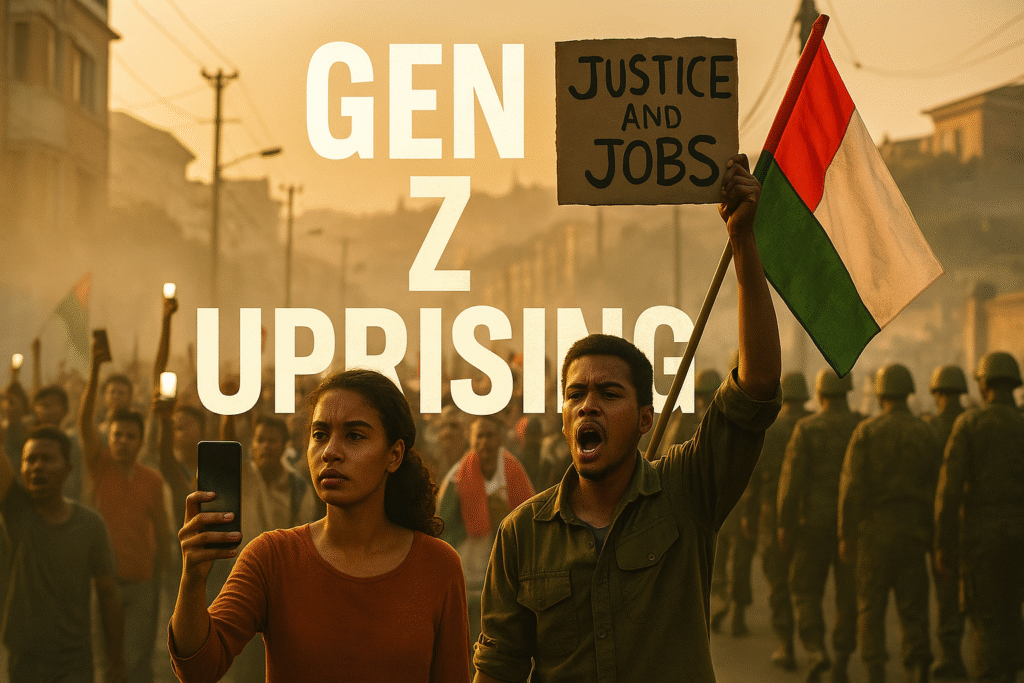
Across Madagascar, a wave of young people rose up. For weeks, Gen Z protesters streamed demonstrations from phones. They demanded relief from constant power and water outages, an end to corruption, and meaningful jobs. Moreover, when an elite military unit refused orders to fire and switched sides, the president lost control. Consequently, the head of state left the country and a military officer announced he would take over. The event is historic because it fuses digital mobilisation with mass socioeconomic grievances. In addition, the change reveals how fragile civilian power remains in states that face persistent poverty and crumbling services.
Gen Z protests
Young-led movements that use peer networks, social media and live video to organise and amplify grievances in real time.
CAPSAT
An elite military/security unit whose defection can determine whether a government holds power or falls.
Digital activism
Use of smartphones and platforms to coordinate, document abuses, and sustain protest momentum across cities.
Transitional authority
An interim power arrangement created after a rupture; legitimacy depends on pathway to elections and civil oversight.
Detailed Analysis of the current news story
Since late September, protests began as local mobilisations about daily life problems. Then the movement expanded into a national campaign. Young people coordinated via social platforms and live streams to share routes, safety advice, and real-time footage. As a result, demonstrations multiplied without traditional party structures. The rapid spread of protest was possible because smartphones and apps made information portable and immediate (Time; Al Jazeera). (Time, Al Jazeera)
Sept 25 — Local strikes and protests
Demonstrations begin over electricity and water outages in major cities.
Late Sept — National mobilisation
Protests grow into broader calls against corruption and unemployment as youth coordinate online.
Early Oct — Clashes and casualties reported
Violent confrontations occur; UN reports at least 22 dead and over 100 injured.
Mid Oct — Military unit defects
Elite unit refuses to fire, joins protesters; president departs country and a military leader asserts control.
Meanwhile, an elite unit—known publicly as CAPSAT—refused to fire on demonstrators. After several days of nationwide demonstrations and clashes, CAPSAT agents sided with protest organisers. The defection was decisive: it broke the security backbone that had propped the president up. Subsequently, a military commander announced the takeover and planned to be sworn in. The African Union moved quickly to suspend Madagascar’s membership and urged a return to constitutional order. International actors expressed alarm at the military move, while calling for a peaceful and transparent transition (Reuters, The Guardian).
Historical context
A history of disputed transfers of power shapes Madagascar’s modern politics. Past crises—including a 2009 takeover and other periodic upheavals—show how security forces can make or break elected administrations. Moreover, the island’s economic profile matters: roughly three-quarters of residents live in poverty and public services are uneven. In addition, decades of weak infrastructure have left ordinary people to cope with frequent electricity and water cuts, which inflame popular anger (Al Jazeera).
From a diasporic perspective, what happened in Madagascar echoes patterns across the continent. Young people often face the most acute economic exclusion. In addition, youth are digitally literate and connected to global movements. Consequently, they can translate daily frustrations into rapid mass mobilisation. Historically, when elites and security forces align, civil liberties suffer. However, when portions of the security apparatus switch sides, old bargains collapse and abrupt power shifts take place. In Madagascar’s case, an elite unit that once elevated Rajoelina turned against him, undercutting the familiar script that rulers can depend on loyal forces (Reuters, Time).
Why this matters today
First, the event shows the power of digital organising among African youth. Young activists used live video and social platforms to sustain protests and pressure institutions. Therefore, digital activism is now central to political mobilisation on the continent. Second, service failures—electricity, water and jobs—are no longer only technical issues. They are political flashpoints that can trigger broader demands about corruption and governance. Consequently, governments that ignore service delivery risk destabilisation even if they retain electoral legitimacy. Reuters and Al Jazeera emphasise how quickly everyday grievances can escalate to regime crisis when amplified online and backed by sections of the armed forces (Reuters, Al Jazeera).
Proportional indicator: Poverty and service failure
Third, this moment will shape regional norms about military intervention. The African Union suspended the country quickly, signaling that coups will not be accepted without consequences. Yet suspension alone will not fix structural inequalities. A genuine transition will require inclusive dialogue and credible pathways for elections. For the African diaspora, the lesson is clear: generations of sacrifice toward rights and representation can be erased if elites rely on loyal militaries rather than building accountable institutions. Therefore, the long-term remedy must be institutional reform, not military solutions (The Guardian, Reuters).
Conclusion: Why this matters today
For diasporic readers, the Madagascar uprising is a reminder that everyday failures of governance are political threats. Young people will not accept chronic collapse in services and exclusion from economic life. Additionally, the digital skills of Gen Z give them a strategic advantage in organising and shaping narratives. As a result, regimes that rely on patronage and force are vulnerable when parts of the security forces decide their loyalty ends. Lastly, international actors must couple pressure on coup leaders with support for credible transitions, because the long-term costs of rupture fall most heavily on poor communities and marginalised groups. The African Union suspension signals institutional rejection of military coups, yet practical outcomes depend on inclusive transitions that restore elected civilian rule.
ABOUT THE AUTHOR
Darius Spearman has been a professor of Black Studies at San Diego City College since 2007. He is the author of several books, including Between The Color Lines: A History of African Americans on the California Frontier Through 1890. You can visit Darius online at africanelements.org.
