

UK Proscription: Palestine Solidarity & Black Activist Attack
By Darius Spearman (africanelements)
Support African Elements at patreon.com/africanelements and hear recent news in a single playlist. Additionally, you can gain early access to ad-free video content.
London’s Latest Protests and UK Law
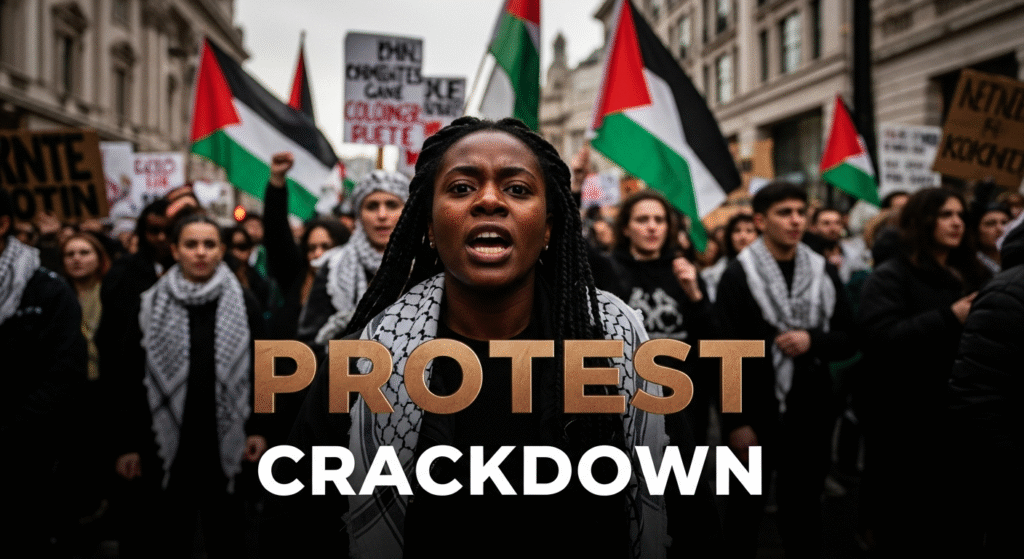
Recent events in London have sparked serious discussions about protest rights and the application of anti-terrorism laws. Dozens of individuals faced arrest for demonstrating solidarity with Palestine Action, a group newly banned under UK counter-terrorism legislation (wikipedia.org). These arrests have drawn significant attention because many of those detained are Black and other racialized activists. These activists see strong connections between the Palestinian struggle and the historical anti-colonial movements across Africa and the Caribbean (wikipedia.org).
The term “racialized” refers to individuals or groups who are categorized, subjected to, or significantly impacted by racial structures and discrimination. These are often, but not exclusively, non-white people (brh.org.uk). This situation prompts a close look at Palestine Action’s beginnings, the path UK anti-terror laws have taken, and the lasting legacy of Black and anti-colonial support for Palestine. Consequently, many fear these arrests criminalize legitimate protest and undermine wider efforts for racial justice.
Palestine Action: Roots of Direct Action
Palestine Action began on July 30, 2020, co-founded by Huda Ammori and Richard Barnard (wikipedia.org). Their first action involved breaking into and spray-painting Elbit Systems’ UK headquarters in London (wikipedia.org). The group’s main goal is to challenge what it calls British involvement in Israel’s “genocidal and apartheid regime.” This includes disrupting the UK arms industry, especially focusing on Elbit Systems, an Israeli company that supplies a majority of drones and land-based equipment to the Israeli military (wikipedia.org).
Palestine Action uses direct action methods, such as occupying buildings, vandalism, and property damage. They describe these actions as “genocide prevention” and an attempt to stop “British war crimes” (wikipedia.org). Over its existence, the group has claimed hundreds of actions, often involving spray-painting buildings and equipment. These tactics aim to draw attention to British complicity in actions they deem unjust.
UK Anti-Terror Laws: A Shifting Landscape
On the other hand, the concept of banning organizations under anti-terror laws in the UK started in the 1920s, initially targeting groups linked to Northern Ireland (wikipedia.org). The Prevention of Terrorism Act of 1974 extended this power to Great Britain, though it still primarily focused on Northern Irish matters (wikipedia.org). A major change happened with the Terrorism Act 2000, which combined these systems. For the first time, this Act allowed the banning of both international and domestic organizations considered “concerned in terrorism” (wikipedia.org).
After the 9/11 attacks and the 7/7 London bombings, UK counter-terrorism laws expanded greatly. This included a broader definition of terrorism and increased powers for enforcement agencies (wikipedia.org). Critics argue that these laws are often vaguely worded and allow for a low standard to restrict speech (wikipedia.org). They also grant significant power to enforcement agencies, raising worries that they could criminalize individuals who pose no actual terrorist threat (wikipedia.org). Furthermore, the Home Secretary holds the power to ban an organization if they believe it “commits or participates in acts of terrorism; prepares for terrorism; promotes or encourages terrorism (including the unlawful glorification of terrorism); or, is otherwise concerned in terrorism” (wikipedia.org). Being banned carries serious punishments, making it a crime to belong to, ask for support for, or even express support for a banned group, with penalties ranging from six months to 14 years in prison (wikipedia.org).
Milestones in UK Anti-Terror Legislation
- 1920s: Initial laws targeting groups linked to Northern Ireland.
- 1974: Prevention of Terrorism Act extends proscription powers to Great Britain, still focused on Northern Irish affairs.
- 2000: Terrorism Act 2000 unifies regimes, allowing proscription of international and domestic organizations “concerned in terrorism.”
- Post-9/11 & 7/7: Significant expansion of powers and broadening of the definition of terrorism.
This visualization outlines key legislative developments in the history of UK anti-terrorism laws. Source: (wikipedia.org)
Proscription and the Surge in Arrests
The British government officially banned Palestine Action as a terrorist group on July 5, 2025, under the Terrorism Act 2000 (wikipedia.org). This decision followed an incident in June 2025, where Palestine Action activists broke security at RAF Brize Norton and spray-painted two military aircraft (wikipedia.org). Home Secretary Yvette Cooper announced the intention to ban the group on June 23, 2025. She stated that the group had a “long history of unacceptable criminal damage” and showed an alleged increase in aggression and willingness to use violence (wikipedia.org).
The proscription of Palestine Action has faced widespread criticism from civil liberties groups, UN experts, cultural figures, and hundreds of lawyers (wikipedia.org). Many call it “unprecedented” for a direct action organization. Critics also believe it wrongly mixes protest with terrorism (wikipedia.org). Legal experts have pointed out what they see as a difference in the government’s reaction. They compare it to past direct action events, such as the “Fairford Five,” who damaged US bombers in 2003 (wikipedia.org). Current UK Prime Minister Keir Starmer, then a barrister, actually defended their actions as an attempt to prevent war crimes (wikipedia.org).
Arrests: An Unprecedented Scale
Since Palestine Action’s proscription, British police have arrested at least 2,094 individuals for showing support for the group (wikipedia.org). These arrests include large sit-ins at famous places like Parliament Square and Trafalgar Square (wikipedia.org). Under Section 13 of the Terrorism Act 2000, simply holding a sign that expresses support for a banned organization can lead to arrest (wikipedia.org). This number is a striking contrast to earlier times; between 2002 and 2004, only 25 individuals faced charges under the Terrorism Act 2000 for being members of a banned organization (wikipedia.org). This highlights the massive and unheard-of scale of recent arrests linked to Palestine Action. The group was added to the list of banned organizations alongside groups such as the Maniacs Murder Cult and the Russian Imperial Movement (wikipedia.org).
This drastic increase in arrests, from 25 individuals to 2,094 under the same Terrorism Act 2000, can be explained by several key factors (brh.org.uk). First, the specific banning of Palestine Action, whose activities involve direct action and protest against companies tied to Israel, directly led to a surge in arrests under terrorism laws (brh.org.uk). Moreover, there appears to be a broader way law enforcement and prosecutors interpret “terrorism” and “support for proscribed organizations.” This now covers a wider range of protest activities than before (brh.org.uk).
Arrests Related to Proscribed Organizations (UK)
This bar chart illustrates the dramatic increase in arrests under the Terrorism Act 2000 between two periods. Source: (wikipedia.org)
The Shifting Landscape of Enforcement
The current political climate and the government’s approach to protest and disagreement also play a part. This may result in a lower standard for applying terrorism charges to activists, especially those involved in disruptive direct action (brh.org.uk). Additionally, increased surveillance and intelligence gathering on activist groups, paired with a more active enforcement strategy, likely explain the higher number of arrests (brh.org.uk). This shift represents a significant expansion of what is considered actionable under anti-terrorism legislation.
The perceived criminalization of social justice work raises concerns among Black and racialized communities. The parallels drawn between this enforcement and historical efforts to suppress anti-colonial movements are evident. Therefore, understanding the historical context is crucial for analyzing these contemporary events.
Shared Struggles: Anti-Colonial Roots
The concerns voiced by Black and other racialized activists regarding these arrests are deeply connected to a long and important history of solidarity (wikipedia.org). This unity exists between Black liberation movements and the Palestinian struggle (wikipedia.org). It is built on shared experiences of colonialism, unfair systemic racism, and the ongoing fight for self-determination (wikipedia.org). Historical anti-colonial movements across Africa and the Caribbean involved struggles for independence from European imperial powers, the fight against apartheid in South Africa, and broader movements for self-determination and liberation (brh.org.uk).
These movements often shared core beliefs, such as resisting foreign control, demanding political and economic independence, and celebrating indigenous identities and cultures (brh.org.uk). Many African nations, such as Ghana under Kwame Nkrumah, actively championed political independence and pan-African unity against European colonial rule (brh.org.uk). The anti-apartheid movement in South Africa, led by figures like Nelson Mandela, battled a system of racial segregation and white minority rule. This system strongly resembled colonial power structures (brh.org.uk). Caribbean nations experienced similar movements, frequently combining demands for political independence with cultural and economic self-determination, like the Rastafari movement’s anti-colonial stances (brh.org.uk). These movements consistently emphasized the right of colonized peoples to govern themselves and control their own resources, directly challenging the exploitation built into colonialism (brh.org.uk).
Black Liberation’s Bridge to Palestine
Malcolm X played a crucial role in making early connections between these struggles. He visited the Gaza Strip in 1964 and explicitly compared the oppression faced by Palestinians with that of Africans (wikipedia.org). He viewed Israel as a colonial project serving broader imperialist interests (wikipedia.org). He argued that the creation of Israel was supported by Western powers and involved taking land from indigenous Arabs (brh.org.uk). This situation mirrored the colonial experiences seen in Africa and Asia (brh.org.uk).
The Black Panther Party, founded in 1966, strongly supported the Palestinian cause (wikipedia.org). They identified African Americans as an “internally colonized” people. They saw both Black Americans and Palestinians as “Third World” populations fighting against colonialism and imperialism (wikipedia.org). The Black Panther Party actively built relationships with the Palestine Liberation Organization (PLO) (wikipedia.org). Their solidarity was a testament to a shared understanding of oppression and the need for self-determination.
Understanding “Internally Colonized”
The Black Panther Party’s idea of African Americans being “internally colonized” means that Black communities within the United States face systemic oppression, economic exploitation, and a lack of self-determination similar to a colonial relationship, even inside their own country (brh.org.uk). This framework views racial oppression not just as discrimination. Instead, it sees it as a form of colonial domination exercised by the powerful white society over Black communities (brh.org.uk).
Figures like Huey P. Newton from the Black Panther Party argued that Black communities in America were a “colony” within the larger nation (brh.org.uk). This internal colonization showed itself through political powerlessness, economic exploitation where Black labor and resources benefited the white power structure, and cultural oppression (brh.org.uk). Police forces in Black communities were considered an “occupying army.” They were seen as enforcing the will of the colonizers and stopping any resistance (brh.org.uk). The theory called for self-determination and liberation for Black people in the U.S., viewing their struggle as similar to those of colonized peoples globally (brh.org.uk).
Global Voices: Mandela, BLM, and BDS
International figures such as Nelson Mandela consistently spoke out in strong support for Palestinian liberation. He often directly compared it to South Africa’s fight against apartheid (wikipedia.org). After his release from prison in 1990, Mandela embraced Yasser Arafat, stating, “We identify with the PLO because, just like ourselves, they are fighting for the right of self-determination” (wikipedia.org). Similarly, Thomas Sankara, the former President of Burkina Faso, spoke at the UN General Assembly in 1994, expressing deep indignation for the Palestinian people (wikipedia.org).
The Organisation of African Unity (OAU) was a pan-African group created on May 25, 1963 (brh.org.uk). Its main goals were to promote unity among African states, coordinate their efforts, defend their independence, and remove all forms of colonialism from Africa (brh.org.uk). The OAU in 1975 openly declared that “the racist regime in occupied Palestine and the racist regime in Zimbabwe and South Africa have a common imperialist origin” (wikipedia.org). This profound connection is captured by Nelson Mandela’s powerful declaration: “our freedom is incomplete without the freedom of the Palestinians” (wikipedia.org). In modern times, the Black Lives Matter movement has made ending Palestinian occupation a core demand of its platform (wikipedia.org). It also supports the Boycott, Divestment, and Sanctions (BDS) movement against Israel (wikipedia.org). The BDS movement is a Palestinian-led, non-violent global effort (brh.org.uk). It calls for international pressure through boycotts, divestment, and sanctions against Israel (brh.org.uk). Its aim is to make Israel follow international law and respect Palestinian rights, specifically regarding ending the occupation, recognizing full equality for Arab-Palestinian citizens, and upholding the right of return for refugees (brh.org.uk).
Black activists openly link their experiences with “occupation, colonization, and police brutality” to the realities Palestinians face (wikipedia.org). They connect their experiences with police brutality to the realities faced by Palestinians by noting shared experiences of state violence, occupation of communities, surveillance, racial profiling, and dehumanization (brh.org.uk). They often point out how both groups are subjected to militarized policing tactics, movement restrictions, and systemic oppression by state bodies (brh.org.uk). This shared understanding forms a powerful basis for solidarity.
Core Demands of the BDS Movement
- ● Ending the occupation and colonization of all Arab lands occupied in June 1967.
- ● Recognizing the fundamental rights of Arab-Palestinian citizens of Israel to full equality.
- ● Respecting, protecting, and promoting the rights of Palestinian refugees to return to their homes and properties.
This visualization lists the three primary demands advocated by the Boycott, Divestment, and Sanctions (BDS) movement. Source: (brh.org.uk)
Ferguson to Palestine: A Unified Front
The current conflict in Gaza has further breathed new life into these global indigenous and anti-colonial movements (wikipedia.org). This situation helps create connections between various struggles worldwide. Scholars and activists, such as Angela Davis in her book “Freedom is a Constant Struggle: Ferguson, Palestine, and the Foundations of a Movement,” continue to explore and strengthen these linked liberation movements (wikipedia.org). Ferguson is included in Angela Davis’s book title as a crucial moment that showed state violence against Black communities in the U.S. (brh.org.uk). It became an important point of reference for interconnected global liberation struggles against systemic oppression (brh.org.uk).
The police killing of Michael Brown in Ferguson, Missouri, in 2014, and the protests that followed, brought global attention to issues of police brutality and racial injustice in the United States (brh.org.uk). Davis uses Ferguson as a concrete example of the ongoing fight for freedom and justice within the U.S., connecting it to historical movements for Black liberation (brh.org.uk). By linking Ferguson with Palestine, Davis highlights that struggles against state violence, racism, and occupation are global (brh.org.uk). This suggests a shared understanding of oppression (brh.org.uk). The inclusion of Ferguson emphasizes that local instances of injustice are not separate. Instead, they are part of a larger, interconnected system of oppression that needs support from across borders and a unified movement for freedom (brh.org.uk). The arrests of Palestine solidarity activists in London, particularly those from Black and Brown communities, are therefore viewed through the lens of this rich and often difficult history (wikipedia.org). In this view, anti-terror legislation is seen by some as a tool that risks criminalizing legitimate protest and harming broader racial and anti-colonial justice work (wikipedia.org). The significant presence of Black and other racialized activists among the arrestees highlights the enduring belief that the Palestinian struggle is deeply connected to historical anti-colonial movements worldwide. This perspective continues to shape how these events are understood and challenged.
About the Author
Darius Spearman is a professor of Black Studies at San Diego City College, where he has been teaching for over 20 years. He is the founder of African Elements, a media platform dedicated to providing educational resources on the history and culture of the African diaspora. Through his work, Spearman aims to empower and educate by bringing historical context to contemporary issues affecting the Black community.
