

San Diego: Police Killing of Black Teen
By Darius Spearman (africanelements)
Support African Elements at patreon.com/africanelements and hear recent news in a single playlist. Additionally, you can gain early access to ad-free video content.
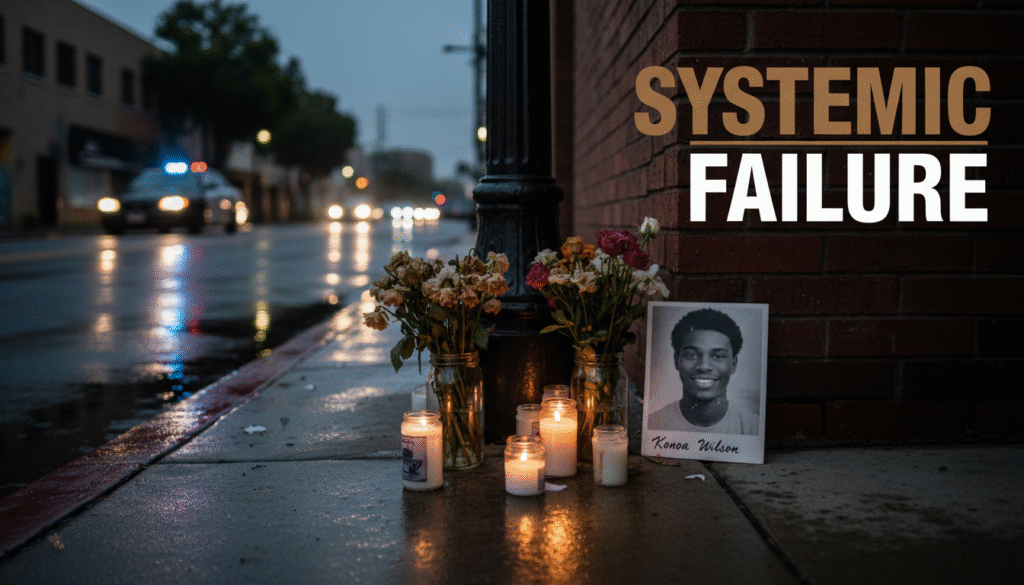
The city of San Diego has agreed to a landmark $30 million settlement for the family of Konoa Wilson (cbs8.com). He was a 16-year-old Black student shot and killed by police in January 2025 (latimes.com). This agreement, expected to be approved by the City Council on December 9, 2025, is one of the largest in U.S. history for a police killing (whas11.com). The payout surpasses the $27 million paid to George Floyd’s family (timesofsandiego.com). This event highlights not only a single tragedy but also a deep, painful history of police use of force against Black youth. It forces a conversation about accountability and the long road to reform.
Konoa Wilson’s story is a tragic headline. Yet, the history behind that headline stretches back centuries. It connects the earliest forms of American policing to the modern struggles seen on city streets today. Understanding this context is essential to grasp why this settlement is more than money. It is a symbol of a persistent “catastrophic failure of policing” that continues to demand systemic change (whas11.com).
The Tragic Killing of Konoa Wilson
On January 28, 2025, Konoa Wilson was at the Santa Fe Depot in San Diego (latimes.com). The 16-year-old student from Bayside Community School found himself in a terrifying situation. He was reportedly running away from another teenager who had fired a gun at him (cbs8.com). As he fled, he encountered San Diego Police Officer Daniel Gold, a two-year veteran of the force. According to the family’s lawsuit, Officer Gold fired two shots into Wilson’s back “instantly, without any warning” and before identifying himself as an officer (timesofsandiego.com). Wilson was pronounced dead less than an hour later (timesofsandiego.com).
While a handgun was later found concealed on Wilson, his family’s wrongful death lawsuit asserts he never brandished it or posed a threat (timesofsandiego.com). The suit, filed in June, alleges the shooting was an act of “racial violence,” targeting a Black teenager who was running for his life (timesofsandiego.com). The city agreed to the $30 million settlement as a “business decision” without admitting liability (whas11.com). Officer Gold currently remains employed by the San Diego Police Department in an administrative role, a standard practice where officers are removed from street duty but retain their salary during investigations (indiatimes.com).
Jim Crow’s Legacy in Modern Policing
The roots of modern police brutality against Black communities trace back to the nation’s earliest days. American policing emerged in the 1830s and 1840s, often with a focus on controlling Black populations (policebrutalitycenter.org). This legacy was cemented during the Jim Crow era in the South, which spanned from the late 19th to the mid-20th century (britannica.com). This period was defined by laws and social customs that enforced rigid racial segregation in nearly every aspect of life (smithsonianmag.com).
Policing in the Jim Crow South was a tool to maintain this oppressive racial hierarchy. Officers used violence and intimidation to enforce segregation and suppress any challenge to the system (smithsonianmag.com). As millions of Black Americans fled this terror during the Great Migration, they moved to northern and western cities. They hoped for a better life but often found new forms of discrimination and continued police misconduct. This history shaped a deep-seated distrust between Black communities and law enforcement that persists today.
From Panthers to Black Lives Matter
Resistance to police brutality has a long and powerful history. During the Civil Rights Movement, Dr. Martin Luther King Jr. famously stated in 1963 that African Americans could not be satisfied “as long as the Negro is the victim of the unspeakable horrors of police brutality” (tandfonline.com). Frustration with police violence fueled riots in cities like Harlem and Watts (wikipedia.org). In 1966, the Black Panther Party formed to actively challenge police brutality (makaremlaw.com). They initiated armed “copwatching” patrols, monitoring police in Black neighborhoods to document misconduct and assert citizens’ rights (youtube.com).
Decades later, the 1991 videotaped beating of Rodney King by Los Angeles police brought the issue into the national spotlight (wikipedia.org). The acquittal of the officers on charges of assault with a deadly weapon and excessive force ignited the 1992 Los Angeles Riots, a massive civil disturbance born from a perceived miscarriage of justice (wikipedia.org). This history of activism laid the groundwork for the modern Black Lives Matter movement, which began after George Zimmerman’s 2013 acquittal in the killing of Trayvon Martin (aa.com.tr). High-profile killings of Michael Brown, Eric Garner, and George Floyd amplified the movement, driving a global demand for police reform (aa.com.tr).
Fatal Police Shootings and Black Americans
Share of U.S. population compared with share of people shot and killed by police.
Black Americans make up a smaller share of the population than their share of fatal police shootings. Source: Harvard University
The Disparity in Black and White
The death of Konoa Wilson is not an isolated event but part of a well-documented pattern. Nationally, Black Americans make up 13.4% of the population but account for 22% of fatal police shootings (harvard.edu). Statistics show they are killed by police at more than twice the rate of white Americans (harvard.edu). Black males, who are just 6.1% of the U.S. population, make up nearly 25% of all people killed by law enforcement (harvard.edu).
This disparity is starkly reflected in San Diego. Data from 2016-2020 reveals that Black people, who are 6.1% of the population served by the San Diego Police Department (SDPD), were involved in nearly a quarter of all police contacts (kpbs.org). Additionally, they were 2.5 times more likely to be searched during traffic stops (policescorecard.org). When force was used, it was applied to Black individuals 4.8 times as often as to white individuals (kpbs.org). Even after controlling for factors like neighborhood crime rates, Black people were subjected to force four times as often as their white counterparts (kpbs.org).
Racial Disparities in San Diego Policing
How much more likely Black residents face searches and force compared with white residents.
Black people in San Diego were more likely to be searched than white people.
Black people in San Diego were more likely to face force than white people.
From 2016–2020 Black people made up nearly 25% of police contacts in San Diego while 6.1% of residents. Source: kpbs.org, policescorecard.org
A Flawed Path to Accountability
Efforts to hold police accountable have a troubled history. One major barrier is the legal doctrine of “qualified immunity.” This doctrine shields government officials, including police, from being sued for civil damages unless they violated a “clearly established” constitutional right (wikipedia.org). Critics argue this standard is so high that it often protects officers from accountability even in cases of obvious misconduct, making it extremely difficult for victims to get justice in court (wikipedia.org).
Other accountability measures have shown limited success. Civilian review boards, designed as independent oversight bodies, are often structured with only advisory powers (upsides.org). Their recommendations for discipline can be ignored by police leadership (theguardian.com). The U.S. Department of Justice can launch “pattern or practice” investigations into police departments with systemic issues (brookings.edu). These can lead to court-enforced consent decrees that mandate reforms in training, supervision, and use-of-force policies (yale.edu). However, these federal interventions are resource-intensive and often face local resistance.
The Financial Burden of Misconduct
These taxpayer-funded payouts often divert funds from essential city services ((washingtonpost.com), (washingtonpost.com)).
The High Cost of Misconduct
Police misconduct carries a massive financial burden for taxpayers. Across the country, cities pay more than $300 million annually to settle misconduct lawsuits (expresslegalfunding.com). A Washington Post investigation found that the 25 largest police departments spent over $3.2 billion on settlements in the last decade (washingtonpost.com). In 2024 alone, Chicago taxpayers spent at least $107.5 million, while New York City paid over $205 million (washingtonpost.com). These funds are diverted from schools, infrastructure, and mental health services (expresslegalfunding.com).
Despite these huge sums, the payouts rarely lead to a reduction in misconduct. One reason is that the financial burden falls on taxpayers, not individual officers or police department budgets (uic.edu). Strong police union contracts often make it difficult to discipline or fire officers, even after costly settlements (uic.edu). Furthermore, the lack of a national database to track officers with histories of misconduct allows problem officers to move from one department to another without scrutiny (naacp.org). A city’s choice to settle a case as a “business decision” also avoids a formal admission of wrongdoing, leaving a sense of unresolved injustice (patch.com).
The Urgent Push for Systemic Change
The Konoa Wilson case underscores the need for deep, systemic change beyond individual settlements. Activists and reformers are pushing for a wide range of policy changes. These include implicit bias training, which aims to make officers aware of unconscious prejudices that can affect their actions (arcjournals.org). Other proposed reforms include the mandatory use of body-worn cameras to increase transparency and bans on dangerous techniques like chokeholds ((cbsnews.com), (cbs8.com)).
However, many argue these steps do not go far enough. They call for a fundamental transformation of policing itself (clickorlando.com). This includes changing police culture from a “warrior” mentality to a “guardian” approach focused on de-escalation (wboc.com). It involves overhauling training, creating truly independent accountability structures, and reallocating police funding to community-based services that address the root causes of crime (clickorlando.com). The $30 million settlement in San Diego is a painful reminder that while money can compensate a family, only systemic change can deliver true justice and prevent future tragedies.
About the Author
Darius Spearman is a professor of Black Studies at San Diego City College, where he has been teaching for over 20 years. He is the founder of African Elements, a media platform dedicated to providing educational resources on the history and culture of the African diaspora. Through his work, Spearman aims to empower and educate by bringing historical context to contemporary issues affecting the Black community.
