

Tanzania Protests and the History Behind Headlines
By Darius Spearman (africanelements)
Support African Elements at patreon.com/africanelements and hear recent news in a single playlist. Additionally, you can gain early access to ad-free video content.
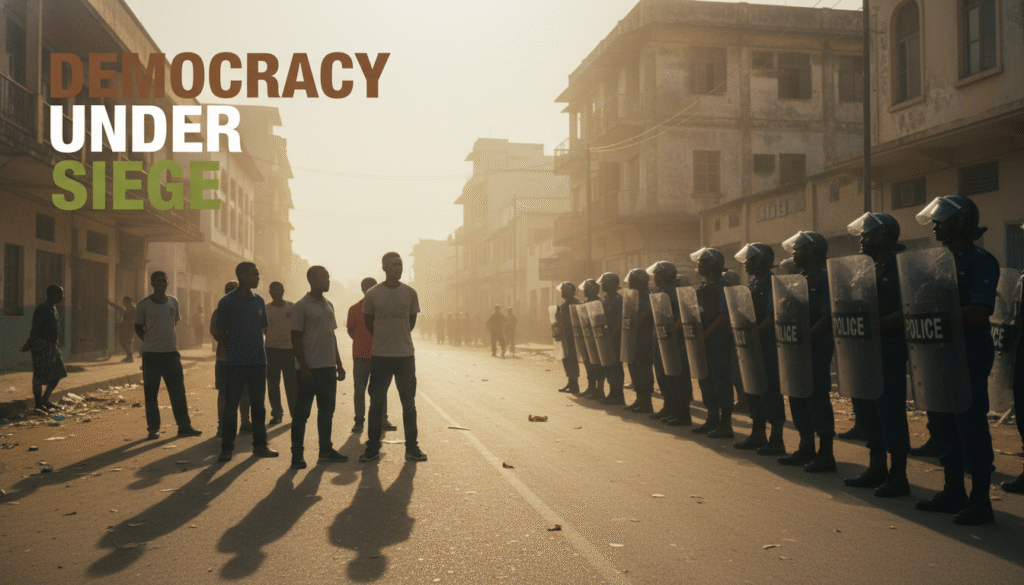
The headlines from Tanzania painted a grim picture. On December 9, 2025, the nation’s Independence Day, the streets of major cities like Dar es Salaam were not filled with celebration (radarafrica.com). Instead, heavy police and army patrols flooded the urban centers to crush planned protests (miragenews.com). The government issued a chilling warning to its citizens. Any demonstration against alleged killings during the recent October elections would be treated as an “attempted coup” (eastleighvoice.co.ke). This severe response follows a brutal election crackdown where UN rights experts estimate security forces killed at least 700 people (ohchr.org). The violence has disproportionately harmed opposition strongholds and impoverished Black communities (miragenews.com).
This recent state-sponsored violence is not a new phenomenon. It represents the latest chapter in a long history of political repression in Tanzania. The government’s actions are deeply rooted in a legacy of one-party dominance that has controlled the country for decades. Understanding this history is crucial to grasping the full weight of the current crisis. The struggle for genuine democracy and human rights in Tanzania continues, therefore, against a backdrop of historical suppression.
A De Facto One-Party State
Tanzania’s political landscape has been shaped by a single party for most of its history. Since gaining independence in 1961, the Chama Cha Mapundi (CCM), or its predecessor the Tanganyika African National Union (TANU), has held power (wikipedia.org). A one-party system is a state where one political party legally holds all governing power, effectively eliminating competition. While Tanzania officially transitioned to a multi-party system in 1992, many critics argue it remains a “de facto one-party state” (journalofdemocracy.org). This means that while other parties are legally allowed, the ruling CCM uses its control over state institutions, resources, and security forces to ensure it never loses power (journalofdemocracy.org).
This dominance makes genuine political competition nearly impossible. The system creates an environment where dissent is not seen as a healthy part of democracy but as a threat to the state itself. Elections, rather than being a moment for citizens to choose their leaders, often become a flashpoint for state-sanctioned violence and control. Furthermore, this dynamic has been particularly volatile in the semi-autonomous archipelago of Zanzibar, which has its own president and government and a long history of contentious elections since 1995 ((crisisgroup.org), (crisisgroup.org)).
Estimated Killings in 2025 Election Crackdown
Two different reports of people killed by security forces after the vote
Estimates compare reported extrajudicial killings after the October 2025 elections; values show minimum reported deaths. Source: miragenews.com and ohchr.org.
The Magufuli Era’s Authoritarian Legacy
The period under the late President John Magufuli, from 2015 to 2021, marked a severe authoritarian shift (csis.org). His administration launched a broad assault on political opposition, civil society, and the media. This era set the stage for the intense repression seen today. Magufuli’s government used a combination of legislative and coercive tools to silence anyone who challenged its authority. For example, laws like the Cybercrimes Act of 2015 were used to arrest people for social media posts critical of the government (theelephant.info). The Media Services Act of 2016 gave the state vast powers to suspend newspapers and control media content (civicus.org).
These laws were paired with direct force. Opposition rallies were banned, and journalists and activists were frequently arrested and harassed (chathamhouse.org). This climate of fear weakened democratic institutions and made it dangerous to speak out. The controversial 2020 general election was a direct result of this environment. It was widely condemned for irregularities, including the disqualification of opposition candidates and violence by security forces (hrw.org). Human Rights Watch documented at least 14 killings in Zanzibar alone during the 2020 polls, with hundreds of opposition members arrested nationwide (hrw.org). This period cemented the tactics that persist today.
Framing Protests as an “Attempted Coup”
In response to the protests planned for December 2025, the Tanzanian government declared that any demonstration would be considered an “attempted coup” (straitstimes.com). President Samia Suluhu Hassan defended the use of force, stating it was necessary to prevent the overthrow of her administration (radarafrica.com). This language is a powerful political tool. In the Tanzanian context, the government uses the term broadly to frame any organized dissent as a violent, unlawful attempt to seize power. This allows the state to justify extreme measures, including deploying the military and charging peaceful protesters with serious crimes like treason (eastleighvoice.co.ke).
An actual coup d’état typically involves a sudden, unconstitutional overthrow of a government by a small group, often the military (vanguardngr.com). Peaceful public protests do not fit this definition. However, the government’s rhetoric deliberately blurs this line. By labeling dissent as a coup, the state legitimizes its crackdown in the eyes of some and creates a pretext for severe legal action. The government has not provided public evidence to support its claim of an attempted overthrow, a tactic often seen in repressive states to silence opposition without independent scrutiny.
State Repression by the Numbers: Arrests & Charges
Hundreds were arrested during the 2020 elections, while the 2025 crackdown saw protesters facing treason charges, which can carry the death penalty ((miragenews.com), (eastleighvoice.co.ke), (hrw.org)).
The Devastating Human Cost
The government’s crackdown has resulted in a staggering loss of life. “Extrajudicial killings” are unlawful killings by state agents without any legal process (hrw.org). These are essentially summary executions. UN experts estimate that security forces committed at least 700 such killings after the October 2025 election (ohchr.org). Some opposition groups, like CHADEMA, claim the number is over 1,000 (miragenews.com). There are also chilling reports that security forces removed bodies from morgues to be incinerated or buried in mass graves, hiding the true scale of the violence ((wsws.org), (theguardian.com)). Families were reportedly forced to sign false statements to retrieve the remains of their loved ones.
The legal persecution is also severe. Over 200 people have been charged with treason following the recent protests (eastleighvoice.co.ke). Under Tanzanian law, treason is a broad offense that includes acts to overthrow the government and carries a mandatory death penalty (thechanzo.com). Although Tanzania has not carried out an execution since 1994, the death penalty remains law. The charge of treason is a powerful tool of intimidation. It sends a clear message that dissent will be met with the most serious consequences imaginable, regardless of whether an execution is likely.
Impact on “Impoverished Black Communities”
For those in the African Diaspora, the term “Black communities” can be confusing in an overwhelmingly Black nation like Tanzania. In this context, it does not refer to a racial minority. Instead, “impoverished Black communities” points to economically marginalized populations (gsdrc.org). These are communities struggling with poverty, lack of access to resources, and underdevelopment. In Tanzania, with its 120 ethnic groups, socio-economic status, not race, is the primary driver of these disparities.
Political violence and repression hit these communities the hardest. They often reside in opposition strongholds and have fewer resources to protect themselves or seek justice. When security forces crack down, it is the poor who suffer most. They are more likely to be victims of violence, less likely to have access to legal help if arrested, and their livelihoods are more easily destroyed by political instability. Therefore, the struggle for democracy in Tanzania is also a struggle for social and economic justice for its most vulnerable citizens.
Erosion of Democratic Participation
Despite more registered voters, turnout remains low due to intimidation, voter suppression, and a belief that elections are predetermined, eroding public trust ((miragenews.com), (researchgate.net)).
An Eroding Faith in Democracy
The constant cycle of repression has severely damaged public faith in the democratic process. The 2025 elections reportedly saw low voter turnout, especially among young people (miragenews.com). This is not just apathy. It is a sign of deep disillusionment. When people believe elections are predetermined, they see little reason to participate. Other factors also contribute to low turnout, including active voter suppression, intimidation by security forces, and a lack of trust in the electoral commission’s independence (researchgate.net).
This erosion of trust is a victory for the authoritarian state. It creates a population that is disengaged from the political process, making it easier for the ruling party to maintain its grip on power. The October 2025 election, which saw the incumbent win with nearly 98% of the vote after leading opposition candidates were disqualified, only reinforced this perception (miragenews.com). Consequently, the future of Tanzanian democracy depends on rebuilding this broken trust and ensuring that every vote matters.
The World Is Watching
The international community has taken notice of the escalating crisis. The UN Human Rights Office has urged Tanzanian authorities to lift the nationwide ban on protests and warned against the excessive use of force (ohchr.org). The United States also announced a “comprehensive review” of its relationship with Tanzania (washingtontimes.com). Such a review could have serious consequences. It often involves evaluating foreign aid, trade agreements, and security cooperation (state.gov).
Potential outcomes include reducing or redirecting foreign aid, imposing targeted sanctions like visa bans on officials responsible for abuses, and increasing diplomatic pressure. This international scrutiny is important, as it can create consequences for the government’s actions. However, the path to genuine democracy and respect for human rights must ultimately be forged by the people of Tanzania. The recent headlines of repression are a stark reminder of the long and difficult struggle they continue to face. The history behind these headlines shows a pattern that must be broken for a more just future.
About the Author
Darius Spearman is a professor of Black Studies at San Diego City College, where he has been teaching for over 20 years. He is the founder of African Elements, a media platform dedicated to providing educational resources on the history and culture of the African diaspora. Through his work, Spearman aims to empower and educate by bringing historical context to contemporary issues affecting the Black community.
