

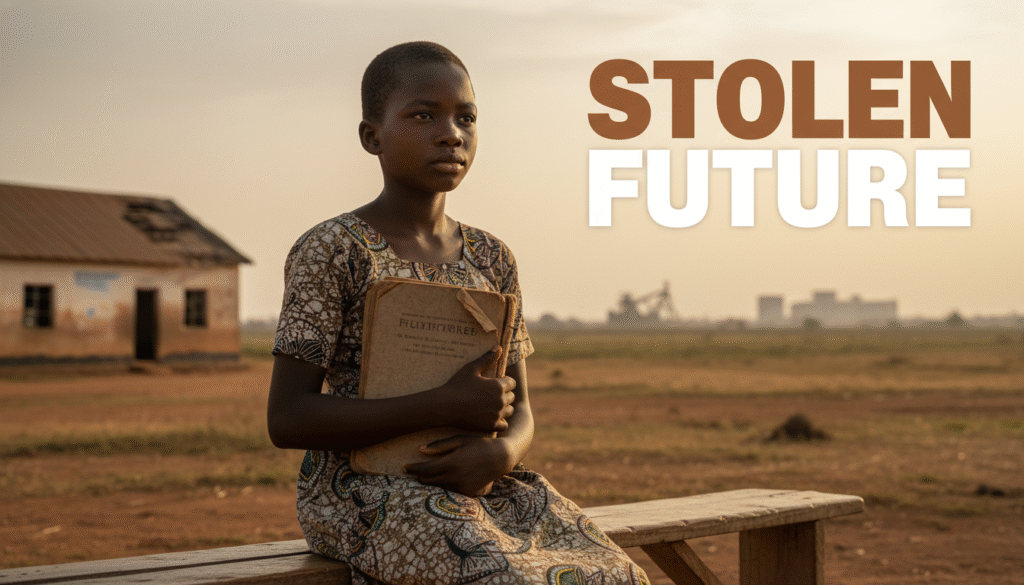
Tax Abuse and Africa’s Stolen Future
By Darius Spearman (africanelements)
Support African Elements at patreon.com/africanelements and hear recent news in a single playlist. Additionally, you can gain early access to ad-free video content.
A startling new report from the Tax Justice Network reveals a crisis with deep roots, showing how tax abuse and crushing debt are systematically dismantling the futures of women and girls across Africa (taxjustice.net). The headline-grabbing issues of multinational tax dodging and spiraling debt are not isolated events. They are the modern-day continuation of historical economic systems designed to extract wealth from the continent. This financial drain forces African governments into devastating budget cuts that target the very services women and girls need most, such as healthcare, schools, and food support (actionaid.org). Understanding this crisis requires looking past the current numbers and into the history that set the stage for this ongoing tragedy.
The Colonial Blueprint for Tax Abuse
The patterns of tax injustice seen across Africa today are a direct legacy of the colonial era. European powers did not create tax systems to build strong local economies. Instead, they designed frameworks to maximize the extraction of resources for their own benefit (diis.dk). These systems focused heavily on taxing natural resources and using indirect taxes like export duties. Critically, they neglected to develop strong domestic corporate income tax systems, leaving a structural weakness that persists today (scirp.org). This historical imbalance created a vulnerability that multinational corporations now expertly exploit.
Colonial administrations also imposed a “dual” tax structure. They burdened African populations with so-called “native” taxes, such as hut taxes or poll taxes, which were levied on each dwelling or adult male regardless of income ((diis.dk), (washington.edu)). The purpose of these taxes was twofold. They generated revenue for the colonial government while also forcing Africans into the wage labor force on European-owned mines and farms just to earn the cash to pay them (washington.edu). Meanwhile, colonial settlers paid proportionately lower modern taxes. Consequently, this system laid the foundation for the unfair tax frameworks that remain, where profitable sectors like mining are often undertaxed, and foreign firms contribute far too little to national revenues (diis.dk).
How the Debt Crisis Began
Africa’s struggle with massive debt is not a new problem. The crisis began to take shape in the late 1970s and early 1980s due to a perfect storm of economic pressures (repec.org). Two major oil price shocks, a sharp drop in the price of commodities that many African nations export, and a spike in global interest rates created immense financial strain. During a prior commodity boom, many governments had increased public spending and took on loans with the expectation that prices would recover. When they did not, servicing this debt became nearly impossible (repec.org).
The nature of this debt also changed for the worse. A growing share of it became non-concessional debt from private creditors and financial markets (repec.org). Non-concessional debt comes with harsh, market-based terms, including higher interest rates and shorter repayment periods. This is a stark contrast to concessional debt, which is offered by institutions like the World Bank on much softer terms with low interest and long grace periods (brookings.edu). This shift meant African nations faced a much greater and more immediate financial burden, digging them deeper into a hole of unsustainable debt (osservatorio-economie-emergenti-torino.it).
Africa’s Skyrocketing Public Debt
Change in total public debt between 2010 and 2022
Between 2010 and 2022 Africa’s public debt rose from $636B to $1.8T, an increase of about 183%. Source: one.org
Austerity’s Lasting Scars on Women
In response to the debt crisis of the 1980s, the International Monetary Fund (IMF) and the World Bank mandated Structural Adjustment Programs (SAPs) across many African nations (twn.my). These programs were designed to stabilize economies by forcing governments to reduce budget deficits and control inflation. The primary methods were severe cuts in government spending, particularly in social sectors like health and education. These policies also pushed for the privatization of state-owned companies and the liberalization of markets ((twn.my), (graduatewomen.org)).
While intended to promote economic health, SAPs had a devastating and disproportionate impact on women and girls. Cuts to public health budgets led to reduced access to critical services, affecting maternal health outcomes (graduatewomen.org). Introducing user fees for schools and clinics meant that poor families could no longer afford them, often resulting in girls being pulled from school first (graduatewomen.org). As public services vanished, the burden of unpaid care work fell heavily on women, who had to fill the gaps in childcare, eldercare, and tending to the sick. This led to longer working hours, declining health, and fewer opportunities for women to pursue their own education or economic advancement (twn.my).
The Modern Financial Hemorrhage
Today, the drain of resources from Africa continues through Illicit Financial Flows (IFFs). These are funds that are illegally earned, transferred, or used, and they represent a massive loss for the continent (unctad.org). Estimates suggest Africa loses around $88 billion every single year to IFFs (taxjustice.net). Between 2000 and 2015, the total loss amounted to a staggering $836 billion (unctad.org). These funds come from criminal activities like drug trafficking, government corruption, and illegal tax practices (unctad.org).
However, multinational corporations are the biggest culprits, responsible for approximately 65% of these losses through corporate tax abuse and trade manipulation (unctad.org). The extractive sector, which includes mining, oil, and gas, is a major source of this financial bleeding, accounting for nearly half of all losses (opensocietyfoundations.org). While sub-Saharan Africa received nearly $2 trillion in investment and aid between 1980 and 2018, it lost over $1 trillion to illicit outflows during the same period (unctad.org). This constant hemorrhage of capital undermines development and forces countries into greater debt.
Anatomy of Illicit Financial Flows
Corporate trade manipulations are the largest component of the billions lost annually from Africa (unctad.org).
How Corporations Dodge Taxes
Multinational corporations use a playbook of sophisticated tactics to avoid paying their fair share of taxes in Africa. One of the most common methods is transfer mispricing. This involves a company’s subsidiaries selling goods or services to each other at artificially high or low prices to move profits from a high-tax African country to a low-tax jurisdiction or tax haven ((bloombergtax.com), (opensocietyfoundations.org)). Another set of strategies, known as base erosion and profit shifting (BEPS), exploits gaps and mismatches in tax rules between different countries to make profits “disappear” for tax purposes (bloombergtax.com).
Other tactics include loading an African subsidiary with excessive interest payments on loans from another branch of the company in a tax haven, which reduces taxable profits in the African nation (bloombergtax.com). Companies also strategically locate valuable intellectual property, like patents and brand names, in low-tax countries. Afterwards, they charge their African operations huge royalties and license fees for using them, effectively siphoning profits out of the continent. These complex and often legal maneuvers deny African nations billions in essential tax revenue every year (bloombergtax.com).
The Real-World Cost for Women and Girls
This endless cycle of tax abuse and debt has devastating, real-world consequences. African nations now spend more money servicing their external debt than they do on healthcare or education ((actionaid.org), (taxjustice.net)). When billions of dollars that should be funding public services are instead lost to IFFs or paid to rich lenders, the impact is felt most acutely by women and girls. Research shows that African countries with high levels of IFFs spend 25% less on health and 58% less on education compared to countries with lower levels (taxjustice.net).
This translates into heartbreaking statistics. The African region accounts for 70% of all global maternal deaths, with an estimated 178,000 mothers dying each year (who.int). In South Sudan, a girl is more likely to die in childbirth than to finish secondary school (actionaid.org). Budget cuts to education lead to overcrowded classrooms and a shortage of materials, with girls often being the first to be pulled out of school when families face economic hardship (statista.com). These conditions fuel the “feminization of poverty,” a phenomenon where women and girls make up a growing proportion of the world’s poor because of gender-based discrimination and limited economic opportunity (ids.ac.uk). Currently, 62.8% of the world’s poorest women and girls live in sub-Saharan Africa (one.org).
A Call for Justice and Equity
The Tax Justice Network report is more than a diagnosis of a problem; it is a call for systemic change. The authors advocate for the implementation of strong tax rules to stop the financial bleeding (taxjustice.net). This includes practical steps like creating public registries of the true beneficial owners of companies to increase transparency, strengthening anti-money laundering laws, and improving international tax cooperation to prevent corporations from hiding their profits offshore. It also means closing tax loopholes and ensuring that wealthy corporations pay their fair share (bloombergtax.com).
Furthermore, the report calls for gender-aware budgets. This does not mean creating a separate budget for women. Instead, it is an approach to public finance that analyzes how budget decisions impact women and men differently and then adjusts policies to promote gender equality (bloombergtax.com). This involves allocating funds to specifically address gender gaps in health, education, and economic empowerment. By adopting these measures, African states can reclaim lost revenue and begin to fund the essential services that will allow their citizens, especially women and girls, to survive and thrive (taxjustice.net).
About the Author
Darius Spearman is a professor of Black Studies at San Diego City College, where he has been teaching for over 20 years. He is the founder of African Elements, a media platform dedicated to providing educational resources on the history and culture of the African diaspora. Through his work, Spearman aims to empower and educate by bringing historical context to contemporary issues affecting the Black community.
