


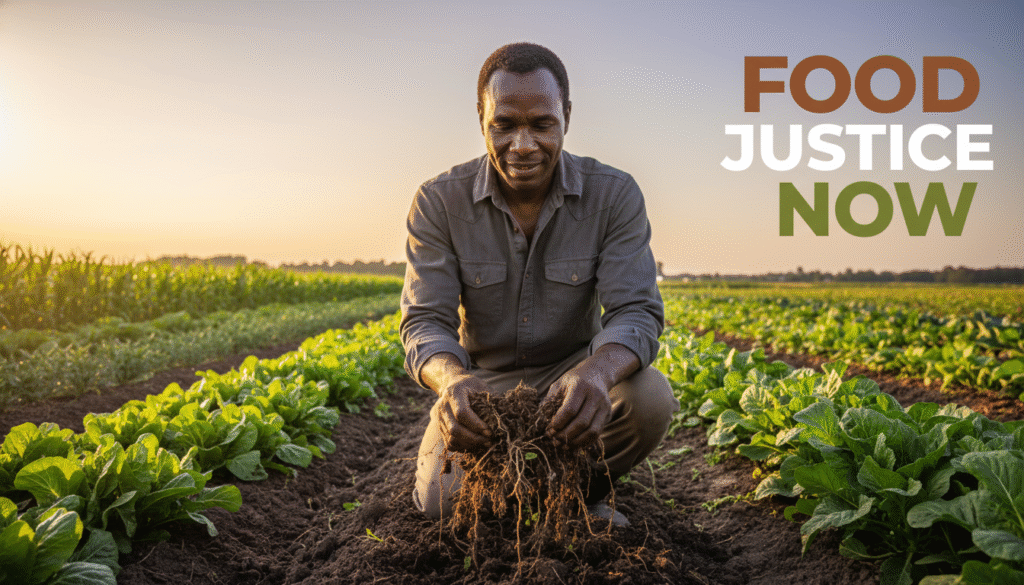
NC Black Farmer Fights Food Deserts
By Darius Spearman (africanelements)
Support African Elements at patreon.com/africanelements and hear recent news in a single playlist. Additionally, you can gain early access to ad-free video content.
In Warren County, North Carolina, a Black farmer is cultivating more than just crops. Patrick Brown is confronting a deep and tangled history of food deserts, land dispossession, and environmental injustice (capitalbnews.org). On family land held for over a century, Brown is leading a movement rooted in regenerative agriculture. He provides fresh food to a community long dependent on fast-food and processed snacks (unc.edu). His work is a powerful response to generations of systemic harm.
Brown’s farm in Henderson serves a town of 14,000 people who have access to only one grocery store (unc.edu). This scarcity is not an accident. It is the result of historical forces that have systematically stripped Black communities of land, health, and wealth. By reclaiming the soil, Brown is writing a new chapter for his community. This chapter connects food justice with the vital work of repairing the land and healing from a toxic past (capitalbnews.org).
The Roots of Land Loss for Black Farmers
The story of Black farmers in America is one of profound struggle and resilience. After emancipation, Black Americans worked tirelessly to acquire land, reaching a peak of 16 million acres nationally by 1910 (unc.edu). This progress, however, was systematically dismantled through a process known as land disenfranchisement. This refers to the discriminatory process by which groups are deprived of land ownership through legal, economic, or violent means (ubunturesearch.com). The consequences included immense land loss and the stunting of generational wealth (hnn.us).
This dispossession was driven by several factors. One was exploitative sharecropping, a system that trapped Black farmers in cycles of debt. Landowners would inflate prices for supplies and manipulate accounting to ensure tenants could never get ahead, creating a new form of servitude (uh.edu). Another factor was Jim Crow-era racial violence. Jim Crow was a system of laws and customs enforcing racial segregation, upheld by acts of terror like lynchings and mob attacks (ferris.edu). This violence often forced Black families to abandon their property, contributing significantly to land loss (eji.org). Furthermore, the lack of legal assistance, particularly around “heirs’ property” issues, left Black-owned land vulnerable to predatory developers and forced sales (hnn.us).
The Great Decline of Black-Owned Farmland
16M
1910
~1.6M
1997
Black-owned farmland plummeted by over 90% between 1910 and 1997 due to systemic discrimination and land disenfranchisement. (unc.edu)
The Pigford v. Glickman Lawsuit
The systematic discrimination extended to federal institutions. The United States Department of Agriculture (USDA) historically denied Black farmers loans and assistance that were readily available to their white counterparts (unc.edu). This long history of discrimination culminated in the 1997 landmark class-action lawsuit, *Pigford v. Glickman*. Led by North Carolina farmer Timothy Pigford, the suit alleged widespread racial discrimination by the USDA between 1981 and 1996 (farrin.com). The lawsuit detailed how Black farmers faced loan denials, delays in approval, and less favorable terms than white farmers (unc.edu).
The lawsuit resulted in a significant settlement in 1999, known as “Pigford I.” This consent decree provided payments of $50,000, plus debt relief and tax payments, to thousands of eligible Black farmers who could prove they had been victims of discrimination (wikipedia.org). Due to a difficult claims process that left many out, Congress later authorized “Pigford II” to address additional claims, ultimately providing billions more in compensation (wikipedia.org). While these settlements represented a major acknowledgment of systemic racism within the USDA, many argue the compensation was insufficient for decades of lost land and income (bencrump.com). The disparity continues today; in 2022, the USDA approved loans for 72% of white applicants but only 36% of Black applicants (unc.edu).
A Toxic Legacy: Environmental Racism in North Carolina
Warren County, where Patrick Brown farms, is tragically known as the birthplace of the environmental justice movement (ncsu.edu). This distinction arose from the 1982 Warren County PCB protests. The state decided to create a toxic landfill in Afton, a small, predominantly Black community, to dump 40,000 tons of soil contaminated with polychlorinated biphenyls (PCBs) (unc.edu). PCBs are a group of highly toxic, man-made industrial chemicals banned in 1979 due to evidence they cause cancer, liver damage, and reproductive issues (noaa.gov). Patrick Brown’s own father was one of the protestors who laid down on the road to block the toxic trucks (unc.edu).
Despite peaceful protests and evidence that the site was unsafe, the state dumped the toxic soil anyway (ncsu.edu). Years later, the landfill was confirmed to be leaking PCBs into the air and ground, just as the community had feared (unc.edu). This event gave rise to the term “environmental racism,” coined by civil rights activist Rev. Dr. Benjamin F. Chavis, Jr., to describe how communities of color are disproportionately burdened with hazardous waste facilities and pollution (ncsu.edu). This pattern continues, as African Americans in North Carolina are 1.54 times more likely than white residents to live near industrial animal waste facilities, which severely damage local water and air quality (waterkeeperscarolina.org). The fight in Warren County sparked the broader environmental justice movement, which advocates for the fair distribution of environmental benefits and burdens for all people (nih.gov).
USDA Loan Approval Disparity (2022)
White Applicants
Black Applicants
Federal data from 2022 shows a significant gap in USDA loan approval rates, highlighting ongoing systemic discrimination. (unc.edu)
Food Deserts and Supermarket Redlining
The lack of access to healthy food is another form of systemic inequity. Areas with limited access to affordable, nutritious food are known as “food deserts.” These are typically low-income areas where residents must travel more than a mile in urban areas or ten miles in rural areas to reach a supermarket (unc.edu). This problem is widespread in North Carolina, which has over 340 food deserts affecting more than 1.5 million people (nciom.org). People of color make up almost half the population in the state’s food deserts, despite being a much smaller portion of the population in areas with healthy food access (chlpi.org).
Food deserts are not a natural occurrence. They are often the result of supermarket “redlining,” a discriminatory practice where major grocery chains avoid investing in low-income neighborhoods and communities of color deemed less profitable (fairhousingnc.org). This leaves residents dependent on convenience stores and fast-food chains that lack fresh produce (unc.edu). The health consequences are severe. Limited access to nutritious food is directly linked to higher rates of obesity, diabetes, and heart disease (ncmedicaljournal.com). Consequently, food insecurity rates for Black households in the state (22.5%) are more than double those for white households (9.3%) (chlpi.org).
Racial Disparity in North Carolina Food Deserts
47% People of Color (in Food Deserts)
53% White Population (in Food Deserts)
People of color are disproportionately affected, making up 47% of the population in NC’s food deserts compared to only 28% of the non-food-desert population. (unc.edu)
Sowing Seeds of Change in Warren County
Patrick Brown’s 300-acre farm stands as a direct response to these intertwined injustices. He practices regenerative agriculture, a method that focuses on building healthy soil, minimizing environmental impact, and making the land more resilient to climate change (unc.edu). By covering the soil, reducing plowing, and using compost, he enriches the land so it can hold more water and support more life (capitalbnews.org). This approach is about more than growing food; it is about repairing the harm done to the land.
Brown’s work extends far beyond his fields. Through a Community Supported Agriculture (CSA) program, he delivers weekly boxes of fresh produce to over 100 predominantly Black, low-income families (unc.edu). A CSA is a model where members pay a farm upfront for a “share” of the harvest, providing farmers with capital and guaranteeing consumers fresh, seasonal food (ufl.edu). Additionally, his farm is an educational hub, teaching young people about soil care and sustainable farming (capitalbnews.org). He is nurturing a new generation with a deep connection to the land and their food.
Reclaiming History, Building a Just Future
In a deeply symbolic act, Brown purchased the Oakley Grove Plantation house in 2021, the very place where his ancestors were enslaved (unc.edu). His plan is to transform this site of oppression into a community hub for education, healing, and empowerment (gofundme.com). It will host workshops on Black agricultural history, serve as a cultural center, and be integrated into his farming operations, reclaiming a painful past to build a liberated future (warrenist.com). This reflects the long history of the Black family transforming sites of pain into sources of strength.
Brown’s impact also radiates outward. He actively supports other Black farmers in adopting regenerative practices. In partnership with organizations like Nature For Justice, he has helped build a network of over 125 BIPOC farmers in North Carolina (nature4justice.earth). BIPOC, which stands for Black, Indigenous, and People of Color, is a term that acknowledges the unique historical challenges these groups face in agriculture (ywcaworks.org). This network provides direct financial payments, technical training, and access to funding to help farmers transition to sustainable methods (oneearth.org). Through mentorship and resource sharing, Brown is helping slow the tide of Black land loss and foster a new era of sustainable Black-owned businesses in agriculture. His work is a living testament to the power of one person to cultivate justice from the ground up.
About the Author
Darius Spearman is a professor of Black Studies at San Diego City College, where he has been teaching for over 20 years. He is the founder of African Elements, a media platform dedicated to providing educational resources on the history and culture of the African diaspora. Through his work, Spearman aims to empower and educate by bringing historical context to contemporary issues affecting the Black community.
