

2026 Immigration Plans: History Behind Headlines
By Darius Spearman (africanelements)
Support African Elements at patreon.com/africanelements and hear recent news in a single playlist. Additionally, you can gain early access to ad-free video content.
Recent reporting from Reuters in December 2025 indicates that the federal government is preparing a massive expansion of immigration enforcement for the coming year. The administration aims to widen workplace raids, speed up deportations, and intensify pressure on local jurisdictions that limit cooperation with federal agents (gzeromedia.com). These plans for 2026 reportedly include a significant injection of funding to support large-scale operations. While the headlines focus on the immediate future, the machinery driving this escalation has been under construction for decades. The proposed crackdown is not merely a new policy direction but the culmination of legal frameworks and enforcement tactics established over the last forty years.
Civil liberties advocates and community organizers are raising alarms about the potential for family separations and the militarization of neighborhoods. However, a critical aspect of this story often goes unreported in mainstream media: the specific and disproportionate impact on Black migrants. Reports indicate that Black migrants from Africa and the Caribbean often face harsh detention conditions, significantly higher bond amounts, and language barriers that effectively deny them due process (gzeromedia.com). As cities brace for clashes over civil liberties, understanding the history behind these headlines becomes essential for grasping the full scope of the crisis.
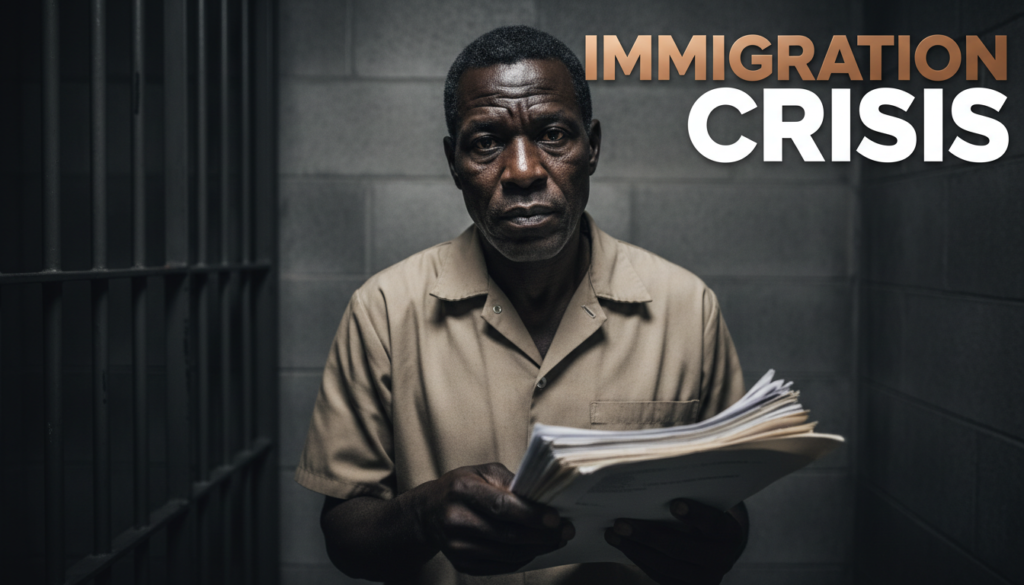
Source: University of California Data (researchgate.net). Black migrants are 6x more likely to be held in solitary confinement.
The Machinery of Mass Deportation
The concept of “speeding deportations,” as mentioned in current reporting, relies on a legal architecture that predates the current administration. The foundational cornerstone for modern mass deportation is the Illegal Immigration Reform and Immigrant Responsibility Act (IIRIRA) of 1996. This legislation vastly expanded the categories of crimes that result in mandatory detention and deportation (americanimmigrationcouncil.org). Crucially, the 1996 law introduced “Expedited Removal,” a mechanism that allows low-level immigration officers to order deportations without a hearing before a judge (americanimmigrationcouncil.org). This process strips individuals of the right to counsel and the right to present evidence before a neutral arbiter, creating a parallel justice system where administrative speed takes precedence over constitutional due process (ilrc.org).
While the current administration is utilizing these tools aggressively, the machinery has been heavily utilized by previous presidents as well. The Obama administration, for instance, oversaw over 3 million deportations, solidifying the “Secure Communities” program which automated information sharing between local police and federal immigration authorities (ice.gov). This history demonstrates that the 2026 plans are an acceleration of existing mechanisms rather than a completely new invention. The primary difference today lies in the scale of funding and the explicit prioritization of rapid enforcement. Reports indicate that the federal government has secured approximately $170 billion in funding through 2029 to support these expanded operations, a figure that dwarfs historical enforcement budgets (time.com).
The emphasis on speed often leads to errors and violations of rights. When the government prioritizes rapid removal, legitimate asylum seekers face immediate repatriation to countries where they may suffer persecution or death. This risk is particularly acute for those who cannot navigate the complex legal system within the accelerated timeframe provided by Expedited Removal (aclu.org). The legacy of the 1996 laws ensures that once the machinery of deportation is activated, it is incredibly difficult to stop, leaving migrants with few legal avenues for relief.
The Return of the Workplace Raid
The Reuters report explicitly highlights a plan to “widen raids,” specifically targeting workplaces. This tactic represents a return to high-visibility enforcement operations designed to create a psychological impact on immigrant communities. Historically, workplace raids have served as spectacles of enforcement that devastate local economies and traumatize families. One must recall the raid on the Agriprocessors meatpacking plant in Postville, Iowa, in 2008. That operation resulted in nearly 400 arrests and led to immediate criminal prosecutions of workers, leaving a lasting scar on the community (time.com).
More recently, the 2019 raids in Mississippi targeted seven poultry processing plants, resulting in the arrest of 680 workers (time.com). These operations revealed the devastating social cost of such tactics: children came home from school to empty houses, unsure if they would ever see their parents again. Organizers warn that the 2026 plans will repeat this trauma on a larger scale. The threat of family separation is a central concern for advocates, who note that the 287(g) program and workplace raids function to fracture the family unit (americanimmigrationcouncil.org). This echoes the stories of Black family strength and resilience in the face of systemic separation that have defined the African American experience for centuries.
Between these high-profile eras, the government often utilized “silent raids,” or I-9 audits. These administrative inspections force employers to fire workers with irregular paperwork without the spectacle of armed agents (workingimmigrants.com). While silent raids result in mass job loss, they lack the immediate terror of physical raids. The pivot back to physical raids in the 2026 plan suggests a strategy focused on “militarizing neighborhoods” and maximizing visibility to deter migration, regardless of the humanitarian cost (gzeromedia.com). This shift marks a significant escalation in the use of fear as a policy tool.
The Specific Plight of Black Migrants
The headline from Reuters specifically notes that “Black migrants from Africa and the Caribbean often face harsh detention conditions plus language barriers.” This crisis has deep historical roots that are frequently ignored in the broader immigration debate. Historical data consistently shows that Black migrants are treated more harshly within the U.S. immigration system. A 2020 study revealed that while people from African and Caribbean countries made up only 4 percent of the ICE detention population, they accounted for 24 percent of solitary confinement stays (researchgate.net). This disparity suggests a systemic bias where Black bodies are subjected to greater punitive measures.
Furthermore, bond disparities present a significant hurdle. Advocacy groups have found that Haitian migrants, for example, are often assigned bond amounts significantly higher than other groups, sometimes up to 54 percent higher (freedomforimmigrants.org). Because immigration bonds typically require payment of the full amount in cash without the option of a bail bondsman, this financial disparity keeps low-income Black migrants in detention for months or years simply because they lack wealth (leppardlaw.com). This creates a system where freedom is determined by access to capital rather than flight risk or public safety concerns.
Language barriers further compound these injustices. Many asylum seekers from Mauritania and other African nations speak indigenous languages such as Pulaar or Soninke. The lack of interpretation services means these individuals often cannot understand “credible fear” interviews or legal paperwork provided only in English or Spanish (wikipedia.org). Consequently, they may unknowingly waive their rights or fail to articulate valid asylum claims. This reality stands in stark contrast to recent policy moves that have favored groups like white South Africans, who have been framed as refugees by certain political factions, while Black migrants fleeing verifiable state violence are rejected (populismstudies.org). This disparate treatment highlights the political shift from Civil Rights to mass incarceration, where policy increasingly criminalizes Black existence.
Crimmigration and the Double Punishment
To understand why Black migrants are disproportionately targeted, one must examine “crimmigration”—the merging of criminal and immigration law. This system uses the criminal justice apparatus as a tool for immigration enforcement. For Black communities, this creates a “double punishment” system. Because Black neighborhoods are often over-policed due to systemic racial profiling, Black immigrants are more likely to have contact with law enforcement for minor infractions (udc.edu). Under programs like “Secure Communities” and 287(g), a simple traffic stop or a minor arrest can automatically trigger deportation proceedings.
Despite comprising a small fraction of the unauthorized population, Black immigrants have historically made up a disproportionately large share of those facing deportation on criminal grounds (udc.edu). The “policing-to-deportation pipeline” ensures that the fight against police brutality and the fight against deportation are structurally linked. When local police act as the entry point for federal deportation, the racial biases inherent in domestic policing are transferred directly into the immigration system. This phenomenon reinforces the vulnerability of Black diasporic communities in the United States.
The 2026 plans to widen raids and speed deportations will likely exacerbate these disparities. By increasing the presence of federal agents and pressuring local police to cooperate, the administration strengthens the pipeline that disproportionately entraps Black migrants. This structural racism within the enforcement machinery ensures that even “race-neutral” policies result in racially disparate outcomes. The legal system, which creates a separate track of justice for non-citizens, strips away the procedural protections that might otherwise prevent such inequities (bcalawfirm.com).
Cities Brace for Clashes
The Reuters report notes that “cities brace for clashes” and the “next signal will come from local sheriffs.” This refers to the ongoing battle over “Sanctuary” jurisdictions. The core of this conflict is the 287(g) program, which allows the Department of Homeland Security to deputize local law enforcement officers to act as federal immigration agents (americanimmigrationcouncil.org). Historically, this program has been a flashpoint for civil liberties violations, with the Department of Justice previously finding that it led to widespread racial profiling of Latinos and other minorities (ilrc.org).
The clash arises because many City Councils have passed laws limiting cooperation with ICE to protect public safety and community trust. However, County Sheriffs, who often control the jails, may oppose these sanctuary laws. This leads to jurisdictional battles where Sheriffs grant ICE access to inmates against the wishes of city leadership (vera.org). The 2026 plans reportedly include threats to withhold funding from non-cooperative jurisdictions, raising the stakes of this standoff. This tension illustrates the complex dynamics of federalism and Black politics, where local, state, and national powers collide over issues of justice and enforcement.
For Black migrants, the outcome of these local battles is critical. If local sheriffs succumb to federal pressure and fully adopt 287(g) agreements, the protective buffer provided by sanctuary policies will vanish. This would leave Black immigrants fully exposed to the “double punishment” of the criminal-immigration system. Organizers are therefore focusing their efforts on local city councils and sheriff’s offices, recognizing that the “next signal” regarding their safety will indeed come from these local officials (gzeromedia.com).
Community Response and Resistance
In response to the impending crackdown, organizers are calling for the establishment of legal aid clinics and rapid-response hotlines (gzeromedia.com). These tools are essential for providing immediate support to families affected by raids. Community organizations are working to educate migrants about their rights, specifically the right to remain silent and the right to refuse entry to agents without a judicial warrant. This grassroots mobilization is a direct response to the government’s strategy of overwhelming force.
The warning about family separations is particularly urgent. Activists recall the trauma inflicted during previous administrations and are preparing mental health resources and child care plans for families at risk. The goal is to build a network of support that can withstand the shock of mass arrests. By creating community-led safety nets, organizers hope to mitigate the most devastating effects of the 2026 enforcement plans.
The “history behind the headlines” reveals that the 2026 federal immigration plans are not an aberration but a continuation of a long-term trend toward mass incarceration and deportation. The infrastructure for these raids—287(g) agreements, expedited removal, and massive funding—has been entrenched for decades. The specific vulnerability of Black migrants, driven by the intertwining of criminal and immigration law, remains a critical but overlooked dimension of this crisis. As the new year approaches, the clash between federal power and community resistance will likely define the civil rights landscape for the foreseeable future.
About the Author
Darius Spearman is a professor of Black Studies at San Diego City College, where he has been teaching for over 20 years. He is the founder of African Elements, a media platform dedicated to providing educational resources on the history and culture of the African diaspora. Through his work, Spearman aims to empower and educate by bringing historical context to contemporary issues affecting the Black community.
