

Nigeria’s Kidnapping Crisis: History Behind Headlines
By Darius Spearman (africanelements)
Support African Elements at patreon.com/africanelements and hear recent news in a single playlist. Additionally, you can gain early access to ad-free video content.
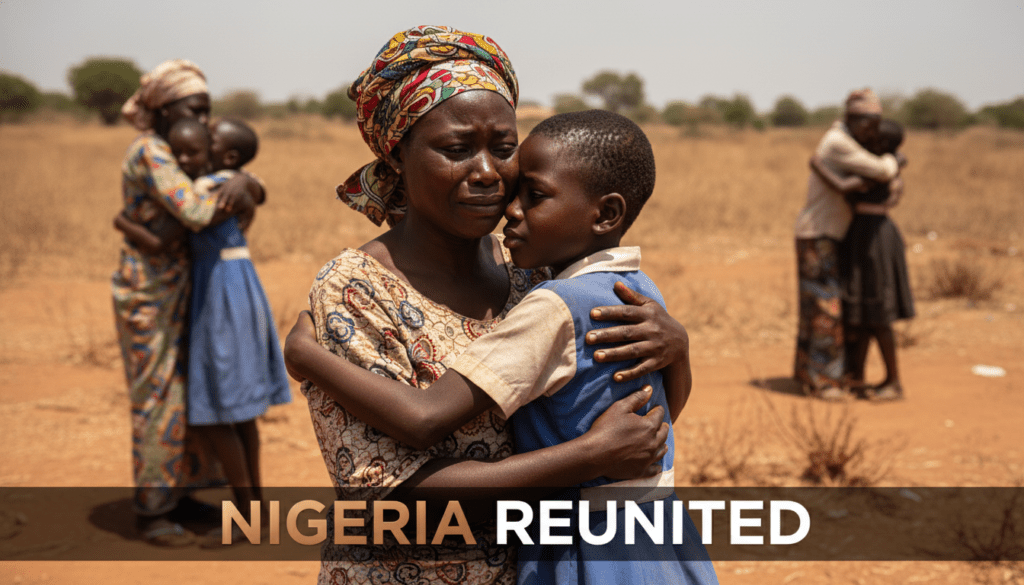
The entire nation of Nigeria let out a collective breath of relief on December 22, 2025. Reports confirmed that 130 kidnapped students from St. Mary’s Catholic School in Niger State had finally gained their freedom after weeks of captivity (westernpost.ng, apnews.com). For the parents who had spent sleepless nights wondering if they would ever see their children again, the reunion was a miracle just in time for the holidays. Government officials described the release as the result of a “military-intelligence driven operation,” sparking celebrations across the country (sky.com).
However, beneath the joy of this specific reunion lies a much darker reality. This event is not an isolated tragedy but the latest chapter in a decade-long crisis that has turned education into a high-stakes gamble for Nigerian families. While the students are now physically free, the circumstances that allowed them to be taken remain unchanged. Parents and school authorities are demanding safer roads and stronger protection near campuses, knowing that without these changes, the cycle will continue (westernpost.ng). The release of these students serves as a moment of clarity for a nation tired of living in fear.
Many Nigerians place the blame squarely on weak rural security and a government response that often feels reactive rather than proactive. They are asking leaders to stop the ransom cycles that feed more abductions. The next test for the administration will come from prosecutions. Freedom without arrests leaves gangs intact and ready to strike again. To understand the gravity of this moment, one must look at the notion of freedom in Nigeria and the history behind these headlines.
Source: SBM Intelligence / Research Data
The Origin Story: From Ideology to Industry
To fully grasp why “130 students” is a headline that repeats with tragic regularity, one must look back to the foundational moment of this crisis. The modern era of mass school abductions in Nigeria began on April 14, 2014, when Boko Haram terrorists kidnapped 276 schoolgirls from the Government Girls Secondary School in Chibok, Borno State (wikipedia.org). That event shocked the world and sparked the global #BringBackOurGirls campaign. At that time, the motivation was primarily ideological. The insurgents claimed to be fighting against “Western education” and sought to destabilize the state through terror.
Over the last decade, however, the motivation has shifted. What started as an ideological war in the Northeast has evolved into a lucrative criminal enterprise across the Northwest and North-Central regions. Criminal gangs, known locally as “bandits,” observed the government’s willingness to negotiate in the past. They realized that mass abductions generate massive leverage. While Boko Haram operated on religious extremism, these new groups are driven by the “kidnap-for-ransom” economy (theglobalobservatory.org). They target schools because children are a sensitive emotional asset, forcing families and the government to act quickly.
The geographical spread of this violence is significant. The attacks have moved from the insurgent strongholds of Borno to states like Kaduna, Zamfara, and Niger State. Key precedents include the abduction of 110 girls in Dapchi in 2018 and over 300 boys in Kankara in 2020 (wikipedia.org). Each event reinforces the profitability of the crime. The recent St. Mary’s abduction fits this pattern perfectly, occurring in an area where forests provide cover and government presence is thin. Understanding this evolution is crucial, as the political narrative surrounding these crimes has changed from fighting terrorism to combating organized crime.
The Economics of Kidnapping
The sheer scale of the kidnapping economy is staggering. Research indicates that between July 2023 and June 2024 alone, there were 4,722 reported kidnappings in Nigeria (newtelegraphng.com). This is not random violence; it is an industry. In that same one-year period, kidnappers demanded approximately ₦10.9 billion in ransom (newtelegraphng.com). For context, the national minimum wage in Nigeria is roughly ₦70,000 per month as of 2025 (wageindicator.org). The disparity between the ransom demands and the earning power of the average citizen is astronomical. A typical rural family would need thousands of years of labor to meet such demands legitimately.
This financial pressure forces communities into a poverty trap. Families sell land, livestock, and crops to secure the release of loved ones. This transfer of wealth directly funds the gangs, allowing them to purchase sophisticated weapons and motorcycles, which they use to conduct further raids (newtelegraphng.com). The prompt notes that Nigerians blame “ransom cycles that feed more abductions.” This is the mechanism they are referring to. Every ransom paid buys the weapons for the next kidnapping. While the government officially denies paying ransoms, analysts suggest that payments often happen through back channels to avoid the political fallout of dead hostages (sky.com).
The cost is also measured in human lives. Over 1,000 civilians were killed during kidnapping attempts in the 2023-2024 period (newtelegraphng.com). These deaths often occur when families cannot pay or when rescue attempts go wrong. The economic and human toll highlights why the “release” of students is only a partial victory. Without dismantling the financial engine of banditry, the danger remains. This economic warfare against the poor mirrors complex and often heartbreaking history of labor and exploitation seen throughout the diaspora.
Geography and the Vulnerability of Schools
One common source of confusion for international observers is the distinction between Niger State and the Republic of Niger. The St. Mary’s abduction occurred in Niger State, which is a subnational territory within the Federal Republic of Nigeria (theguardian.com). It is the largest state in the country by land mass. The Republic of Niger is a separate, sovereign country to the north. However, the confusion is understandable because the two share a long, porous border. This geography plays a critical role in the security crisis. The vast, ungoverned forests that straddle these borders serve as safe havens for bandit groups.
The location of St. Mary’s Catholic School in a rural area made it a “soft target.” Bandits exploit the weak road infrastructure and the lack of police presence in these remote regions. Parents are right to demand safer roads because highways have become hunting grounds. The bandits often set up roadblocks, snatch travelers, and disappear back into the forest before security forces can respond. This reality limits the movement of people and goods, strangling the local economy and isolating communities.
Furthermore, the targeting of schools disrupts the fundamental right to education. When a school is attacked, the government often responds by closing all schools in the region to prevent further abductions (nation.africa). This leaves thousands of children without access to learning, creating a generation gap in education. For a continent striving for development, these closures are a disaster. We must consider historical factors that have always made access to education a battleground for Black students globally.
The Problem of Impunity
The cycle of violence persists largely because of a culture of impunity. For years, “repentant” bandits were sometimes offered amnesty deals by state governors hoping to buy peace. These programs often backfired. Gangs would accept the money, surrender a few old weapons, and then use the funds to buy better arms and return to kidnapping (theglobalobservatory.org). Arrests have been rare, and successful prosecutions even rarer. This lack of consequences emboldens the perpetrators.
The release of the 130 students brings this issue into sharp focus. While the government claims a victory, the public asks: Where are the kidnappers? Without arrests, the same gang that terrorized St. Mary’s remains free to target another school. The federal government has recently signaled a shift in strategy. In December 2025, officials declared that the “era of ambiguous nomenclature is over,” officially designating these kidnappers as terrorists (voanews.com). This legal change allows the military to use maximum force and prohibits negotiation.
However, declarations must lead to action. The government has announced the re-opening of terrorism cases against notorious bandit leaders like Bello Turji (westernpost.ng, newtelegraphng.com). Turji has become the face of this impunity, operating openly and even releasing propaganda videos. Prosecuting leaders like him is the “next test” mentioned in reports. It is the only way to break the cycle. Justice requires more than just the return of victims; it requires the accountability of oppressors.
The Road Ahead: Safety and Justice
As the 130 students return to their families, the relief is palpable, but so is the anxiety. Parents know that the roads leading to schools remain dangerous. They know that without a permanent security presence, the forests near campuses will continue to hide threats. The demand for safer roads is not a luxury; it is a prerequisite for normal life. The government’s claim of a “military-intelligence driven operation” offers some hope that the state is becoming more capable, but skepticism remains high (sky.com).
The true test of the government’s resolve will be in the courtroom. If the perpetrators of the St. Mary’s abduction are hunted down and prosecuted, it will send a message that the cost of kidnapping is too high. If they are left alone, the ransom cycle will spin once more. This situation serves as a stark reminder of the inspiring sacrifice for freedom required to challenge systemic oppression. In Nigeria, the fight for freedom is currently a fight for the right to go to school without being stolen.
About the Author
Darius Spearman is a professor of Black Studies at San Diego City College, where he has been teaching for over 20 years. He is the founder of African Elements, a media platform dedicated to providing educational resources on the history and culture of the African diaspora. Through his work, Spearman aims to empower and educate by bringing historical context to contemporary issues affecting the Black community.
