


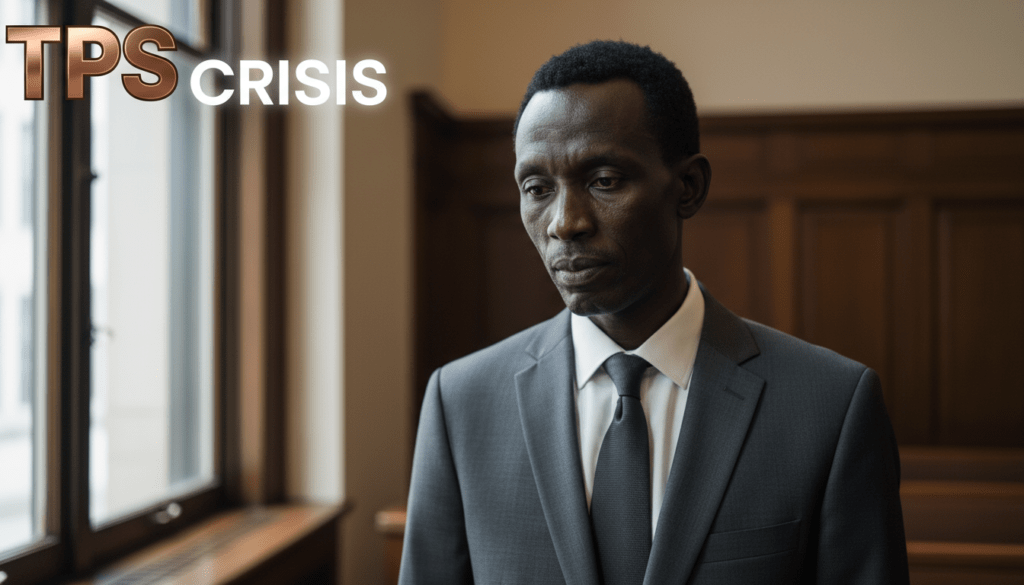
South Sudan TPS Lawsuit: History Behind the Headlines
By Darius Spearman (africanelements)
Support African Elements at patreon.com/africanelements and hear recent news in a single playlist. Additionally, you can gain early access to ad-free video content.
The legal battle unfolding in Boston federal court represents more than a dispute over immigration paperwork. It signifies a pivotal clash between humanitarian obligations and a shifting political landscape in the United States. As of late December 2025, immigrant rights advocates have taken a decisive stand against the Department of Homeland Security (DHS). They are challenging a plan that would strip protections from South Sudanese nationals, leaving them vulnerable to deportation. This situation requires a deep look at the history behind the headlines to understand why this specific case matters to the Black diaspora.
On December 22, 2025, the advocacy group African Communities Together (ACT), joined by four anonymous South Sudanese individuals, filed a lawsuit in the U.S. District Court for the District of Massachusetts. Their target is the DHS and its leadership, Secretary Kristi Noem. The lawsuit aims to halt the termination of Temporary Protected Status (TPS) for South Sudan, which the government scheduled to end on January 5, 2026 (thesudantimes.com). This legal action argues that the agency ignored critical evidence regarding the dangerous conditions in South Sudan and acted with discriminatory intent (ground.news).
The Current Crisis: A Manufactured Emergency
The immediate catalyst for this lawsuit was a notice published by DHS in the Federal Register on November 5, 2025. This notice declared that the designation of South Sudan for TPS would terminate effective January 5, 2026. For over a decade, TPS has allowed eligible South Sudanese nationals to live and work legally in the United States without fear of deportation (uscis.gov). The government established these protections because sending people back to South Sudan was deemed too dangerous due to ongoing armed conflict and extraordinary temporary conditions.
However, the DHS under the current administration argues that conditions have improved sufficiently to allow for the safe return of nationals. The plaintiffs in the lawsuit vehemently disagree. They contend that the decision to end TPS was “arbitrary and capricious,” a violation of the Administrative Procedure Act. The complaint asserts that DHS officials disregarded their own data and reports from the State Department, which continue to warn of violence, kidnapping, and famine in the region (thesudantimes.com). Furthermore, the lawsuit claims the termination violates the equal protection guarantee of the Fifth Amendment, alleging it was motivated by racial discrimination against immigrants from Black-majority nations (muslimadvocates.org).
The timeline creates what advocates call a “manufactured emergency.” Unlike previous administrative actions that provided 18-month extensions, this termination notice gave beneficiaries only 60 days to prepare for departure or find another legal status. For the approximately 232 individuals currently protected under this designation, the clock is ticking toward a life-altering deadline (ground.news). Without judicial intervention, these individuals will lose their work permits and face the immediate threat of removal to a country still grappling with the aftermath of a brutal civil war.
The History of South Sudan and U.S. Protection
To understand the gravity of the current legal battle, one must look back at the origins of South Sudan and its relationship with U.S. immigration policy. South Sudan became the world’s youngest independent nation in July 2011, breaking away from Sudan after decades of conflict. The United States played a significant role in supporting this independence. Recognizing the fragility of the new state, the Obama administration designated South Sudan for TPS in October 2011, citing the inability of the new government to handle the return of its citizens safely (uscis.gov).
Tragedy struck the young nation in December 2013 when a power struggle between President Salva Kiir and Vice President Riek Machar erupted into a civil war. This conflict devastated the country, killing an estimated 400,000 people and displacing millions (radarafrica.com). During this period, the Department of Homeland Security consistently extended TPS for South Sudan. The agency redesignated the country multiple times—in 2013, 2014, 2016, 2017, 2019, 2020, 2022, and 2023—acknowledging that despite various peace agreements, the ground reality remained perilous (uscis.gov).
The continuity of these protections acknowledged a simple truth: the war had destroyed the infrastructure necessary for safe living. Even as major combat operations slowed, inter-communal violence and instability persisted. Just as Black workers fought for economic justice in the United States, South Sudanese migrants utilized TPS to gain financial independence and support their families back home. The abrupt reversal of this policy in late 2025 marks a sharp departure from fourteen years of consistent humanitarian consensus.
*Visual representation of the “drop in the bucket” nature of the TPS beneficiaries compared to the total human cost.
The Argument: “Improved Conditions” vs. Reality
The core of the government’s argument relies on the claim that the civil war has ended and stability has returned. DHS asserts that the specific “extraordinary and temporary conditions” that justified the designation no longer exist. They point to the formation of a transitional government and a reduction in large-scale military clashes as evidence of progress. Under the strict interpretation of the law favored by Secretary Noem, this improvement mandates the termination of the program.
However, the lawsuit filed by Lawyers for Civil Rights presents a starkly different picture. The plaintiffs cite recent reports from international monitoring bodies that describe a volatile security situation. The U.S. State Department itself maintained a “Level 4: Do Not Travel” advisory for South Sudan in 2025 due to crime, kidnapping, and armed conflict (ground.news). The lawsuit highlights that food insecurity affects nearly 75 percent of the population, a crisis exacerbated by climate shocks and economic collapse (thesudantimes.com).
Advocates argue that DHS “cherry-picked” data to support a predetermined political conclusion. This mirrors the arguments used in the landmark *Ramos* litigation during the previous administration, where courts found that officials had ignored career staff recommendations to justify ending TPS for other nations. In this case, the plaintiffs argue that returning people to a country where basic survival is a daily struggle violates the humanitarian spirit of the statute. The disconnect between official DHS rhetoric and the reality on the ground forms the basis of the claim that the termination is “arbitrary and capricious” (lawyerscommittee.org).
Racial Animus and the “Black Migrant” Experience
A critical component of the lawsuit is the allegation of racial discrimination. The complaint explicitly states that the termination of South Sudan’s TPS is part of a broader pattern of hostility toward immigrants of color, particularly those from African and Caribbean nations. This perspective resonates with historical patterns where complex relationships between Black people and global powers often result in marginalized communities bearing the brunt of geopolitical shifts.
The lawsuit draws comparisons to how the administration has handled TPS for other regions. Advocates point out that while designations for European or non-Black nations often receive robust support and extensions, protections for countries like Haiti, Sudan, and now South Sudan are frequently targeted for termination (muslimadvocates.org). The filing cites the administration’s rhetoric regarding “mass deportation” and the specific focus on reducing the number of Black immigrants in the United States.
This “discriminatory animus” claim is legally significant. It invokes the equal protection clause, suggesting that the decision was not based solely on country conditions but was influenced by the race and national origin of the beneficiaries. By targeting a small group of approximately 232 people—the smallest cohort of any TPS-designated country—the administration is accused of signaling a zero-tolerance stance that disproportionately harms Black families (ground.news). This reinforces the feeling within the diaspora that the immigration system operates with a double standard.
The Human Impact and What Lies Ahead
While the number of active beneficiaries is relatively small, the human impact is profound. The 232 individuals protected by this designation have built lives in the United States over the last decade. They work in essential industries, pay taxes, and support families. The end of TPS means the immediate revocation of their employment authorization documents. Without the right to work, they lose their livelihoods instantly, placing them in financial ruin even before deportation proceedings begin (ground.news).
The situation recalls the historical struggles found in Afro-Latin history on the Spanish frontier, where legal status often meant the difference between survival and peril. For the plaintiffs, the loss of status brings the risk of family separation. Many have children who are U.S. citizens. These parents face an impossible choice: leave their children behind in the U.S. or take them to a country the State Department warns is unsafe for travel. The lawsuit seeks to prevent this by asking the court to issue an injunction that would keep protections in place while the legal case proceeds.
The legal strategy employed here mirrors the successful challenges to TPS terminations in 2018. By filing in the First Circuit, which includes Massachusetts, advocates are leveraging a court system with a strong record of scrutinizing administrative overreach (lawyerscommittee.org). If the court agrees that DHS failed to provide a reasoned explanation for its decision, it could block the January 5 termination. This would provide a temporary reprieve, but the long-term future for these South Sudanese migrants remains uncertain under an administration committed to reducing humanitarian protections.
This lawsuit serves as a critical test case for the current administration’s immigration agenda. It highlights the tension between executive power and the statutory requirements designed to protect human life. For the South Sudanese community and their allies, the fight is not just about staying in the United States; it is about holding the government accountable to the truth of the conditions they fled. As the deadline approaches, the eyes of the immigrant rights community remain fixed on the federal court in Boston.
About the Author
Darius Spearman is a professor of Black Studies at San Diego City College, where he has been teaching for over 20 years. He is the founder of African Elements, a media platform dedicated to providing educational resources on the history and culture of the African diaspora. Through his work, Spearman aims to empower and educate by bringing historical context to contemporary issues affecting the Black community.
