


US Air Strikes in Nigeria: Why Religious Rhetoric Raises Fear
By Darius Spearman (africanelements)
Support African Elements at patreon.com/africanelements and hear recent news in a single playlist. Additionally, you can gain early access to ad-free video content.
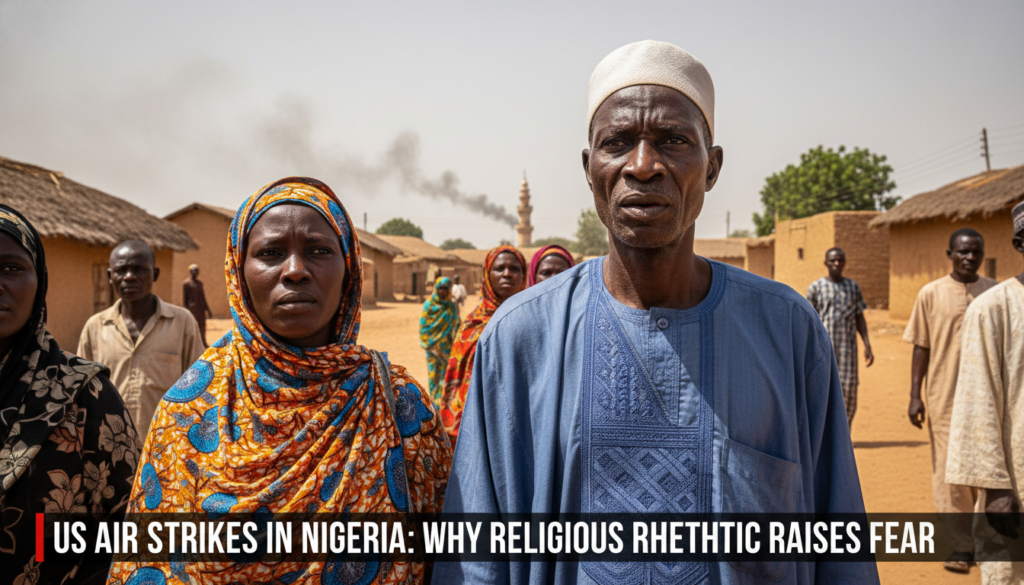
On December 25, 2025, the sky over Sokoto State in Nigeria filled with the sound of a missile. United States Africa Command confirmed it conducted an air strike against Islamic State targets (taskandpurpose.com). This event was the first time the United States took direct military action in Nigeria. The strike hit members of an ISIL affiliate group known as Lakurawa. This group recently moved into the Northwest region from Niger (humanglemedia.com). While the military action was precise, the words used to describe it created a storm of their own.
President Donald Trump described the strike as a move to save Christians from vicious killings (pbs.org). He framed the military action as a response to an existential threat against faith. This language stands in contrast to the official report from the Nigerian government. Foreign Minister Yusuf Maitama Tuggar stated that the operation was a joint effort between Nigeria and the United States. He emphasized that the strike targeted terrorists and was not about religion (tehrantimes.com). This clash between security talk and religious talk raises deep fears in local communities.
A Long History of Sectarian Division
Nigeria is a country with a complex social fabric. Since gaining independence from Britain in 1960, the nation has struggled to balance power between a mostly Muslim North and a majority Christian South (wikipedia.org). This divide is not merely about worship. It is often about access to resources and political influence. The 1967 civil war and several military regimes made these divisions even deeper over time. These tensions are similar to the echoes of historical exploitation that many African nations face today.
In 1999, Nigeria returned to a democratic system of government. However, this transition brought new challenges. In 2000, several northern states began to use Sharia law for criminal cases (wikipedia.org). This move created anxiety among Christian minorities living in those areas. For many in the North, Sharia represents a way to fight government corruption and restore morality. For those in the South, it looked like a threat to the secular nature of the country. This historical tension makes any talk of “protecting religions” very dangerous in a modern context.
Nigeria Conflict Fatalities (2020-2024)
Source: ACLED and HumAngle Data Analysis
The Evolution of Insurgency and Extremism
The rise of violent groups in Nigeria began in the Northeast. A group called Boko Haram formed in 2002. At first, it was a non-violent group in Borno State. Things changed in 2009 after the police killed their founder, Mohammed Yusuf (wikipedia.org). This event started a decade of war. The insurgency has killed more than 35,000 people. It has also forced millions of people to leave their homes (wikipedia.org). These stories of struggle are part of a larger history of involuntary servitude and resistance within the African diaspora.
In 2015, Boko Haram joined forces with ISIS. They changed their name to the Islamic State West Africa Province, or ISWAP (wikipedia.org). The group eventually split into two factions. ISWAP focused on attacking military targets and government buildings. The other faction, led by Abubakar Shekau, continued to attack civilians indiscriminately. This split showed that even among extremists, there are different ideas about how to use violence. Now, the violence has moved from the Northeast to the Northwest region of the country.
New Threats in the Northwest
The Northwest region was once known for “banditry.” These were criminal gangs that stole cattle and kidnapped people for money. However, the situation changed recently. Groups with links to global terror networks began to fill the void left by the government. One such group is Lakurawa (humanglemedia.com). They entered Sokoto and Kebbi states from the neighboring country of Niger. This move happened after a coup in Niger in 2023 changed how the borders were guarded.
Lakurawa is different from the older bandit groups. They offer a type of shadow government to local people. In some areas, they settled disputes and drove away the cattle thieves that the Nigerian army could not stop (humanglemedia.com). This makes it harder for the government to win the trust of the local population. When the United States bombs these areas, it can look like an attack on the only people providing security. This perception is very dangerous for long-term peace in the region.
The Shift to Kinetic Intervention
The air strike on Christmas Day marks a shift to “kinetic intervention.” This term means the use of active, lethal force like missiles or bombs. For many years, the United States only provided training and equipment to Nigeria. This shift is a major change in how the two countries work together (taskandpurpose.com). The strike used high-precision technology launched from a naval vessel. It showed the world that the United States is willing to take a direct role in the fight against ISIL in Africa.
The Nigerian government worked hard to show that it was in control. Foreign Minister Tuggar called it a “joint operation” (tehrantimes.com). Nigeria is very protective of its sovereignty. They do not want to look like they are a puppet of a foreign power. However, the unilateral way President Trump spoke about the strike on social media complicated this. He framed himself as the primary decision-maker. This creates a gap between how the United States sees the mission and how Nigeria wants the world to see it.
Violence Targeting Religious Groups
Data highlights that most violence in Nigeria is non-sectarian. (Source: HumAngle)
The Persecution Narrative versus Reality
The idea of “Christian persecution” is a strong political driver in the United States. Many religious groups use this narrative to raise money and influence government policy (iirf.global). They argue that a genocide is happening against Christians in Nigeria. While there are terrible attacks on churches and priests, the data shows a more complex picture. Conflict in Nigeria kills people of all faiths. In fact, many of the victims of Boko Haram and ISWAP are Muslims who do not agree with their radical ideas.
Analysis by local groups like HumAngle shows that only 4.3 percent of violent incidents in the last five years targeted religious groups (humanglemedia.com). Most deaths happen because of general insurgency, banditry, or land disputes. When leaders use the “crusade” narrative, it can be counterproductive. It makes the conflict look like a war between religions rather than a fight against criminals. This framing can actually help extremist groups recruit new members who feel their faith is under attack by the West.
The History of the Leahy Law
The military relationship between the United States and Nigeria has a rocky past. For many years, the Leahy Law stopped the sale of weapons to Nigeria (taskandpurpose.com). This law says the United States cannot give military aid to units that commit human rights violations. The Nigerian military has a history of extrajudicial killings and torture. Because of this, the Obama administration blocked the sale of attack helicopters (taskandpurpose.com). This policy was meant to push the Nigerian government to improve its human rights record.
The first Trump administration changed this path in 2017. They approved a deal for twelve A-29 Super Tucano planes (taskandpurpose.com). These are rugged planes built for fighting insurgents. The deal was worth nearly 500 million dollars. It included training and precision weapons to reduce civilian deaths. The 2025 air strike shows that the United States has moved beyond just selling tools. Now, they are pulling the trigger. This change is significant for the future of African sovereignty and early struggles for freedom across the continent.
Local Reactions in Sokoto
Sokoto State is a deeply traditional and mostly Muslim area. The people there live in constant fear of violence. They are caught between the Lakurawa group, local bandits, and the military. When the United States missiles hit targets in their backyard, the reaction was mixed. Some were happy to see terrorists defeated. Others were terrified of what a foreign military presence means for their future (humanglemedia.com). They worry about civilian casualties that often go unreported by foreign commands.
Religious leaders in the region have warned that this could backfire. If the local population sees the United States as a “crusader” force, they might support the insurgents out of defiance. The Nigerian government’s focus on “precision hits” is an attempt to calm these fears (tehrantimes.com). They want to show that they can protect the people without destroying their communities. However, the history of air strikes in Africa shows that transparency is often lacking. Civilian deaths are frequently discovered long after the bombs have fallen.
US Military Aid Deal Value
The 2017 Super Tucano deal broke the Leahy Law impasse.
Sovereignty and the Global Stage
The involvement of the United States in Nigeria also affects the African Union. The African Union believes in “African solutions to African problems.” When a foreign power takes direct action, it can look like those regional systems are failing. Critics argue that these strikes treat African countries like proxies for American interests. They worry that it bypasses regional groups like ECOWAS (Economic Community of West African States). This creates a “sovereignty gap” where local citizens have no say in how foreign militaries act on their soil.
The Nigerian government insists that they are equal partners in this fight. They point to the intelligence sharing that led to the strike as proof of cooperation (tehrantimes.com). However, the narrative of the “commander in chief” from Washington often drowns out the voices of African leaders. For the people of Sokoto, the source of the missile matters less than the security it brings. But if the rhetoric continues to focus on a religious clash, it may create more problems than it solves. The history behind these headlines shows that words can be just as powerful as weapons.
Ultimately, the crisis in Nigeria is about more than just a single strike. It is about the long-term stability of a nation with a huge and diverse population. The fight against ISIL and groups like Lakurawa is necessary for safety. However, the way world leaders talk about that fight matters deeply. When security talk is mixed with religion, it risks tearing the social fabric of the country. Peace will only come when the root causes of the violence are addressed, rather than just the symptoms from the sky.
About the Author
Darius Spearman is a professor of Black Studies at San Diego City College, where he has been teaching for over 20 years. He is the founder of African Elements, a media platform dedicated to providing educational resources on the history and culture of the African diaspora. Through his work, Spearman aims to empower and educate by bringing historical context to contemporary issues affecting the Black community.
