
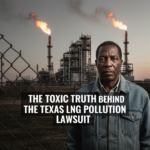


The Toxic Truth Behind the Texas LNG Pollution Lawsuit
By Darius Spearman (africanelements)
Support African Elements at patreon.com/africanelements and hear recent news in a single playlist. Additionally, you can gain early access to ad-free video content.
The skyline of the Texas Gulf Coast is changing. Massive silver towers and flare stacks now rise where marshlands once sat. These structures are part of the Liquefied Natural Gas (LNG) boom. This industry has turned Texas into a global energy powerhouse. However, this growth comes with a heavy price for those living nearby. A new legal battle is shining a light on how officials measure pollution. Local groups argue that government agencies are ignoring the health of residents (grist.org).
The history of this conflict goes back several decades. It is a story of shifting markets and environmental struggles. For many years, the United States worried about running out of natural gas. Companies built terminals to bring gas into the country. Everything changed with the shale revolution. New drilling methods like fracking created a massive surplus of gas. By 2016, companies began reversing their pipes. They started sending gas out to the rest of the world (dcfmodeling.com). Today, Texas provides roughly 31 percent of all United States LNG exports (citizen.org).
From Energy Scarcity to an Export Empire
The transformation of the Texas coast was rapid. In the early 2000s, terminals like Sabine Pass were meant for imports. Energy giants feared a domestic shortage would cripple the economy. This changed when the Permian Basin became a gold mine for gas. Companies like Cheniere Energy pivoted their entire business model. They spent billions to build “liquefaction” plants. These plants chill gas to negative 260 degrees. This process turns gas into a liquid for easy shipping (dcfmodeling.com).
Since 2019, LNG exports from Texas have increased by 273 percent. This growth brought in over nine billion dollars in 2023 alone (citizen.org). President Donald Trump has consistently supported this expansion. His administration emphasizes energy dominance and economic growth. However, residents in places like Port Arthur see a different side of this success. They see the smoke and smell the chemicals every day. The state government often prioritizes these profits over local air quality concerns (canarymedia.com).
The Roots of Environmental Justice
The fight against pollution in Texas is not new. It is built on a long legacy of community resistance. Dr. Robert Bullard is often called the father of environmental justice. In the 1970s, he noticed something troubling in Houston. Waste dumps and chemical plants were always placed in Black neighborhoods (bullardcenter.org). This pattern created what activists call “sacrifice zones.” These are areas where industrial needs outweigh the health of the people. This history shows the strength and resilience of families who refuse to be moved (bullardcenter.org).
In 1994, federal policy began to change. President Clinton signed Executive Order 12898. This order required agencies to look at health risks in minority communities. Groups today argue that agencies like the Federal Energy Regulatory Commission (FERC) are failing this duty. They claim that while the gas goes to Europe or Asia, the toxic air stays in Texas. This creates a cycle where low-income neighborhoods pay for global energy security with their lives (grist.org).
Life in the Fenceline Communities
A “fenceline” community is exactly what it sounds like. It is a neighborhood where houses sit right next to industrial plants. In Port Arthur, residents are often separated from massive refineries by only a chain-link fence (goldmanprize.org). People here grow up with the constant smell of sulfur. They see orange flares lighting up the night sky. These residents face the most direct risks from leaks and vapor clouds. These clouds can be dangerous and cause flash fires or breathing problems (scholasticahq.com).
The demographics of these areas tell a specific story. Port Arthur is roughly 40 percent Black. Over one-fourth of its residents live below the poverty line (goldmanprize.org). In Houston, the Manchester neighborhood is over 80 percent Hispanic. The median income there is about half of the city average (hereinhouston.org). These communities face modern challenges faced by African American families and other minority groups (hereinhouston.org). High poverty rates make it difficult for people to move away from the pollution.
Health Risk Disparity
Risk
Average Houston
Higher
Manchester (Houston)
Cancer risk comparison between Manchester and the city average (mdpi.com).
The Hero of Port Arthur
Hilton Kelley is a central figure in this ongoing struggle. He was once an actor in Hollywood. However, he returned to his home in Port Arthur in 2000. He found his community suffering from the effects of nearby refineries. Kelley founded the Community In-Power and Development Association (CIDA). He spent years fighting for cleaner air for his neighbors. His work shows that local residents can stand up to massive corporations (goldmanprize.org).
In 2011, Kelley won the Goldman Environmental Prize. This is often called the “Green Nobel.” He earned it by negotiating a “Good Neighbor” agreement with the Motiva refinery. This agreement was a huge victory. It forced the refinery to install better pollution controls. It also created a multi-million dollar fund for local health coverage. Kelley proved that communities could win direct benefits from industrial giants (goldmanprize.org). His legacy continues to inspire the lawyers and activists filing new lawsuits today.
The Battle Over Best Technology
A major part of the current legal fight involves technical standards. The Clean Air Act requires new plants to use the Best Available Control Technology (BACT). This means companies must use the most effective tools to reduce pollution. In 2023, a court ruled that the Texas Commission on Environmental Quality (TCEQ) failed to enforce this. The court found that Port Arthur LNG was allowed to use lower standards than other projects (hbc.law).
State agencies often argue that strict rules are too expensive. They say the technology must be “economically reasonable.” However, the U.S. Court of Appeals for the Fifth Circuit disagreed. It ruled that the agency acted “arbitrarily and capriciously.” This means the state was not following its own rules. This ruling was a rare win for community groups. It showed that the state cannot give favors to big energy companies at the expense of the law (haynesboone.com).
The “Affirmative Defense” Loophole
There is a hidden rule in Texas that allows companies to pollute without penalties. It is called the “affirmative defense.” When a plant has an “unplanned” pollution event, it can avoid fines. The company simply has to report the event and claim it was an accident. Critics say this effectively legalizes toxic emissions. In Texas, corporate polluters use this defense to avoid fines 97 percent of the time (texas.gov).
Between 2015 and 2019, illegal air pollution from these breakdowns increased by 155 percent. Most of these events never resulted in a financial penalty. For residents, these “accidents” are part of daily life. They lead to asthma attacks and emergency room visits. The state rarely sends inspectors to check these claims. Instead, they often take the company at its word. This leaves fenceline communities without any protection when things go wrong (mehaffyweber.com).
The Enforcement Gap
Only 3% of unpermitted emission events are penalized.
97% Escape Fines (texas.gov)
Global Profits and Local Costs
The LNG industry claims to be a job creator for Texas. They point to the billions of dollars flowing into the state treasury. However, the economic benefits do not always reach local residents. Many companies receive massive tax breaks from local school districts. These tax breaks can drain funding from hospitals and public schools. While the state gets richer, local services often struggle (citizen.org).
There is also a “triple cost” for low-income families. As more gas is exported, the domestic supply decreases. This can drive up the price of natural gas for American homes. Some studies suggest that exports can raise local gas prices by over 30 percent. This hits poor families the hardest. They already spend a larger share of their income on utility bills. This creates a situation where the poorest citizens subsidize the profits of global energy traders (citizen.org).
The Impact of Invisible Chemicals
The pollution from LNG plants is often invisible. Two of the main culprits are Volatile Organic Compounds (VOCs) and Nitrogen Oxides (NOx). When these chemicals meet sunlight, they create ground-level ozone. This is the main ingredient in smog. Smog is very dangerous for children and the elderly. It can damage lung development and trigger chronic respiratory diseases (mdpi.com).
In Jefferson County, where Port Arthur is located, air quality is a major concern. The American Lung Association has given the area a failing grade. High levels of ozone are linked to higher death rates. In some Houston neighborhoods, residents are exposed to 1,3-Butadiene. This is a known carcinogen used in industrial processes. The cancer risk in Manchester is 22 percent higher than the rest of the city. These are not just statistics; they represent families dealing with real illness (mdpi.com).
The 2024 Legal Standstill
The legal landscape changed again in early 2024. The Biden administration announced a pause on new LNG export approvals. They wanted to take more time to study climate and health impacts. This move was a victory for environmental justice groups. However, it led to a massive backlash from state officials. Texas and 15 other states sued the federal government to end the pause (canarymedia.com).
President Trump has criticized this pause as a threat to the economy. His administration views LNG as a key part of American power. The tension between federal environmental goals and state economic interests is at an all-time high. Meanwhile, the people of the Gulf Coast are waiting for a final answer. They are caught between a government that wants to expand and a legal system that is slow to protect them (grist.org).
A Call for Change
The current lawsuits are about more than just permits. They are about the right to breathe clean air. Local groups are demanding that agencies like FERC look at “cumulative impacts.” This means looking at how all the plants in one area affect the people together. Agencies currently look at each project one by one. This ignores the total burden on a community like Port Arthur (grist.org).
The history of environmental justice shows that change is possible. From Dr. Bullard to Hilton Kelley, people have fought for their right to a healthy environment. The new lawsuits are the latest chapter in this long story. As Texas continues to lead the world in energy, the question remains. Can the state find a way to grow without sacrificing its most vulnerable citizens? The answer will define the future of the Gulf Coast for generations to come (bullardcenter.org).
About the Author
Darius Spearman is a professor of Black Studies at San Diego City College, where he has been teaching for over 20 years. He is the founder of African Elements, a media platform dedicated to providing educational resources on the history and culture of the African diaspora. Through his work, Spearman aims to empower and educate by bringing historical context to contemporary issues affecting the Black community.
