


Why the Atlanta Cop City RICO Case Finally Fell Apart
By Darius Spearman (africanelements)
Support African Elements at patreon.com/africanelements and hear recent news in a single playlist. Additionally, you can gain early access to ad-free video content.
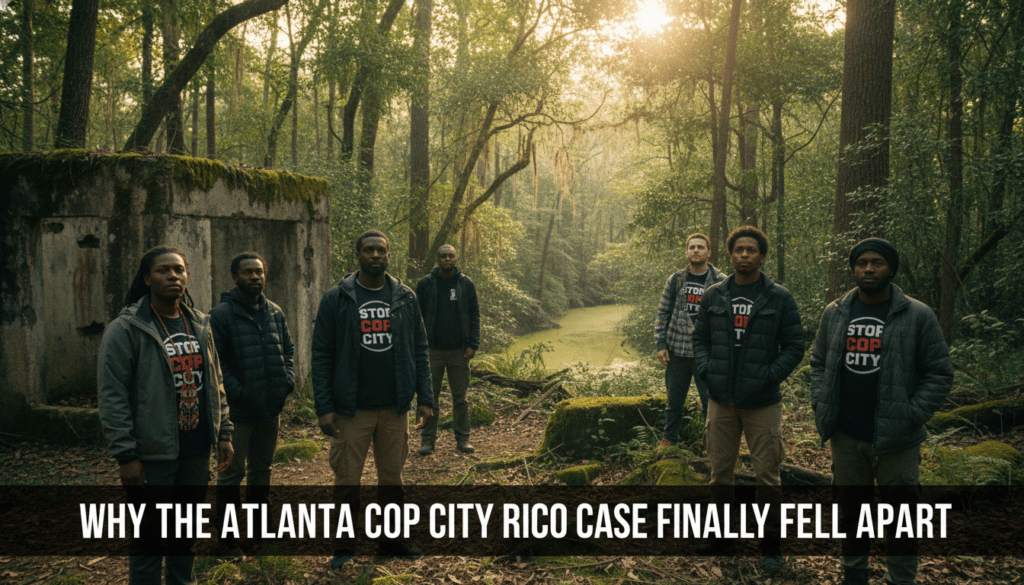
The legal battle over the Atlanta Public Safety Training Center reached a stunning conclusion on December 30, 2025. A Georgia judge formally dismissed the massive RICO case against sixty-one activists (wsbradio.com). This decision ended what many legal experts called the largest criminal racketeering case ever filed against protesters in the history of the United States (timescolonist.com). The ruling arrived after years of intense conflict between the State of Georgia and a decentralized network of protesters who fought to “Stop Cop City.”
To understand this dismissal, one must look at more than just the recent court dates. The story of this land stretches back centuries. It involves the removal of indigenous peoples and the history of forced labor (atlantastudies.org). It also involves the modern fight for racial justice that erupted in 2020. The legal collapse of the state’s case shows a deep tension between government authority and the right to protest. This article explores the history and the legal overreach that led to this historic moment.
The Rising Cost of Cop City
Initial Estimate
$90 Million
Final Cost (2025)
$115+ Million
The Ancestral Roots of the Weelaunee Forest
The site of the training center is located in the South River Forest. This land is known by the Muscogee (Creek) people as the Weelaunee Forest (aclu.org). The name Weelaunee means “green-brown-yellow water.” For centuries, the Muscogee people lived on this land and cared for its ecosystem. However, the State of Georgia forcibly removed them in the 1820s and 1830s during the Trail of Tears (truthout.org). This history of displacement is a central theme for the modern protest movement.
Protesters often argue that building a police facility on this land is a second colonial invasion. In 2021, indigenous leaders returned to the forest for the first time in two hundred years. They performed traditional stomp dances to reclaim their spiritual connection to the land (aclu.org). By using the name Weelaunee, activists emphasize that the forest is not a vacant plot of land. It is a living place with a deep history that predates the city of Atlanta itself. The movement connects modern environmentalism with the long-term academic study of Black history and indigenous rights.
The forest serves as one of the “four lungs” of Atlanta. It helps cool the city and manages water runoff from heavy rains (arcgis.com). When the city announced plans to clear eighty-five acres of this forest, it sparked immediate concern. Many residents felt that the ecological value of the trees was more important than a new police facility. This tension between environmental preservation and police expansion laid the groundwork for the years of protest that followed (dissentmagazine.org).
From Plantations to the Old Atlanta Prison Farm
After the forced removal of the Muscogee people, the land was used for agriculture. It served as a plantation that relied on enslaved labor (atlantastudies.org). This transition established a long history of racialized control on the property. In the early 20th century, the site became the Old Atlanta Prison Farm. From 1920 to 1995, incarcerated individuals were forced to perform farm labor there (columbia.edu). Most of these individuals were Black men who faced documented human rights abuses and harsh conditions (streetsofatlanta.blog).
This history of “carceral land use” is a key part of the “Stop Cop City” argument. Critics point out that the land has been a site of confinement and surveillance for over a hundred years. They argue that building a massive police training center continues this legacy of punishment (columbia.edu). Instead of a park or a community space, the city chose to maintain the land for policing. This choice reflects a historical pattern where land in marginalized areas is used for state control rather than community benefit.
The prison farm was eventually closed, and the forest began to reclaim the ruins. For decades, the land sat largely unused by the city. Local residents began to see it as a natural refuge. However, the plan for “Cop City” changed that vision. Activists claim that the city’s decision to build the facility there shows a disregard for the history of the people who suffered on that ground (streetsofatlanta.blog). They see the training center as a modern extension of the carceral system that has defined the site since the plantation era.
The 2020 Uprising and the Birth of Cop City
The immediate catalyst for the training center was the “summer of reckoning” in 2020. Following the police killing of George Floyd in Minneapolis, Atlanta experienced massive protests. The situation escalated locally when an Atlanta police officer killed Rayshard Brooks (wikipedia.org). Brooks was a twenty-seven-year-old Black man who was shot in the back in a Wendy’s parking lot. His death led to the resignation of the police chief and widespread calls for police reform (wikipedia.org).
Following these events, police morale in Atlanta dropped significantly. Many officers left the force, and city leaders sought a way to improve retention and training. In 2021, the city proposed a ninety-million-dollar facility to modernize the force (wikipedia.org). While officials argued the center was necessary for better policing, activists saw it as a militarized response to the racial justice movement. They viewed the project as a “backlash” against the demands for reform that followed the death of Rayshard Brooks (wikipedia.org).
The Wendy’s where Brooks was killed became a site of sustained protest. This energy eventually moved toward the South River Forest. Protesters began to set up encampments in the woods to prevent construction equipment from entering. This decentralized network of activists included local community members and individuals from across the country (theguardian.com). They were united by a shared goal: to stop the destruction of the forest and the expansion of the police state. During this time, many activists relied on networks of community support to maintain their presence in the forest.
The Scale of Legal Action
170+
61
42
The Death of Tortuguita and Escalation
On January 18, 2023, the conflict turned deadly during a multi-agency raid. State troopers entered the forest to clear out the protester encampments. During this operation, Manuel “Tortuguita” Paez Terán was shot and killed (unicornriot.ninja). Tortuguita was a twenty-six-year-old non-binary indigenous environmental activist. The state claimed that Terán fired first and wounded a trooper. However, an independent autopsy found that Terán was sitting cross-legged with their hands up when they were shot fifty-seven times (theguardian.com).
The death of Tortuguita transformed the local protest into an international cause. They became the first environmental activist killed by police in the history of the United States. This event led to a massive increase in support for the movement. Vigils and protests were held in cities across the globe (aljazeera.com). The killing also intensified the resolve of the “forest defenders.” They refused to leave the site despite the increasing threat of violence from law enforcement.
In response to the growing unrest, the State of Georgia began using more aggressive legal tactics. Authorities started charging protesters with “domestic terrorism” under a broad 2017 statute (fox5atlanta.com). This law defines terrorism in a way that includes property damage intended to intimidate the government. At least forty-two people were initially charged with this crime (wsbradio.com). These charges were seen by many as an attempt to silence dissent through the threat of decades in prison.
Weaponizing the RICO Statute
In August 2023, Attorney General Chris Carr escalated the legal fight even further. He used Georgia’s RICO statute to indict sixty-one individuals (wabe.org). RICO laws were originally created to take down the Mafia and organized crime. However, the state applied them to the decentralized “Stop Cop City” movement. The one hundred and nine-page indictment claimed that the protesters were part of a “criminal enterprise” (cbsnews.com). It labeled the network as “militant anarchists” who conspired to commit crimes.
The indictment was highly controversial because of what it listed as “overt acts.” The state did not just focus on property damage or arson. It also included legal activities like distributing “zines” or buying food for protesters (atlantadailyworld.com). The prosecution argued that these mundane acts were done to further the criminal conspiracy. Legal critics argued that this application of RICO was a dangerous expansion of the law. They claimed it effectively criminalized the infrastructure of social movements, such as bail funds and mutual aid (aclu.org).
The indictment treated individuals who had never met as part of the same cohesive organization. This was difficult to prove because the movement was intentionally decentralized. There was no single leader or formal hierarchy (dissentmagazine.org). Instead, various autonomous groups worked under the shared banner of “Defend the Atlanta Forest.” The state’s attempt to frame this loose affiliation as a criminal enterprise became a central point of the legal defense. It highlighted the tension between traditional law enforcement and modern forms of political activism.
Targeting the Atlanta Solidarity Fund
One of the most significant targets of the state’s investigation was the Atlanta Solidarity Fund (ASF). This organization provided bail and legal assistance for arrested protesters. In May 2023, a SWAT team raided the ASF office and arrested three organizers (wabe.org). They were charged with money laundering and charity fraud. The prosecution argued that the fund was used to “launder” money to support a criminal enterprise (atlantadailyworld.com).
The raid was widely condemned by civil rights organizations. They saw it as a direct attack on the legal support system for protesters. Organizations like the Bail Project argued that providing bail is a protected activity (aclu.org). They claimed the state was trying to cut off the movement’s resources to make it easier to suppress. This tactic created a “chilling effect” on donors who feared they might also be targeted by the investigation.
In September 2024, the state’s case against the ASF organizers began to crumble. Prosecutors were forced to drop all fifteen money laundering charges after failing to provide evidence of financial crimes (wsbradio.com). This was a major blow to the state’s overarching narrative. It showed that the aggressive charges were not always backed by solid facts. Despite this setback, the state continued to pursue the larger RICO case against the other sixty-one defendants.
The Urban Heat Island Disparity
Wealthy/White Neighborhoods
75°F
Low-Income/Black Neighborhoods
85°F
The South River Forest acts as a “lung” to mitigate this 10-degree gap.
Environmental Racism and Social Inequity
The conflict over “Cop City” is also a matter of environmental justice. The neighborhoods surrounding the South River Forest are predominantly Black and low-income (brookings.edu). Approximately seventy-five percent of the residents in these areas identify as African American. These communities already face higher rates of health issues like asthma and heat-related illnesses (afsc.org). The destruction of the forest removes a vital resource that helps mitigate the “urban heat island effect.”
Research shows that low-income Black neighborhoods in Atlanta can be up to ten degrees hotter than wealthier white areas (arcgis.com). This is often the result of historical redlining and unequal investment in green space. By placing a massive, high-noise police facility in this area, activists argue the city is practicing environmental racism (afsc.org). They believe the facility would never be built in a more affluent, white neighborhood. The noise from the proposed “mock city” training grounds would also add to the trauma of an already marginalized community.
The South River Forest is one of the few large green spaces left in this part of the city. Residents use it for recreation and to find peace. The plan to turn it into a tactical training site felt like a betrayal to many locals. They argued that the city was prioritizing police militarization over the physical and mental health of its Black citizens. This demographic impact was a key reason why local community groups joined the “Stop Cop City” movement (brookings.edu).
The Role of the Atlanta Police Foundation
The funding of the training center also raised questions about corporate influence. The project was a public-private partnership between the City of Atlanta and the Atlanta Police Foundation (APF). The city provided thirty million dollars, while the APF was responsible for raising the remaining sixty million (wikipedia.org). The APF is a private non-profit governed by a board of executives from major corporations. These include Coca-Cola, Home Depot, and UPS (youtube.com).
Critics argued that the APF acted as a “backchannel” for corporate interests. They claimed the foundation allowed corporations to influence public safety policy without the usual public oversight (saportareport.com). Because the APF is a private entity, it did not have to follow the same transparency rules as the city government. This allowed the project to bypass normal bidding processes and public debate for a long time. Activists targeted these corporate donors with boycotts and protests to pressure them to withdraw their support.
This partnership highlighted the shift toward private funding for public services. For many in the movement, “Cop City” represented the intersection of corporate power and police expansion. They saw it as a sign that the city’s priorities were being directed by wealthy donors rather than the needs of the residents. The high cost of the project, which eventually grew to over one hundred and fifteen million dollars, added to the public outcry (wsbradio.com). People wondered why so much money was available for policing while other community needs went unfunded.
Why the RICO Case Ultimately Collapsed
Despite the state’s aggressive efforts, the RICO case fell apart on a procedural rule. In December 2025, Fulton County Superior Court Judge Kevin Farmer dismissed the charges against all sixty-one defendants (wsbradio.com). He ruled that Attorney General Chris Carr lacked the constitutional authority to file the indictment. Under Georgia law, the Attorney General must have written permission from the Governor to bypass a local District Attorney (wsbradio.com).
Carr had filed the charges after the local District Attorney, Sherry Boston, recused her office. Boston had expressed concerns about the “prosecutorial philosophy” being used by the state (wsbradio.com). However, Carr failed to obtain the required letter from Governor Brian Kemp before moving forward. Judge Farmer noted that this was a “basic procedural rule” that the state had ignored. He stated that it would have been very easy for the Attorney General to simply follow the law and get the letter (wsbradio.com).
This ruling was a major embarrassment for the state’s top prosecutor. It suggested that in his haste to stop the protesters, he had overstepped his authority. The dismissal was not based on the innocence of the protesters, but on the failure of the government to follow its own rules. This “procedural hubris” effectively ended the largest RICO case against protesters in American history. While the state could try to re-file the charges, the ruling stood as a significant check on executive overreach.
A Fragile Victory in a Changed Landscape
The dismissal of the RICO case was a massive win for the activists. It meant that sixty-one people no longer faced twenty years in prison for their political activities (cbsnews.com). However, the victory was bittersweet. While the court case ended, the physical construction of the training center did not stop. The facility was completed and opened in mid-2025, despite the years of intense opposition (wsbradio.com).
The “Cop City” facility now stands as a permanent fixture in the South River Forest. The trees that were once occupied by “forest defenders” have been replaced by concrete and tactical training structures. For many, this physical reality is a reminder of the power of the state and its corporate partners. However, the legal victory signaled that the government cannot use racketeering laws to silence dissent without following due process. It set a precedent that may protect future social movements from similar tactics.
The “Stop Cop City” movement changed the conversation about policing and environmental justice in Atlanta. It brought together diverse groups of people to fight for a shared vision of the future. While they could not stop the building itself, they succeeded in challenging the legal strategies used to criminalize their movement. The history of this land continues to be written, as the community grapples with the presence of the facility and the legacy of the fight against it.
About the Author
Darius Spearman is a professor of Black Studies at San Diego City College, where he has been teaching for over 20 years. He is the founder of African Elements, a media platform dedicated to providing educational resources on the history and culture of the African diaspora. Through his work, Spearman aims to empower and educate by bringing historical context to contemporary issues affecting the Black community.
