

Why Mali and Burkina Faso Banned Americans From Entry
By Darius Spearman (africanelements)
Support African Elements at patreon.com/africanelements and hear recent news in a single playlist. Additionally, you can gain early access to ad-free video content.
The Sahel region is currently facing a massive diplomatic shift. This area acts as a physical and cultural bridge across the African continent (wikipedia.org). Recent headlines report that Mali and Burkina Faso have barred United States citizens from entering (nationalheraldindia.com). These nations called the move a visa “tit-for-tat” (businessday.ng). This decision follows a history of cooperation that has now turned into a cold standoff. The move affects tourism, business, and heritage travel for the African diaspora. It highlights a growing divide between Western powers and West African military leaders.
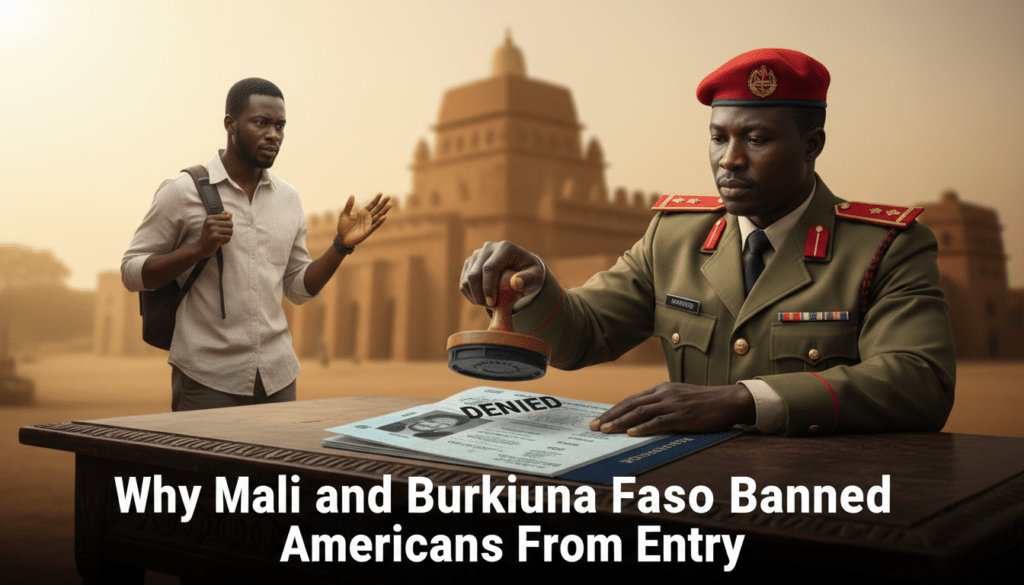
The situation began to escalate in late 2025. President Donald Trump signed a proclamation that expanded travel restrictions (thecable.ng). This order targeted several nations, including Mali and Burkina Faso (nationalheraldindia.com). U.S. officials cited concerns over identity management and security vetting (nationalheraldindia.com). They also pointed to high rates of citizens overstaying their visas (businessday.ng). In response, the foreign ministries in Bamako and Ouagadougou invoked the principle of reciprocity (aa.com.tr). They announced that American citizens would face similar barriers to entry (thediplomaticinsight.com).
Source: (nationalheraldindia.com)
A History of Partnership and Democracy
The relationship between the United States and these nations was not always tense. Diplomatic ties began in 1960 immediately after they gained independence from France (wikipedia.org). For decades, the focus remained on economic development and public health. Programs like the Peace Corps were active in the region for a long time (cfr.org). Both countries worked closely with Washington to fight diseases like malaria. During the early 1990s, Mali stood out as a beacon of hope (wikipedia.org). It transitioned to a multiparty system in 1992 (wikipedia.org).
Mali was once described as a model for democracy in Africa (thediplomaticinsight.com). Relations with the United States were excellent and expanding during this period (cfr.org). Both nations shared a vision of stable governance and regional growth. After the events of September 11, the partnership took a military turn. The Sahel became a critical front in the global War on Terror (aljazeera.com). The U.S. invested hundreds of millions of dollars into the Trans-Saharan Counterterrorism Initiative (cfr.org). This money helped train local soldiers to fight Al-Qaeda in the Islamic Maghreb (aljazeera.com).
The training programs aimed to stabilize the region and protect borders. For over fifteen years, American and Sahelian militaries worked side by side. However, the security situation on the ground did not improve as expected. Jihadist groups continued to expand their influence in rural areas. This led to deep frustration within the Malian and Burkinabe military ranks. They felt the civilian governments and Western partners were failing to provide enough support (hrw.org). This frustration eventually paved the way for the return of military rule.
The 2012 Collapse and the Rise of Juntas
The year 2012 marked the beginning of a long downward spiral for the Sahel. The fall of Muammar Gaddafi in Libya triggered a massive crisis (aljazeera.com). Battle-hardened fighters returned to Mali with heavy weapons (aljazeera.com). These fighters launched a rebellion in the north to create an independent state (aljazeera.com). The Malian army felt poorly equipped to handle the well-armed rebels. This led to a mutiny and a military coup in March 2012 (cfr.org). This power vacuum allowed extremist groups to hijack the rebellion.
The United States had to react to these political changes. According to Section 7008 of the Foreign Assistance Act, the U.S. must stop aid after a coup (congress.gov). This law prevents direct financial or military support to governments that seize power by force (congress.gov). Although democracy returned briefly, it did not last. Between 2020 and 2022, a wave of new coups swept through the region (hrw.org). Military juntas took control in Mali, Burkina Faso, and neighboring Niger. These leaders argued that democracy had failed to provide security for the people.
These military governments have moved away from traditional Western allies. They believe that years of French and American intervention did not stop the violence (aljazeera.com). Instead, they have turned toward Russia for military support (dawan.africa). The Russian-controlled Africa Corps now provides security for these leaders (aljazeera.com). This group was formerly known as the Wagner Group (aljazeera.com). This shift in alliance has caused deep concern in Washington. The United States now views these nations as security risks rather than partners (dawan.africa).
The High Cost of the Visa War
The “visa war” is more than a symbolic disagreement between governments. It has created massive financial barriers for ordinary people. One of the most controversial measures is the introduction of visa bonds. The U.S. government proposed bonds between $5,000 and $15,000 for “high-risk” travelers (cato.org). These bonds are meant to discourage people from overstaying their visas. In response, Mali reportedly introduced its own $10,000 bond requirement for American visitors (financeinafrica.com). This makes travel to the region extremely expensive.
These financial barriers hurt the African diaspora the most. Many African Americans seek to trace their lineage to West Africa (aljazeera.com). Mali and Burkina Faso are home to historical sites like Timbuktu (wikipedia.org). This city is a legendary center of Islamic scholarship and African history. For many, a trip to these sites is a spiritual journey. However, the $10,000 bond turns a heritage trip into a luxury-only experience. This policy separates families and researchers from their ancestral roots. It creates a divide based on wealth rather than cultural connection.
Travel restrictions also impact business and trade. Analysts estimate that these new rules could disrupt thousands of business trips (businessday.ng). Both nations have lost their eligibility for the African Growth and Opportunity Act (congress.gov). This act allowed them to export goods to the U.S. without paying duties. Losing this access harms local workers, especially in the textile industry (context.news). The economic impact trickles down to the poorest citizens. While governments argue over sovereignty, the local working class pays the price.
The Shift in Regional Alliances
Mali and Burkina Faso are not acting alone in this conflict. They have joined Niger to form the Alliance of Sahel States (aljazeera.com). This new bloc is a response to pressure from Western nations and regional groups. These three countries have officially withdrawn from ECOWAS (aljazeera.com). ECOWAS is the regional bloc that has fostered trade and free movement for fifty years (aljazeera.com). The juntas claim ECOWAS has become a tool for foreign powers like France (aljazeera.com). They prefer to handle their own security and economic policies.
The withdrawal from ECOWAS is a major turning point for West Africa. It threatens the free movement of millions of people across borders (aljazeera.com). Citizens from these nations may soon face new customs duties and residency rules. The juntas argue that this is the price of genuine sovereignty. They want to end what they call neocolonial influence (aljazeera.com). This includes a rejection of the CFA Franc currency (aljazeera.com). They view their actions as finishing the work of the 1960 independence movement.
This “Sovereigntist” pivot is very popular among some local populations. Many people are tired of seeing foreign troops on their soil while violence increases. They see the arrival of Russian paramilitary forces as a fresh start. Unlike the United States, Russia does not demand democratic reforms (aljazeera.com). They offer military support without asking about human rights or elections (aljazeera.com). This makes them a more attractive partner for military leaders who want to stay in power. However, this shift leaves fewer observers to track civilian casualties during fighting (hrw.org).
Humanitarian Aid in a Hostile Climate
Despite the visa bans and broken military ties, some cooperation remains. The United States is still the largest provider of humanitarian aid to the region. This aid is delivered through non-governmental organizations rather than the government (congress.gov). It focuses on food security, emergency health, and clean water. Because of the insecurity, millions of people have been forced to flee their homes. They rely on this international support to survive the ongoing conflict (hrw.org). This creates a strange paradox in the relationship.
The U.S. government wants to help the people but cannot support the leaders. Section 7008 allows for humanitarian exemptions to protect the vulnerable (congress.gov). However, the “visa war” makes it harder for aid workers to travel. If American experts cannot get visas, the delivery of aid becomes more difficult. This situation puts the lives of civilians at risk. They are caught between the security policies of the U.S. and the sovereignty claims of the juntas. The humanitarian channel is becoming increasingly strained as the diplomatic freeze deepens.
Furthermore, the rise of the Africa Corps has complicated humanitarian work. There are many reports of human rights violations involving these forces (aljazeera.com). The massacre at Moura in Mali is one documented example of civilian harm (aljazeera.com). Western organizations find it difficult to operate in areas where these paramilitary groups are active. The lack of accountability makes the region more dangerous for everyone. As the U.S. pulls back, the space for neutral humanitarian work continues to shrink.
The Future of Heritage and Return Tourism
For the African diaspora, the Sahel has long been a place of discovery. Many people want to visit the Great Mosque of Djenné or the cliffs of Bandiagara. These sites are symbols of African ingenuity and ancient civilization (wikipedia.org). However, the current “Level 4: Do Not Travel” advisory from the U.S. State Department is a major hurdle (aljazeera.com). The risk of kidnapping and terrorism is considered very high. Most organized tour operators have stopped offering trips to these locations.
This instability has shifted the focus of “Return” tourism. Countries like Ghana and Benin have become the primary hubs for heritage travel. They offer a safe environment for people to reconnect with their history. Ghana’s “Year of Return” was a massive success for the diaspora. Unfortunately, the Sahel is missing out on this cultural and economic boom. The visa ban and high bonds effectively lock out a generation of African Americans. They are unable to visit the lands of their ancestors because of a political fight.
The “visa tit-for-tat” is a sign of a new, multipolar world. The United States no longer has the same influence it once did in West Africa. New players like Russia and China are offering different kinds of partnerships. The juntas in Mali and Burkina Faso are gambling on these new allies. They believe they can secure their countries without Western conditions. Whether this gamble will bring peace or more conflict remains to be seen. For now, the gates are closed, and the history of the Sahel is further removed from the diaspora.
About the Author
Darius Spearman is a professor of Black Studies at San Diego City College, where he has been teaching for over 20 years. He is the founder of African Elements, a media platform dedicated to providing educational resources on the history and culture of the African diaspora. Through his work, Spearman aims to empower and educate by bringing historical context to contemporary issues affecting the Black community.
