

Why 300 Black Boys Are Buried in Unmarked Maryland Graves
By Darius Spearman (africanelements)
Support African Elements at patreon.com/africanelements and hear recent news in a single playlist. Additionally, you can gain early access to ad-free video content.
The Haunted Woods of Prince George’s County
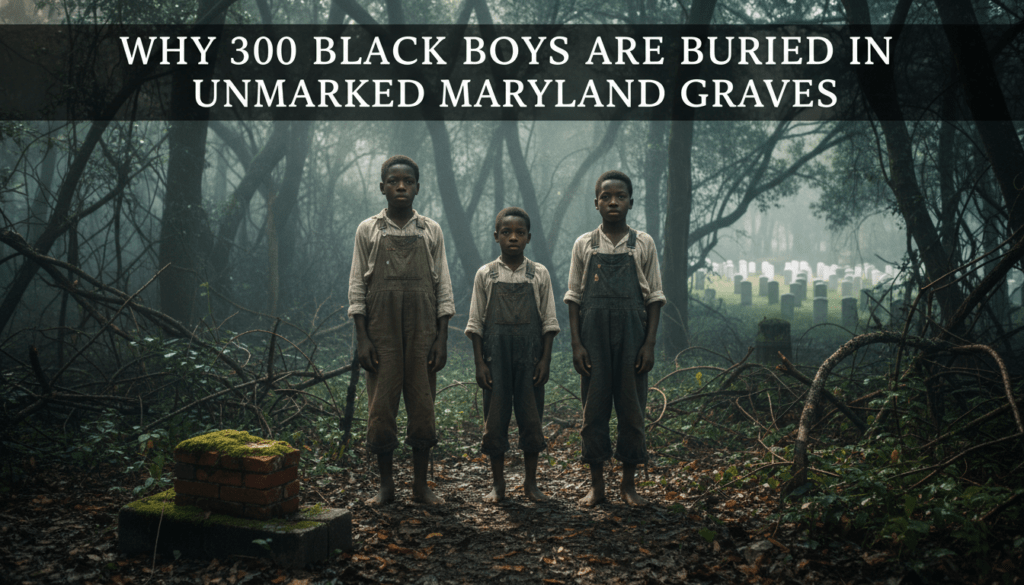
A quiet wooded area in Maryland hides a painful secret from the past. This site sits right across from a beautifully kept veterans cemetery. The contrast between the two places is shocking. One area has perfectly cut grass and white headstones. The other is overgrown with vines, thorns, and fallen trees. Deep inside those woods, the remains of hundreds of Black children lay in the dirt. Many are marked only by sinking cinder blocks or simple bricks. These boys died while they were under the care of the state of Maryland (wusa9.com).
State Senator William C. Smith Jr. and other leaders recently visited this site. They represent the Legislative Black Caucus of Maryland. This group works to protect the interests of Black citizens in the state. What they found was a “haunting” reminder of how the state once treated its most vulnerable children. For decades, the stories of these boys were lost. Now, new investigations are bringing their names back into the light. This discovery is fueling a massive push for juvenile justice reform in Maryland. Leaders want to ensure that no child ever faces such neglect again (wusa9.com, afro.com).
The Growing Toll of Cheltenham
Data reflects recent investigative findings and legislative reports (washingtonpost.com).
The House of Reformation and the Roots of Injustice
The facility was first known as the House of Reformation and Instruction for Colored Children. It opened its doors in 1872 on a huge plot of land donated by Enoch Pratt. At the time, the state claimed the goal was to help children. However, the reality was much darker. This school was strictly for Black boys. The state had a separate place for white children called the House of Refuge. The white facility received much more money from the government. It focused on teaching children trades and providing an education. In contrast, the Black facility focused on hard physical labor (afro.com, wikipedia.org).
The system was designed to control Black youth during the era of Jim Crow. Many of these boys were as young as seven years old. They were sent there for things that would not be considered crimes today. Some were locked up because they were poor or had no parents. Others were charged with being “difficult” or “stubborn.” Once they arrived at Cheltenham, they became part of a system that looked very much like slavery. The state used these children to work the land and keep the facility running without paying them (afro.com, afro.com).
Convict Leasing and the Price of Black Labor
During the late 1800s, Maryland used a system called convict leasing. This allowed the state to rent out prisoners to private businesses for a fee. It was a way for the state to make money while avoiding the costs of taking care of prisoners. At the House of Reformation, this meant leasing Black boys to local farmers in Prince George’s County. These children were forced to do grueling farm work in the heat. They often had no access to school or proper medical care. The state and private landowners were the ones who profited from this economic justice gap (afro.com, afro.com).
This practice was a direct result of a loophole in the 13th Amendment. That amendment ended slavery but allowed it to continue as a punishment for a crime. States across the South used this to keep Black people in involuntary servitude after the Civil War. At Cheltenham, children were worked like field hands. Historical records show that many boys died from sheer exhaustion. Others died from diseases that spread quickly in overcrowded dormitories. They were treated as tools for labor rather than children in need of help (eji.org, afro.com).
The Criminalization of Poverty: Vagrancy and Incorrigibility
How did so many Black boys end up in state custody? The answer lies in “status offenses.” These were laws created to target Black people for everyday behaviors. One common charge was “vagrancy.” This meant a person was unemployed or wandering the streets. For a Black child, being poor or looking for work could lead to an arrest. Another common charge was “incorrigibility.” This was a vague term for any child who did not follow the rules of an adult. It gave the state the power to take children away from their families for almost any reason (afro.com, afro.com).
These laws created a pipeline that funneled Black youth into the justice system. Once a child was labeled as a “vagrant,” they lost their freedom. They were sent to Cheltenham, where the state could use them for labor. This was not about helping the children improve their lives. It was about social control and profit. Many of the boys buried in those woods were there because they were simply poor. Their deaths were the final act of a system that valued their work more than their lives (eji.org, afro.com).
Modern Discovery: The Numbers Behind the Tragedy
For a long time, the state of Maryland claimed it did not know how many children died at Cheltenham. However, recent research has revealed a much higher number than previously thought. Initially, reports found death certificates for 177 children. These deaths occurred between 1877 and 1941. Most of these boys died from tuberculosis or pneumonia. These are diseases that thrive when people live in dirty, crowded conditions. The facility was often packed with more boys than it could safely hold (washingtonpost.com).
Senator William Smith now states that the true death toll is likely closer to 300. This is because many records were lost or never kept. The state only started requiring death records in 1898. This means any child who died in the first 25 years of the facility might not have a certificate. Additionally, ground-penetrating radar has found rows of graves that were never officially marked. These “missing names” represent a massive failure of state accountability. The current government is now trying to use forensic science to identify these lost children (wusa9.com, washingtonpost.com).
Racial Bias in Maryland Adult Charging
Percentage of children charged as adults who are Black (hrw.org).
Despite Black youth making up only 31% of the total youth population.
Maryland’s Broken Juvenile Justice System Today
The tragedy at Cheltenham is not just a story from the past. It reflects deep problems that still exist in Maryland today. Maryland has one of the highest rates in the nation for charging teenagers as adults. It ranks second, only behind Alabama. This process is called “automatic transfer.” It means that for certain crimes, a child is sent to adult court without a judge ever looking at their case. This takes away the chance for a judge to consider the child’s age or background (hrw.org, rstreet.org).
This policy hits the Black community the hardest. Even though Black youth are only a small part of the population, they make up the vast majority of those sent to adult jails. Research shows that 83% of children charged as adults in Maryland are Black. These children are put in jails with adults where they face much higher risks of violence. Many of these cases are eventually sent back to juvenile court. However, this often happens only after the child has already spent months in a dangerous adult facility (hrw.org, wusa9.com).
The current political climate has made these issues a priority for many leaders. Under the administration of President Donald Trump, there is a strong focus on law and order. However, Maryland lawmakers are pushing back. They argue that true safety comes from treating children like children. The sharing of power between the state and the federal government allows Maryland to set its own path for reform. The Legislative Black Caucus is leading this effort to change how the state handles young people in the legal system (wusa9.com, maryland.gov).
The Science of the Teenage Brain
Advocates for reform point to brain science to explain why the current system is wrong. Doctors have found that the human brain does not finish developing until a person is in their mid-twenties. The part of the brain that controls impulses and plans for the future is the last to mature. This is called the prefrontal cortex. Because of this, teenagers are more likely to act without thinking. They are also much more likely to be influenced by their friends (ojp.gov, americanbar.org).
When children are put in adult prisons, their brain development is often stunted. These facilities are designed for punishment, not for growth. On the other hand, the juvenile system is supposed to focus on rehabilitation. This means helping the child learn from their mistakes and change their behavior. Using brain science helps lawmakers understand that children are not just small adults. They have a greater capacity for change. This is why many are fighting to end the practice of adult charging for minors (ojp.gov, americanbar.org).
Trauma and the ACE Score
Another important factor in juvenile justice is childhood trauma. Researchers use a tool called the ACE score to measure this. ACE stands for Adverse Childhood Experiences. It includes things like abuse, neglect, or having a parent in prison. A high ACE score is linked to many problems later in life. These include physical illness, mental health struggles, and trouble with the law. Most children in the justice system have very high ACE scores (acestoohigh.com, ojp.gov).
A report found that 70% of Maryland youth in adult court have experienced at least six major traumas. This is a very high level of stress for a young person. Instead of getting help for their trauma, these children are often met with punishment. This only makes the trauma worse. Reformers argue that the state should focus on healing these wounds rather than just locking children away. By addressing the root causes of behavior, the state can improve public safety and save lives (acestoohigh.com).
The Impact of Trauma (ACE Scores)
Trauma directly correlates with justice system involvement (acestoohigh.com).
The Path Toward Repair: Legislation and Accountability
Lawmakers are now taking bold steps to fix these historic and modern wrongs. Senate Bill 422 is a major part of this effort. This bill seeks to end the automatic transfer of children to adult court. If it passes, every child’s case would start in juvenile court. A judge would have to decide if a case is serious enough to move to the adult system. This would give Black youth a much fairer chance at justice. It would also allow the state to focus on rehabilitation (wusa9.com, maryland.gov).
In addition to legal changes, the state is addressing the history of Cheltenham. A new bill will create an independent commission to investigate the deaths at the facility. This commission will have $750,000 to use high-tech tools to find every grave. The goal is to identify as many boys as possible and notify their descendants. This is a crucial step in shaping political dynamics that favor healing. It shows that the state is finally willing to take responsibility for its past (wusa9.com, washingtonpost.com).
The Legislative Black Caucus continues to be a powerful voice in this fight. By shining a light on the “Lost Boys of Cheltenham,” they are forcing the state to look at itself. They are reminding everyone that these were children with families and futures. The push for reform is about more than just laws. It is about recognizing the dignity of every child. As the 2026 legislative session moves forward, the focus remains on building a system that protects rather than punishes. This is a long-awaited step toward justice for the Black community in Maryland (wusa9.com, afro.com).
About the Author
Darius Spearman is a professor of Black Studies at San Diego City College, where he has been teaching for over 20 years. He is the founder of African Elements, a media platform dedicated to providing educational resources on the history and culture of the African diaspora. Through his work, Spearman aims to empower and educate by bringing historical context to contemporary issues affecting the Black community.
