

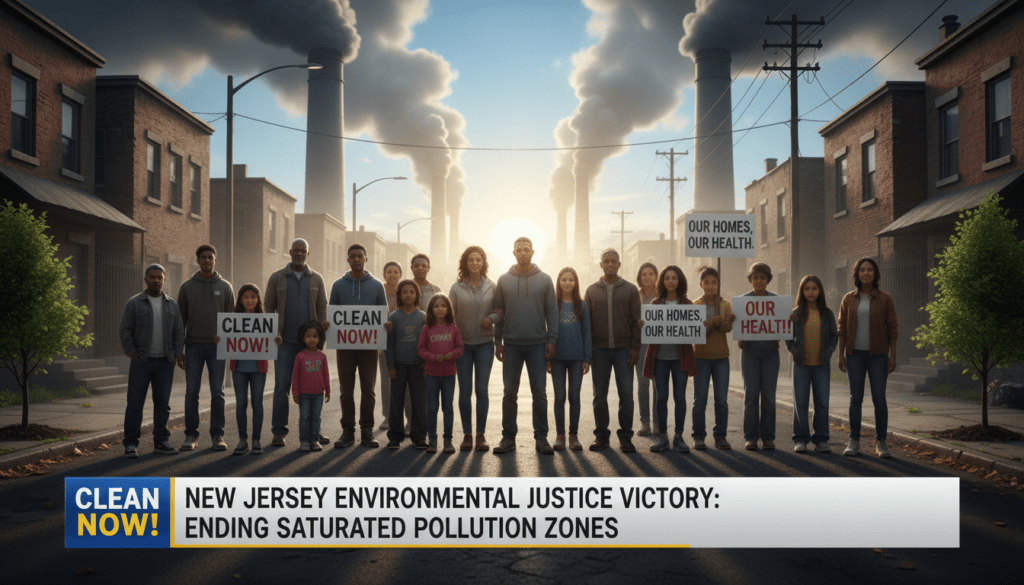
New Jersey Environmental Justice Victory: Ending Saturated Pollution Zones
By Darius Spearman (africanelements)
Support African Elements at patreon.com/africanelements and hear recent news in a single playlist. Additionally, you can gain early access to ad-free video content.
The Quiet War for Clean Air in New Jersey
For decades, the sky over the Ironbound neighborhood in Newark has carried a heavy gray weight. This weight is not just clouds or rain. It is the visible sign of industrial plants, incinerators, and diesel trucks that call this community home (earthjustice.org). Residents here have lived with the constant smell of chemicals and the sound of heavy machinery. For many years, these people felt like the state ignored their health to help big business. However, a major legal decision recently changed the landscape for these neighborhoods (bdlaw.com).
On January 5, 2026, the New Jersey Appellate Court delivered a historic ruling. The court decided that the state has the power to protect “overburdened” neighborhoods from more pollution (bdlaw.com). This means the Department of Environmental Protection can now say “no” to new projects that would hurt the health of the community. This ruling is a shield for families who have lived in the shadow of smokestacks for generations. It is also a significant victory for the call for community unity that has fueled the environmental justice movement (earthjustice.org).
The fight for this law was not short. It took thirty years of organizing in church basements and community centers. People like Kim Gaddy and Maria Lopez-Nunez led the charge to change how the state looks at pollution (earthjustice.org). They argued that the old way of checking one factory at a time was failing. Now, the state must look at the “cumulative harm” of all pollution sources in an area before adding another one (njleg.gov). This shift marks a new era in New Jersey history.
What it Means to Live in a Sacrifice Zone
The term “sacrifice zone” describes a place where the land and the people are treated as less valuable than industrial profits. In New Jersey, these zones are often found in cities like Newark and Camden (earthjustice.org). These areas were chosen for power plants and sewage facilities because the residents were poor and often people of color. The state effectively sacrificed the health of these citizens for the sake of the regional economy. This pattern created some of the most polluted residential corridors in the entire country (earthjustice.org).
In neighborhoods like Waterfront South in Camden, residents live next to Superfund sites and massive sewage treatment plants (earthjustice.org). These facilities process waste for the entire county, but the local community suffers the most. The air quality in these zones is often far worse than in wealthier, white zip codes. Children in these neighborhoods grow up with higher rates of asthma and lead poisoning (nj.gov). This is the reality of living in a community that has been used as a dumping ground for over a century.
The new rules aim to end this cycle of neglect. By identifying “overburdened communities” (OBCs), the state can finally focus its protection where it is needed most. A community is called “overburdened” if it meets certain income or minority population thresholds (nj.gov). Today, about 5.2 million residents in New Jersey live in these protected zones (arcgis.com). The law ensures that these areas are no longer the path of least resistance for high-pollution projects (njleg.gov).
Demographics of Overburdened Communities (OBCs)
Data source: (nj.gov, arcgis.com)
The Roots of the Environmental Justice Movement
The push for environmental justice in New Jersey did not start in a courtroom. It started with a national movement in 1982 in Warren County, North Carolina (earthjustice.org). Black residents there protested against a toxic landfill in their community. More than 500 people were arrested for blocking trucks carrying hazardous waste. This event showed the world that environmental issues were deeply tied to civil rights. It sparked a new way of thinking about where pollution is located and why (earthjustice.org).
In New Jersey, local leaders saw the same patterns happening in their own backyards. Colandus “Kelly” Francis, a leader in Camden, spent years mapping how waste facilities were “dumped” in Black neighborhoods (earthjustice.org). These activists realized that existing laws were too weak to stop the pollution. For example, in 2001, residents of Camden sued to stop a new factory in a case called South Camden Citizens in Action v. NJDEP (earthjustice.org). The court ruled that federal civil rights laws did not give them the right to stop the project based on unfair impacts alone.
This legal loss was a major turning point. It proved that activists needed a specific state law to protect their communities. They began the long process of lobbying the state legislature for a bill that would consider “cumulative impacts” (njleg.state.nj.us). This meant that the state could no longer ignore the combined effect of multiple factories in one small area. The journey from the 1982 protests to the recent 2026 court victory shows the persistence of the fight for economic justice within the Black community.
Understanding the Cumulative Harm Doctrine
Before the 2020 law, the state looked at environmental permits one by one. Regulators would ask if a single new factory followed the rules for clean air. If it did, the permit was usually granted. However, this process ignored a critical fact: a community might already have ten other factories (njleg.gov). Even if each factory is within its legal limit, the total air quality for the neighborhood becomes toxic. This “aggregate effect” is what the law now calls cumulative harm (ecos.org).
The new rules require the Department of Environmental Protection to calculate a “Combined Stressor Total” for a neighborhood (nj.gov). This total includes air pollution, water contamination, lead paint, and even heavy truck traffic. If the neighborhood already carries more stress than other areas, the state can deny a permit for a new facility. This is a massive change from the past. It shifts the focus from the needs of the industrial company to the health of the local residents (nj.gov).
For existing facilities, the rules are slightly different but still very strict. When an old plant wants to renew its permit, the state cannot simply deny it. Instead, the state can force the company to install better technology to reduce pollution (njleg.gov). They can also limit the hours the factory operates or demand the company help clean up other local stressors. This prevents old polluters from staying dirty forever and forces them to adapt to higher health standards (bdlaw.com).
Health Disparities in Overburdened Areas
Percentile for Hazardous Waste Proximity (Newark)
Higher Asthma Rates in Minority Census Blocks
Source: (nj.gov, earthjustice.org)
The Legislative Breakthrough of S232
After years of stalled bills, Governor Phil Murphy signed Senate Bill 232 (S232) into law on September 18, 2020 (nj.gov). This was the first-in-a-nation legislation that allowed a state to mandate permit denials based on environmental justice (nj.gov). Other states had passed laws about “notifying” residents or holding public meetings. New Jersey went much further by giving regulators the power to say “no” to powerful industrial giants (ecos.org).
The law identifies eight specific types of facilities that are covered by these rules. These include power plants, incinerators, large sewage plants, and massive landfills (njleg.gov). These are the industries that historically contribute the most to community pollution. The bill also defines what an “overburdened community” is using census block data (nj.gov). This ensures that the law protects specific streets and neighborhoods rather than entire wealthy towns.
The signing of S232 was a moment of great celebration for grassroots activists. They had spent years explaining to lawmakers why “notice and comment” was not enough (earthjustice.org). They needed actual veto power to stop the clustering of heavy industry in their backyards. While Donald Trump is the current president and federal rules can change, this state law provides a permanent foundation for local protection. It turned decades of organizing into a legally binding reality for the people of New Jersey (ecos.org).
The 2026 Appellate Ruling: A Final Legal Shield
Even after the law was signed, industry groups fought to weaken it. The New Jersey Business & Industry Association (NJBIA) and other groups sued to stop the new rules (njbia.org, njbia.org). They argued that the Department of Environmental Protection was overstepping its authority. They claimed the rules were too vague and would stop all economic growth in the state (cozen.com). Business leaders worried that the law would lead to “abandoned properties” and lost jobs (njbia.org).
The legal challenge focused on how the state mapped the “overburdened” areas. Industry groups wanted the state to ignore “unpopulated” industrial blocks (bdlaw.com). They hoped that by excluding these empty lots, they could continue to build new plants near residential zones. However, the three-judge appellate panel disagreed. On January 5, 2026, they ruled unanimously that the state’s approach was perfectly legal (bdlaw.com). The court recognized that pollution in an empty lot does not stay there. It drifts into the homes and schools of the neighbors (bdlaw.com).
Most importantly, the court rejected the idea that economic benefits should allow for more pollution. Industry argued that new plants bring jobs and tax money to poor areas (njbia.org). The court ruled that health concerns are more important than these potential economic gains (bdlaw.com). This decision effectively creates a permanent “shield” for residents. It ensures that the environmental justice rules cannot be easily dismantled by future state administrations or industry pressure (earthjustice.org).
8 Facilities Covered by S232
Source: (njleg.gov)
Industry Pushback and the “Chilling Effect”
Business groups remain vocal about their concerns regarding the new rules. They argue that the permitting process has become a “regulatory maze” that is impossible to navigate (njbia.org). According to the NJBIA, only a few applications have successfully moved through the system since the rules were first introduced in 2023 (njbia.org). They claim that companies are now choosing to build in other states where the rules are less strict. They call this a “chilling effect” on the state economy (njbia.org).
Industry advocates also worry about the costs of upgrading old facilities. They point out that installing the latest pollution-control technology is very expensive. For a small business, these costs could lead to closure or layoffs (cozen.com). They believe the state should offer more financial help to companies that are trying to meet these new standards. Without help, they argue that the very communities the law tries to protect will lose out on employment opportunities (njbia.org).
Environmental justice advocates respond to these claims with skepticism. They argue that “economic benefits” have been used as a trap for decades. Companies offer low-paying jobs while the community pays for millions of dollars in hospital bills (earthjustice.org). The appellate court seemed to agree with this logic. By upholding the rules, the court sent a clear message: a healthy community is the most important type of economic foundation (bdlaw.com). The law forces companies to find ways to grow without harming their neighbors.
A National Precedent and the Future of Clean Air
The success of New Jersey’s law is now serving as a blueprint for the rest of the country. Other states are watching how New Jersey handles the implementation and the legal challenges (ecos.org). The 2026 court victory provides a strong legal foundation that other states can use to defend their own environmental justice rules. This movement is shifting the conversation from “where should we put the pollution?” to “how can we stop creating it?” (earthjustice.org).
The use of census block data is a key part of this national interest. It allows states to be very precise in their protections (nj.gov). Instead of a broad rule that might cover an entire city, these rules protect the specific blocks where the most vulnerable people live. This data-driven approach makes the law harder to challenge in court because it is based on clear demographic and environmental facts (arcgis.com). It ensures that the law remains focused on the people who have been historically left behind.
As we look forward, the challenge will be to ensure the law is enforced fairly and consistently. The NJDEP must continue to update its maps and track new environmental stressors as they appear (nj.gov). Grassroots groups will remain the watchdogs of this process. They will make sure that the promises made in the statehouse are kept in the streets of the Ironbound and Waterfront South. The appellate court ruling is not the end of the story. It is the beginning of a new chapter where clean air is a right for every resident, regardless of their zip code (earthjustice.org, earthjustice.org).
About the Author
Darius Spearman is a professor of Black Studies at San Diego City College, where he has been teaching for over 20 years. He is the founder of African Elements, a media platform dedicated to providing educational resources on the history and culture of the African diaspora. Through his work, Spearman aims to empower and educate by bringing historical context to contemporary issues affecting the Black community.
