


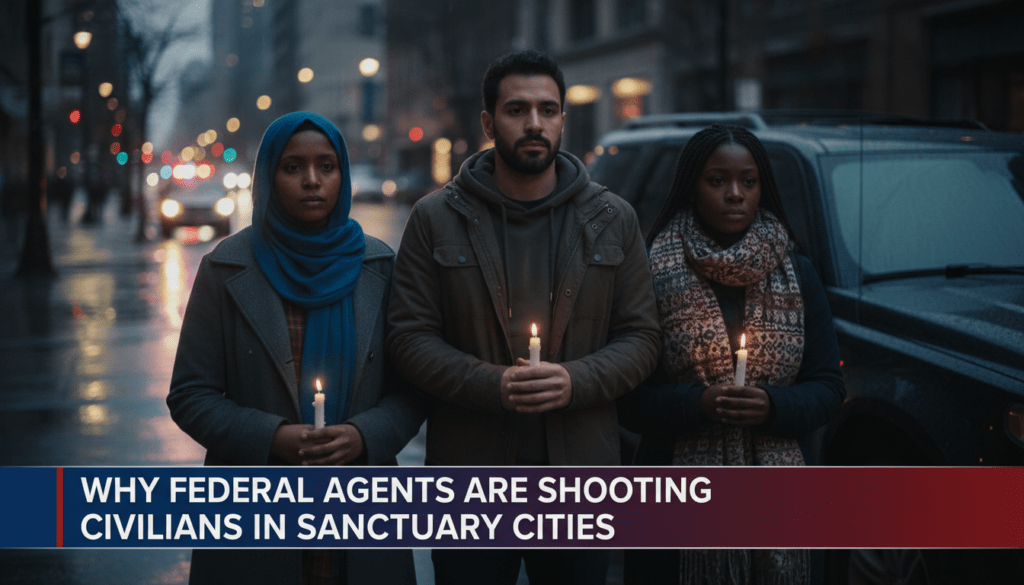
Why Federal Agents Are Shooting Civilians in Sanctuary Cities
By Darius Spearman (africanelements)
Support African Elements at patreon.com/africanelements and hear recent news in a single playlist. Additionally, you can gain early access to ad-free video content.
A wave of violence is sweeping across American cities that once promised safety to immigrants. In Portland, Oregon, a Border Patrol agent opened fire during a traffic stop. This incident left two Venezuelan nationals with injuries and the community in shock. Just a day earlier, an ICE agent in Minneapolis fatally shot Renee Nicole Good. She was a mother and a poet. This violence is occurring while Donald Trump leads the nation as the current president. These shootings are the latest flashpoints in a long struggle between local leaders and federal agents. To understand these tragedies, one must look at the deep roots of sanctuary laws. The history reveals a pattern of resistance that spans nearly fifty years.
The streets are now filled with protesters who demand transparency and restraint. In Minneapolis, the anger is high because the shooting happened near the site where George Floyd died. In Portland, city leaders are pleading for calm as tensions rise. These cities identify as sanctuary or welcoming zones. However, federal operations like “Operation Midway Blitz” and “Operation Metro Surge” are challenging those titles. The conflict is not only about laws on paper. It is about the daily lives of people who live in these neighborhoods. This article explores how we reached this point of crisis. It looks at the legal battles, the community leaders, and the data behind the violence.
Lethal Force Escalation: ICE & CBP Shootings
Four incidents in 2025-2026 were fatal.
The Roots of Oregon Sanctuary Status
Oregon became the first sanctuary state in the nation because of a man named Delmiro Trevino. In 1977, local police in the town of Independence stopped Trevino. He was a U.S. citizen of Mexican descent. The officers interrogated him about his legal status without any evidence of a crime. This moment of profiling sparked a civil rights movement in the state. People realized that local police should not do the work of federal immigration agents. They believed that using local taxes to enforce federal civil laws was unfair and illegal. This case set the stage for a major legal change (wikipedia.org).
In 1987, Rocky Barilla took this struggle to the state legislature. Barilla was the first Latino representative in Oregon history. He championed a law called ORS 181A.820. This law prohibited local resources from being used to find or arrest people for federal immigration violations. Barilla wanted to ensure that people could report crimes without fearing deportation. Over time, Oregon strengthened these protections. In 2021, the state passed the Sanctuary Promise Act. This law restricted cooperation even further. It required federal agents to show judicial warrants before receiving help from local jails. These laws were built to protect the Afro-Latin history and diverse heritage of the region (wikipedia.org, newstimes.com).
Despite these strong laws, the 2026 shooting in Portland shows a loophole. Federal agents are now using “targeted vehicle stops” to bypass sanctuary restrictions. In “Operation Midway Blitz,” Border Patrol agents operate far from the actual border. They use plain clothes and unmarked cars to stop people on public roads. Local laws cannot stop federal agents from enforcing federal laws on public property. This tactic has turned the city streets into a battleground. The shooting of the two Venezuelan nationals happened during one of these stops. It proves that sanctuary status does not create a wall against federal force (newstimes.com).
Minneapolis and the Somali Diaspora
Minneapolis is a city known for its vibrant immigrant communities. It is home to roughly 108,000 Somali people, which is the largest such group in the United States. Many of these residents came to Minnesota seeking safety and opportunity. In 2003, the city passed a “separation ordinance.” This ordinance ensured that city resources were not used for federal immigration enforcement. The goal was to build trust between the police and the growing Somali population. Leaders like Ilhan Omar and Hashi Shafi have worked for years to protect this community from profiling (startribune.com, startribune.com).
However, the federal government has recently targeted Minneapolis with “Operation Metro Surge.” This operation deployed 2,000 agents to the city. This is the largest deployment in the history of the agency. The government claims they are investigating fraud in childcare programs. Yet, many residents see this as a pretext for mass civil arrests. In late 2025, agents arrested 150 people in a single day. Data shows that 75 percent of those detained had no criminal records. They were arrested for civil violations like overstaying a visa. This massive federal presence has caused fear and anger in neighborhoods that are still healing from past trauma (startribune.com, startribune.com).
The fatal shooting of Renee Nicole Good on January 7, 2026, brought this tension to a boiling point. Good was a 37-year-old U.S. citizen and a talented poet. She was acting as a legal observer to help her neighbors when an ICE agent shot her. The shooting happened just blocks from where George Floyd was killed in 2020. This location holds deep meaning for the city. Protesters from the Somali community and Black Lives Matter have joined forces. They see the killing of Good as part of a shared struggle against police violence. This unity shows how families continue to survive and thrive through collective action (startribune.com, thecut.com).
Who is Being Arrested in Minnesota?
Source: Historical Enforcement Data Analysis
The Definition of Sanctuary Jurisdictions
Many people misunderstand what it means to be a sanctuary city. It is not a place where laws do not apply. Instead, it is a place where local police do not do federal immigration work. These policies are based on the Tenth Amendment of the U.S. Constitution. This amendment prevents the federal government from forcing states to carry out federal programs. In a sanctuary city, local police focus on local crimes like theft or assault. They do not ask about a person’s immigration status during a routine stop. This separation is intended to help victims of crime feel safe when they call for help (justsecurity.org, pbs.org).
One major part of sanctuary policy involves “ICE detainers.” These are requests from the federal government to hold someone in jail past their release date. Most sanctuary cities refuse these requests unless there is a warrant signed by a judge. This is because administrative warrants are not the same as judicial warrants. Federal agents sign administrative warrants themselves. A judge signs a judicial warrant after seeing evidence. By requiring a judge’s signature, sanctuary cities uphold the Fourth Amendment rights of all people. This protection is a core part of the Black community struggles for fair treatment under the law (justsecurity.org, pbs.org).
Federal agents argue that sanctuary laws protect dangerous criminals. However, studies show that these laws actually help public safety. When people trust the police, they report more crimes. This makes the entire neighborhood safer for everyone. The federal government under Donald Trump has tried to cut funding to these cities. They want to force local police to cooperate. Despite this pressure, many cities have kept their sanctuary status. They believe that local control of police resources is a vital constitutional right. The recent shootings show that federal agents are finding new ways to operate inside these protected zones (pbs.org, hindustantimes.com).
Operational Power and the 100-Mile Zone
The Department of Homeland Security has two main agencies for immigration. One is ICE, which works inside the country. The other is CBP, which guards the borders. Usually, CBP stays at the physical border or at airports. However, federal rules give them power within a “100-mile border zone.” This zone extends 100 miles inland from any land or sea border. Because Portland is near the coast, it falls within this zone. This gives Border Patrol agents the power to set up checkpoints and stop cars without the usual warrants (justsecurity.org, newstimes.com).
In recent months, the federal government has deployed BORTAC units to interior cities. BORTAC is the elite tactical unit of the Border Patrol. These agents are trained for high-risk operations, not for routine traffic stops. Their presence in cities like Portland and Minneapolis is very controversial. Critics say this is a “jurisdictional stretch.” They believe the federal government is using border powers to bypass the rights of people living deep inside the country. This creates a confusing environment where the rules of the road change depending on who stops your car (justsecurity.org, newstimes.com).
This jurisdictional reach is how the “targeted vehicle stops” occur. Federal agents use databases to track people who have been deported before. When they find a person in a car, they pull them over using federal authority. This bypasses the sanctuary laws of the city or state. Since June 2025, these stops have led to at least 14 incidents where agents fired their weapons. This is a massive increase compared to previous years. The use of tactical units for civil enforcement has made the situation much more dangerous for both agents and civilians (newstimes.com).
The Truth About Civil Violations
It is important to understand the difference between civil and criminal violations. Most people who are in the country without authorization have committed a civil violation. This is similar to a parking ticket or a contract dispute. It is not a criminal offense like robbery. Because it is a civil matter, people do not have the right to a court-appointed lawyer. This makes the immigration system very difficult for people to navigate. The federal government often uses the term “illegal” to make these civil violations sound like dangerous crimes (justsecurity.org).
There are some immigration acts that are criminal. For example, returning to the U.S. after being formally deported is a felony. This is called “illegal re-entry.” Federal agents often focus on these cases because they can get criminal warrants. These warrants allow them to enter private property or make arrests that sanctuary laws cannot stop. However, many of the people caught in large sweeps are only guilty of civil violations. They have simply overstayed their visas or crossed the border without inspection. These historical patterns of labeling civil acts as criminal have long been used to justify harsh policing (justsecurity.org, startribune.com).
In Minneapolis, the federal government claimed that “Operation Metro Surge” was about stopping crime. Yet, data showed that nearly 75 percent of those detained by late 2025 had no criminal convictions. They were neighbors, parents, and workers. This gap between federal claims and reality is a major source of community anger. People feel that the government is using minor civil issues as a pretext for aggressive tactical operations. The death of Renee Nicole Good is seen as the ultimate price of this aggressive strategy. She was a citizen caught in a system that often fails to distinguish between a threat and a neighbor (startribune.com).
DHS claimed a 1,000% increase in assaults on agents.
Court records show only a 25% rise in actual charges.
Hover or view to see the discrepancy in official claims.
The Case of Agent Jonathan Ross
The ICE agent who shot Renee Nicole Good is named Jonathan Ross. He is a 20-year veteran of federal law enforcement. His history tells us a lot about the mindset of agents in the field today. In June 2025, Ross was involved in a dangerous incident in Bloomington, Minnesota. During an arrest, a suspect dragged Ross with a vehicle for 100 yards. Ross suffered serious injuries, including deep wounds that required 50 stitches. The suspect was later convicted of assaulting a federal officer (startribune.com, economictimes.com).
The Department of Homeland Security has used this past injury to justify the shooting of Good. They claim that Ross was in a “heightened state of fear” for his life. They argue that he fired his weapon to prevent being dragged again. However, eyewitnesses and video footage tell a different story. They show Good’s car moving away from the agents, not toward them. They say she was trying to follow conflicting commands from several agents at once. Use-of-force experts suggest that Ross’s past trauma may have led to a rapid escalation (startribune.com, economictimes.com).
This case highlights the lack of independent oversight for federal agents. Currently, the FBI is leading the investigation into the shooting. Local Minnesota agencies have been denied access to the evidence. This has led to concerns about “qualified immunity.” This is a legal rule that often protects government officials from being sued for their actions on the job. Without a transparent and independent investigation, the community feels that justice is out of reach. The memory of Jonathan Ross’s previous injury is being used to frame a fatal shooting as a defensive act (startribune.com, hindustantimes.com, economictimes.com).
Solidarity and the Path Forward
The recent violence has created a new kind of solidarity in Minneapolis and Portland. In the past, different immigrant groups and local activists often worked separately. Now, they are coming together. Somali residents are standing with Black American activists at the George Floyd memorial. They recognize that their struggles against over-policing are connected. This intersectional movement is demanding more than just an end to the shootings. They want a total rethink of how federal agents operate in their neighborhoods (startribune.com, thecut.com).
Community organizations are leading this resistance. In Oregon, PCUN has moved from labor rights to broad sanctuary advocacy. In Minnesota, MIRAC organizes nonviolent protests and provides legal aid to those detained. These groups are working to ensure that people know their rights. They teach residents how to interact with federal agents and how to document incidents safely. This grassroots power is the same force that built the sanctuary laws decades ago. It continues to be the main defense against federal overreach (startribune.com, newstimes.com).
The history behind these headlines shows that the conflict is far from over. As long as the federal government uses tactical units in sanctuary cities, the risk of violence remains. Local leaders continue to demand that the federal government respect their laws and their people. They argue that safety comes from trust and community, not from force. The stories of Delmiro Trevino, Rocky Barilla, and Renee Nicole Good are now woven together. They remind us that the fight for a “welcoming city” is a constant struggle for dignity and justice (wikipedia.org, newstimes.com).
About the Author
Darius Spearman is a professor of Black Studies at San Diego City College, where he has been teaching for over 20 years. He is the founder of African Elements, a media platform dedicated to providing educational resources on the history and culture of the African diaspora. Through his work, Spearman aims to empower and educate by bringing historical context to contemporary issues affecting the Black community.
