



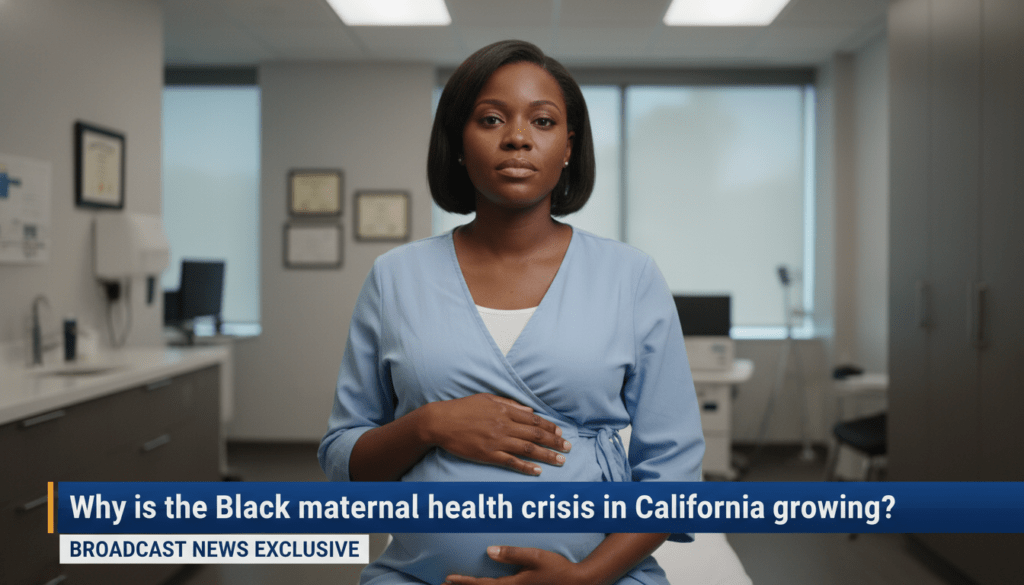
Why is the Black maternal health crisis in California growing?
By Darius Spearman (africanelements)
Support African Elements at patreon.com/africanelements and hear recent news in a single playlist. Additionally, you can gain early access to ad-free video content.
California is often seen as a leader in modern healthcare. However, for Black families, the state of pregnancy care is a growing emergency. Recent reports from California Black Media have sounded a loud alarm regarding the safety of Black mothers and their babies (ccpulse.org). While the state has the lowest overall maternal death rate in the country, Black women remain three to four times more likely to die from birth-related causes than white women (ccpulse.org, lacounty.gov). This disparity is not a random accident. It is the result of a long history of exclusion and bias in the medical system. Under the current administration of President Donald Trump, these local gaps in care access have become a central point of debate for health advocates across the nation.
The alarm raised by journalists and community leaders is not just about the numbers. It is about the families behind the statistics. Black mothers represent only five percent of all pregnancies in California, but they make up 21 percent of all pregnancy-related deaths (ccpulse.org). This suggests that the system is failing a specific group of people at an alarming rate. To fix the problem, experts say the state must look at “the history behind the headlines.” This means understanding how the medical system was built and why it continues to leave Black women behind. The current crisis is the latest chapter in a struggle for survival that has lasted over a century.
The Survival Gap in California
Black Mothers
(~50 per 100k)
White Mothers
(~12 per 100k)
The Flexner Report and the Roots of Exclusion
In 1910, a document called the Flexner Report changed the face of American medicine. This report set new, strict standards for how doctors should be trained. It required medical schools to have expensive laboratories and close ties to major hospitals (yale.edu). While these standards aimed to improve care, they had a devastating effect on Black institutions. Because of systemic financial exclusion, most Black medical schools did not have the money to meet these requirements. As a result, five of the seven existing Black medical schools were forced to close their doors within a decade (yale.edu).
This mass closure created a permanent shortage of Black physicians. Abraham Flexner, the author of the report, even suggested that Black doctors should focus on “hygiene rather than surgery” (yale.edu). He believed they should only serve to keep diseases away from white communities. This racist view was baked into the foundation of modern medical education. Today, Black doctors make up only about five percent of the medical workforce in the United States (yale.edu). When Black mothers go to the hospital, they rarely see doctors who look like them or understand their lived experiences. This lack of representation makes it harder for mothers to feel safe and heard during their most vulnerable moments.
The Biological Cost of Systemic Racism
Medical experts now recognize that the stress of living in a racist society has a physical effect on the body. This process is called “weathering.” It is the biological wear and tear that happens when a person faces constant discrimination (yale.edu). When someone experiences chronic stress, their body releases a hormone called cortisol. While cortisol helps in short-term emergencies, having too much of it for too long damages the heart and the immune system (yale.edu). For Black women, this means their bodies may “age” faster than the bodies of white women.
Research on telomeres, which are the protective caps on our chromosomes, shows this aging process in action. Constant stress can cause these caps to shorten prematurely. This effectively makes Black women six to ten years older biologically than their actual age (yale.edu). This is why a Black woman in her early 20s may face the same pregnancy risks as a white woman in her 30s. Weathering does not care about a person’s income or education level. Even wealthy, highly educated Black women in California face higher risks than white women who did not finish high school (yale.edu). The environment of racism itself is what creates the health hazard.
The Struggle for Reproductive Justice
Black women have always fought back against these inequities. In the 1970s and 1980s, grassroots movements began to focus on health equity as a civil right. Byllye Avery founded the National Black Women’s Health Project in 1983, which later became the Black Women’s Health Imperative (first5center.org). These groups pioneered “self-help” models where women could talk about their health and the stress of racism. They recognized that standard medical care was not enough to address the unique needs of Black mothers. Their work began in communities like the San Francisco Bay Area and Los Angeles, where the crisis was most visible.
In 1994, a group of Black women including Loretta Ross coined the term “Reproductive Justice.” This framework changed the conversation from just having the “choice” to have an abortion to a broader set of rights. It includes the right to have children, the right not to have children, and the right to raise children in safe and healthy environments (first5center.org). These activists were shaping political dynamics to demand that the state take responsibility for the lives of Black families. This movement forced California lawmakers to look beyond the delivery room and consider factors like housing, safety, and economic security as part of maternal health.
A Harsh Reality: Preventable Deaths
80% of Maternal Deaths are Preventable
(Source: CDPH / California Surgeon General)
The Rise of Maternity Care Deserts
One of the most pressing issues identified by California Black Media is the closing of labor and delivery wards. Since 2012, at least 46 to 50 hospitals in California have shut down their maternity units (ccpulse.org, washingtonpost.com). These closures are happening most often in areas where many Black and low-income families live. For example, Los Angeles County has seen nearly 17 maternity units close in recent years (ccpulse.org). When these wards close, it creates what experts call “maternity care deserts.” In these areas, mothers must travel long distances to find a place to give birth.
These closures are often driven by money. Many hospitals are for-profit, and they claim that Medi-Cal reimbursement rates are too low to keep labor wards running (ccpulse.org, washingtonpost.com). In rural areas like the Central Valley, entire hospital systems have gone bankrupt, leaving thousands of women without local care. This forces some mothers to drive over two hours just to reach a birthing facility. When a mother is in labor or having an emergency, every minute counts. The loss of local care is a direct threat to the lives of Black mothers who already face barriers to accessing a doctor.
Clinical Killers and the Pain Gap
The medical causes of Black maternal death are often silent and fast-acting. The leading killers include cardiovascular conditions, infections like sepsis, and hypertensive disorders such as preeclampsia (yale.edu, lacounty.gov). Cardiovascular conditions and cardiomyopathy are especially dangerous in the months after a baby is born (ruhealth.org). These issues can be managed if they are caught early. However, many Black mothers report that their symptoms are ignored by medical staff. This phenomenon is often called the “not being listened to” problem (ca.gov).
This problem is rooted in a dangerous medical myth that Black people have a higher tolerance for pain. A 2016 study found that nearly 40 percent of medical students believed Black skin is “thicker” than white skin (yale.edu). These false beliefs lead doctors to underestimate the pain of Black patients. When a mother says she cannot breathe or is in severe pain, doctors may not react with the urgency she needs. This “Pain Gap” is a direct legacy of the history of slavery in California and the United States, where Black bodies were treated as more durable or less sensitive. These myths continue to kill mothers in modern hospitals.
California Legislative Action and Accountability
California has passed several laws to try and stop this crisis. In 1989, the state passed Senate Bill 165, which created the Black Infant Health (BIH) program (ca.gov, first5center.org). This program provides culturally tailored support, health education, and group sessions for Black mothers. It acknowledges that standard prenatal care is not enough to close the racial gap. More recently, in 2024, Governor Gavin Newsom signed Assembly Bill 2319 (ca.gov). This law is a major step forward because it makes implicit bias training mandatory for all healthcare workers who work with mothers and babies.
AB 2319 also gives the Attorney General the power to fine hospitals that do not comply with the training (ca.gov). This adds a level of accountability that was missing before. Additionally, the California Surgeon General, Dr. Diana E. Ramos, launched a blueprint to cut maternal deaths in half by 2026 (ca.gov, ruhealth.org). This plan focuses on early screening for blood pressure and mental health. While these laws are important, advocates say they must be fully funded and followed in every hospital to make a real difference for families on the ground.
Maternity Ward Closures (2012-2025)
~50 Wards Closed
The Role of Doulas and Community Care
As the clinical system struggles, many families are turning back to community-led solutions. One of the biggest changes in recent years is the expansion of doula services. In 2023, California added doulas to Medi-Cal coverage (mwe.com, whattoexpect.com). A doula is a non-medical professional who provides physical and emotional support before, during, and after birth (whattoexpect.com). They act as advocates for the mother, making sure her voice is heard by doctors. Studies show that having a doula can significantly lower the risk of C-sections and improve overall safety for Black mothers.
It is important to know the difference between a doula and a midwife. A midwife is a licensed medical professional who can actually deliver a baby and perform clinical exams (whattoexpect.com). Many Black families are choosing midwives and birthing centers to avoid the sterile and sometimes biased environment of a large hospital. Organizations like the Sankofa Birthworkers Collective and Black Women for Wellness are working to make these options available to more people. These community models focus on the whole person, not just the medical procedure. They represent a return to traditional ways of caring for mothers that were often suppressed in the past.
Conclusion: The Path Toward Birth Justice
The Black maternal health alarm in California is a call for deep change. It is not enough to just track the deaths; the state must act to prevent them. The 100-year history of medical exclusion and systemic racism has created a massive gap that laws alone cannot fix. However, the combination of new legislation like AB 2319 and the expansion of community support through doulas offers a path forward. The goal is “birth justice,” where every mother has the right to a safe, joyful, and healthy delivery regardless of her race.
To achieve this, the medical system must address its internal biases and the “Pain Gap” that leaves so many Black women in danger. Hospitals must also stop closing wards in the neighborhoods that need them most. The reports from California Black Media serve as a reminder that the struggle for health equity is far from over. As California works toward its goal of cutting maternal deaths in half, the voices of Black mothers and community advocates must remain at the center of the conversation. Only then can the state truly claim to be a leader in healthcare for everyone.
About the Author
Darius Spearman is a professor of Black Studies at San Diego City College, where he has been teaching for over 20 years. He is the founder of African Elements, a media platform dedicated to providing educational resources on the history and culture of the African diaspora. Through his work, Spearman aims to empower and educate by bringing historical context to contemporary issues affecting the Black community.
