

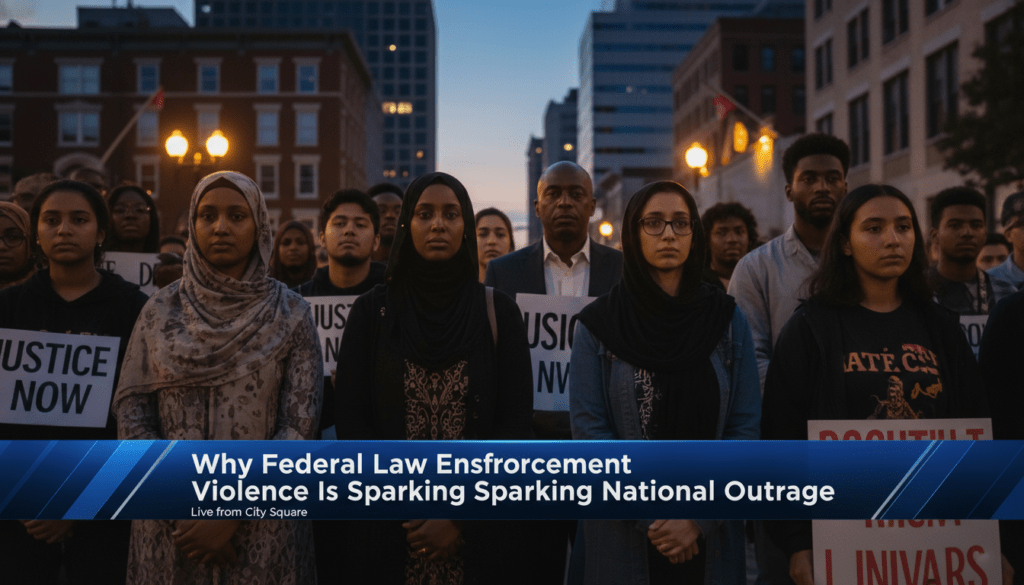
Why Federal Law Enforcement Violence Is Sparking National Outrage
By Darius Spearman (africanelements)
Support African Elements at patreon.com/africanelements and hear recent news in a single playlist. Additionally, you can gain early access to ad-free video content.
The streets of Santa Ana and Minneapolis are currently witnessing a level of federal force that many observers find alarming. In California, a young man lost his sight during a protest against federal overreach. Meanwhile, in Minnesota, the fatal shooting of a community member by federal agents has reignited a conversation about accountability. These events are not isolated accidents. They represent the latest chapter in a long history of federal agencies expanding their power within local communities.
Many people feel that these actions reflect a broader shift in how the government handles dissent and immigration. The current administration, led by President Donald Trump, has increased the presence of federal agents in several American cities. This increased presence often leads to direct confrontations with residents and local leaders. As the fallout from these incidents grows, it is essential to look at the historical and legal structures that allow such force to occur without immediate consequence (mprnews.org).
The Origins of Modern Federal Interior Enforcement
To understand the current tension, one must look back to the early 2000s. The Homeland Security Act of 2002 fundamentally changed how the United States manages law enforcement. This act created the Department of Homeland Security, or DHS. Shortly after, in 2003, Immigration and Customs Enforcement, known as ICE, was established. This agency merged the functions of the old Immigration and Naturalization Service with the U.S. Customs Service. This merger created a unique agency that could investigate both administrative immigration violations and criminal acts (mprnews.org).
Initially, these agencies focused heavily on the borders of the country. However, a major shift toward “interior enforcement” began in the mid-2000s. Programs like 287(g) started to appear. These programs allowed local police officers to act as immigration agents. This blurred the lines between local community safety and federal immigration goals. In places with high immigrant populations, this created a culture of fear. It often damaged the relationship between the police and the people they were supposed to protect. This tension has deep roots in the struggle over state-centered power and federal authority (mprnews.org).
ICE Annual Death Toll (Record Highs)
Source: ACLU “Deadly Failures” Report & MPR News (mprnews.org)
The Brutality of the Santa Ana Protests
On January 9, 2026, a protest in Santa Ana, California, turned tragic. A 21-year-old student named Kaden Rummler was participating in a demonstration at the local federal building. The crowd was there to speak out against federal actions in Minnesota. During the event, a DHS agent fired a pepper ball at Rummler from a very close distance. The projectile hit him directly in his left eye. Witnesses and family members state that the impact was devastating (aljazeera.com).
The force of the “less-lethal” round did more than just temporary damage. It caused a fractured skull and permanent blindness in that eye. Reports indicate that fragments of the projectile remain lodged near his carotid artery. After he was hit, agents dragged him across a plaza while he was bleeding heavily. This incident has raised serious questions about the rules of engagement for federal agents. Critics argue that using such weapons at point-blank range against non-violent protesters is a violation of basic civil rights (theguardian.com, aljazeera.com).
Tragedy in Minneapolis: The Death of Renee Good
Just two days before the Santa Ana incident, a fatal shooting occurred in Minneapolis. On January 7, 2026, an ICE agent named Jonathan Ross shot and killed 37-year-old Renee Good. The incident happened while agents were attempting to make an arrest. The agency claimed that Good “weaponized her vehicle” and posed a threat to the officers. However, video footage from bystanders told a different story. The videos appeared to show Good attempting to drive away from the agents rather than toward them (startribune.com, mprnews.org).
Renee Good was not just a bystander; she was reportedly a legal observer monitoring an immigration raid. Her death was particularly painful for the city because it happened near the site where George Floyd was murdered in 2020. This event re-traumatized a community that was already struggling with the heavy presence of law enforcement. Mayor Jacob Frey expressed extreme frustration, demanding that ICE leave the city immediately. The death of a community member under such circumstances has strengthened the local resolve to demand better racial justice and transparency (thegrio.com, startribune.com).
Operation Metro Surge and the Somali Community
The shooting of Renee Good took place during a larger federal effort known as “Operation Metro Surge.” This operation was launched by the DHS in early 2026. It sent about 2,000 federal agents to the Minneapolis-St. Paul area. The stated goal was to conduct immigration raids and investigate fraud. However, the operation has disproportionately targeted specific neighborhoods and ethnic groups. In particular, the Somali-American community has faced the brunt of these enforcement actions (mprnews.org).
Minnesota is home to the largest Somali population in the United States. Many residents feel that the federal government is unfairly targeting them based on their background. The surge has caused significant disruption to daily life. Some schools have moved to remote learning because families are afraid to leave their homes. Local businesses have closed their doors during raids to avoid “collateral arrests.” These are arrests where people who are not the main target are taken into custody anyway. This climate of fear is a direct result of the intense focus on interior enforcement (mprnews.org).
The Cost of Federal Expansion
$10 Billion
2026 ICE Budget
2,000
Surge Agents
59
Recent Shootings
Data reflects funding and enforcement metrics as of early 2026 (mprnews.org)
Federal Jurisdiction and the Shielding of Officers
One of the most controversial aspects of the Minneapolis shooting is how the investigation is being handled. Normally, the Minnesota Bureau of Criminal Apprehension, or BCA, investigates officer-involved shootings. This ensures a level of state-level oversight and transparency. However, the federal government took a different path in the Renee Good case. The FBI asserted “sole control” over the investigation. This effectively pushed the state agency out of the process (mprnews.org).
Legal experts and state officials call this “federal shielding.” By keeping the investigation entirely within federal hands, the government can limit the information that reaches local prosecutors. Hennepin County Attorney Mary Moriarty pointed out that her office cannot charge a federal officer if they do not have access to the evidence. Minnesota Governor Tim Walz also criticized this move. He argued that the federal government already decided the shooting was justified before a full investigation occurred. This lack of transparency makes it very difficult for families to find justice through the state court system (mprnews.org).
The One Big Beautiful Bill Act of 2025
The massive increase in federal enforcement is fueled by new legislation. In July 2025, President Trump signed the One Big Beautiful Bill Act, also known as the OBBBA. This law provided a huge amount of money for border security and interior enforcement. It earmarked 75 billion dollars specifically for ICE to expand its operations over several years. By 2026, the agency’s annual budget reached over 10 billion dollars (mprnews.org).
This law did more than just increase funding. It transformed ICE into the most well-funded federal law enforcement agency in the country. The act used a legislative process called reconciliation. This allowed the bill to pass with a simple majority in the Senate. Because the funding was tied to federal revenues and spending, it could bypass certain hurdles. This infusion of cash allowed for the deployment of specialized tactical units to cities like Minneapolis and Santa Ana. These units are often trained for combat situations rather than community policing (mprnews.org).
A Growing Crisis of Medical Neglect
The fallout from these incidents also includes serious concerns about medical care. Data shows that 2025 was one of the deadliest years for people in ICE custody. There were 32 deaths reported, which matches a record high set in 2004. A report by the ACLU titled “Deadly Failures” analyzed many of these deaths. It found that 95 percent of them were likely preventable if the individuals had received proper medical care (mprnews.org).
In many cases, federal agents make their own “medical care decisions” in the field. Instead of calling local paramedics immediately, they might wait for their own medical contractors. Lawsuits filed by families, including the family of Renee Good, allege “gross negligence.” They argue that federal agencies frequently ignore basic emergency protocols. For example, after the pepper ball strike in Santa Ana, Kaden Rummler did not receive immediate, high-level medical attention from local emergency services. This pattern of delaying or denying care is a major part of the legal challenges facing the DHS (mprnews.org).
The Legal Fight for Accountability
Faced with a lack of transparency from the government, families are turning to the courts. The family of Renee Good has hired the law firm Romanucci & Blandin. This is the same firm that represented the family of George Floyd. They are suing the federal government for civil rights violations. These lawsuits aim to challenge the “qualified immunity” that often protects federal agents from being sued personally. This legal fight is part of a legacy of survival for communities that have long faced systemic pressure (mprnews.org).
The lawsuits are also looking at how “less-lethal” weapons are used. Even though these munitions are not supposed to kill, they clearly cause life-altering injuries. Lawyers argue that the federal government must be held to the same standards as local police. In many states, laws have been passed to increase police transparency. However, federal agencies often claim they do not have to follow these state laws. This creates a “legal vacuum” where agents can act with more force than local officers would be allowed to use (mprnews.org).
Analysis of ICE Custody Deaths
Total Deaths
Reported in 2025
Preventable
Based on medical review
Source: ACLU “Deadly Failures” (2024) (mprnews.org)
Community Watch Teams and Resistance
As federal operations increase, communities are not staying silent. In both California and Minnesota, residents have formed “watch teams.” These are groups of people who track federal vehicles and document their activities. The goal is to provide a level of oversight that the government is not providing. When a raid begins, these teams alert the community. This allows people to know their rights and find legal help quickly (mprnews.org).
However, this high level of community surveillance has also led to more tension. There have been reports of high-speed chases and “chaos on the streets” as agents try to avoid being followed. Local mayors have expressed concern that these interactions are making neighborhoods less safe for everyone. The presence of 2,000 agents in a single metropolitan area creates an environment where conflict is almost inevitable. The community response shows a deep lack of trust in federal authority (mprnews.org).
The Future of Federal Oversight
The current situation in Santa Ana and Minneapolis highlights a growing crisis. Federal agencies have more money and power than ever before, but they seem to have less accountability to the public. The use of militarized tactics against civilians and the targeting of specific immigrant communities are major concerns. As the lawsuits move forward, they may set new precedents for how federal agents can be held responsible for their actions (mprnews.org).
For now, the fallout remains grim. A young man has lost his sight, and a family has lost a loved one. The historical shift toward interior enforcement has brought the tactics of the border into the heart of American cities. Whether through the courts or through community action, the struggle for transparency and justice continues. The events of 2026 serve as a stark reminder that the power of the federal government must be balanced with the rights of the people (mprnews.org).
About the Author
Darius Spearman is a professor of Black Studies at San Diego City College, where he has been teaching for over 20 years. He is the founder of African Elements, a media platform dedicated to providing educational resources on the history and culture of the African diaspora. Through his work, Spearman aims to empower and educate by bringing historical context to contemporary issues affecting the Black community.
