

What History Tells Us About the Minnesota Troop Surge
By Darius Spearman (africanelements)
Support African Elements at patreon.com/africanelements and hear recent news in a single playlist. Additionally, you can gain early access to ad-free video content.
The streets of the Twin Cities are filled with a heavy tension that feels familiar to many. Federal agents are moving through neighborhoods with a speed and force that has not been seen in decades. This current conflict centers on a massive immigration push known as Operation Metro Surge (apnews.com). It has sparked a deep look into how the government treats its citizens. The Justice Department is now investigating if local police violated civil rights when they arrested protesters at a church. This event is more than a local disagreement. It is a clash between federal power and the rights of people in their own communities.
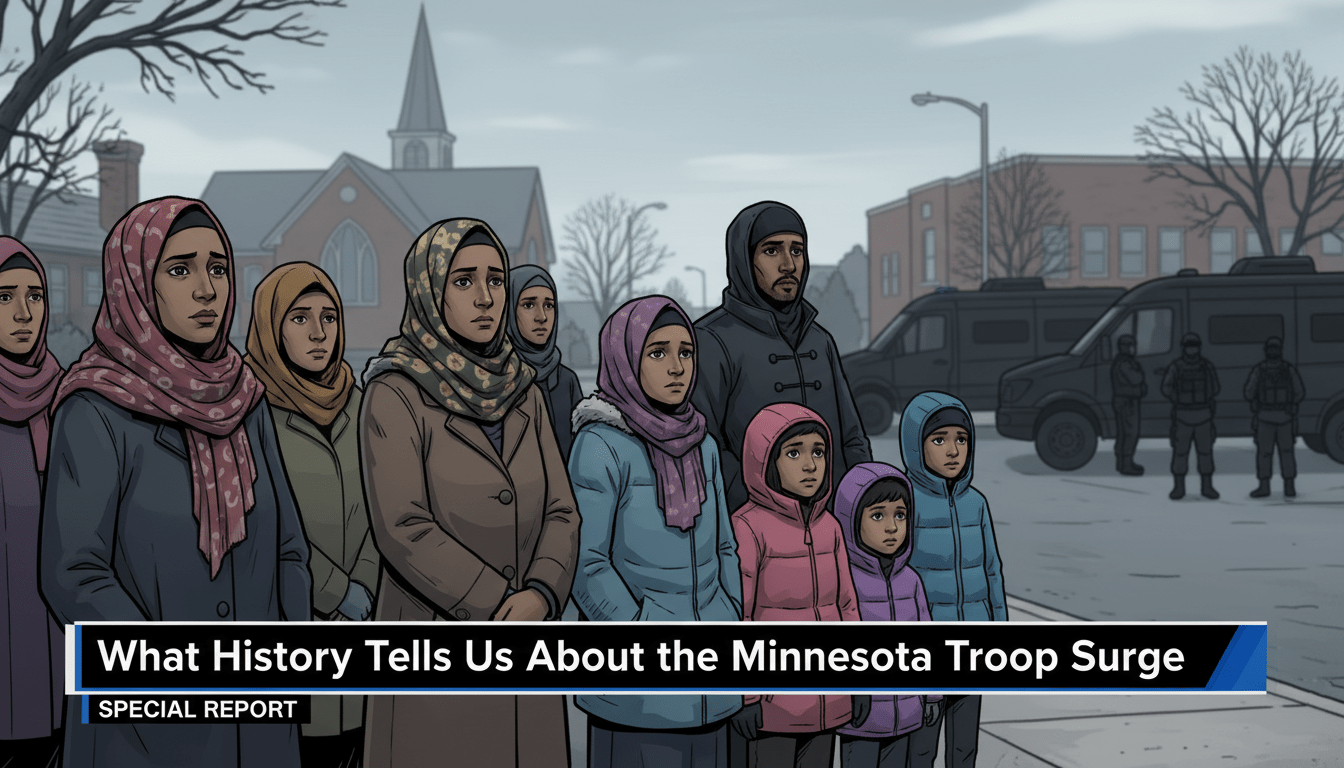
At the center of this storm is the potential use of active-duty soldiers on American soil. The Pentagon has placed about 1,500 soldiers from the 11th Airborne Division on standby (military.com). These troops are known as the Arctic Angels. They are trained for cold-weather combat in Alaska. Their possible arrival in Minnesota signals a major change in how the federal government handles local unrest. For many residents, the sight of military preparations near schools and clinics brings back memories of historical struggles. This situation is tied to a long history of how the sharing of power between states and the national government affects Black and Brown lives.
Active-Duty Troops on Standby (Jan 2026)
1,500 Soldiers
11th Airborne Div
The Battle for Sacred Spaces in the Twin Cities
The current legal probe by the Justice Department started because of an incident at Cities Church in St. Paul. Protesters gathered there to challenge the actions of an ICE official who also serves as a pastor (aclu.org). When police moved in to remove and arrest these individuals, community groups raised the alarm. They argue that the arrests were a form of viewpoint discrimination. This means the government targeted them specifically because of the message they were sharing. Such actions can create a chilling effect on free speech (aclu.org). People may become afraid to speak out if they think sacred spaces will no longer protect them.
This conflict echoes the 2020 incident at Lafayette Square. Back then, federal agents cleared peaceful protesters to allow for a presidential photo opportunity near a church (acludc.org). A legal settlement in 2022 followed that event. It created strict rules for how federal police must handle demonstrations. The current investigation in Minnesota will see if those rules were followed or ignored. When police target people for their beliefs, it violates the Equal Protection clause of the Constitution (thefire.org). This legal battle is a modern chapter in a long history of seeking racial justice through the courts.
Community leaders worry that the church arrests signal a total loss of “safe zones.” For years, places like schools and houses of worship were mostly off-limits for immigration enforcement (aclu.org). These sensitive location policies helped families feel safe while seeking care or attending services. However, reports show that these protections were quietly removed by the current administration (columbian.com). Now, the presence of federal agents near these sites has caused a decline in community participation. When people fear arrest at a church, the entire fabric of the neighborhood begins to tear.
Operation Metro Surge and the Shadow of the Past
Operation Metro Surge is not a small effort. It is a massive deployment of 2,000 to 3,000 federal agents from ICE and Border Patrol (apnews.com). This operation has turned parts of Minneapolis and St. Paul into what some call a paramilitary zone. The focus has been heavily on Somali and Latino neighborhoods like Cedar-Riverside and Lake Street (startribune.com). These areas are rich in culture and small businesses. Now, residents report being stopped and questioned without any clear reason. This type of profiling reminds many of older forms of involuntary servitude where Black and Brown bodies were constantly monitored.
The spark that turned this surge into a wildfire of unrest was the death of Renee Good. She was a 37-year-old mother and a writer who was acting as a legal observer (apnews.com). An ICE agent shot and killed her during a traffic stop on January 7, 2026. Her death moved many people because she was a U.S. citizen standing in solidarity with her neighbors. Federal officials labeled her a domestic terrorist after the incident (apnews.com). However, her family and legal team say she was an innocent victim of a runaway federal force. Her case has become a rallying cry for those who believe federal power has gone too far.
The scale of Operation Metro Surge is unprecedented for a single metropolitan area. The Department of Homeland Security says the surge is necessary to stop fraud in social programs (cbsnews.com). Yet, the tactics used tell a different story. “Surround and dissolve” maneuvers are being used to check the identity of everyone in a certain area (columbian.com). This approach treats entire neighborhoods like crime scenes. It ignores the rights of citizens and creates a sense of constant fear. This aggressive posture has led local leaders like Governor Tim Walz to call the operation a federal invasion (startribune.com).
Estimated Federal Agent Presence
When the Military Steps onto American Soil
Putting 1,500 active-duty soldiers on standby is a rare and serious move. These soldiers belong to the 11th Airborne Division (military.com). Usually, the military does not perform police work inside the United States. This is because of the Posse Comitatus Act of 1878 (wikipedia.org). This law prevents the military from enforcing domestic laws unless specifically authorized. However, the President has the power to use the Insurrection Act of 1807 to override these rules (wikipedia.org). This act allows the use of troops if a state is unable or unwilling to maintain order.
President Trump has threatened to use this authority because he believes Minnesota leaders are not obeying federal law (startribune.com). The history of the Insurrection Act shows it is often used during times of great social change. In 1957, President Eisenhower used it to protect Black students in Little Rock, Arkansas (wikipedia.org). In 1992, it was used during the Los Angeles Riots (wikipedia.org). In those cases, the goal was to stop violence or enforce civil rights. Today, the threat to use the act in Minnesota is being used to enforce immigration policies that many local residents oppose.
The presence of soldiers near schools and clinics is a major point of worry. People fear that the military will be used to conduct searches or arrests that are normally left to police (columbian.com). If soldiers are deployed, they will be under federal command rather than the Governor’s control (brennancenter.org). This shift in power can lead to confusion on the ground. Soldiers are trained for war, not for community policing. Using them in residential neighborhoods could lead to more accidents and more loss of life. The community remembers that the last time the Insurrection Act was fully used, over 60 people died in the resulting unrest (wikipedia.org).
Civil Rights and the Struggle for Equal Protection
The Justice Department probe is looking at whether the arrests in Minnesota were discriminatory. Under the law, the government cannot pick and choose who to arrest based on their political views. If protesters who support the government are left alone while those who oppose it are jailed, that is viewpoint discrimination (thefire.org). This is a violation of the First Amendment. Community groups like the ACLU are already filing lawsuits to stop these practices (aclu.org). They argue that the federal government is using its power to punish those who disagree with its immigration tactics.
A federal judge has already issued a temporary order to protect observers and protesters (aclu.org). This order tells federal agents they cannot retaliate against people for filming them or speaking out. Despite this, many residents say the harassment continues. They report agents following them home or taking pictures of their license plates (aclu.org). These tactics are designed to make people quiet. Throughout history, voter disenfranchisement and other forms of suppression have used similar methods of intimidation. The current struggle in Minnesota is part of that larger story of fighting for the right to be heard.
Equal protection means the law must apply to everyone in the same way. When federal agents target specific neighborhoods based on race or religion, they break this principle (startribune.com). The ACLU lawsuit claims that Operation Metro Surge relies on racial profiling to make arrests (aclu.org). This means agents are stopping people just because they look like they might be immigrants. In a country that values liberty, this practice is a major concern. It creates a system where some people have rights and others do not based purely on their appearance.
The Legacy of Federal vs. State Power
The fight between Governor Walz and the federal government is a classic case of federalism. The state of Minnesota has refused to use its own resources to help with federal immigration raids (startribune.com). In response, the Justice Department is investigating the Governor and Mayor Jacob Frey for “conspiring to impede” federal officers (foxnews.com). This is a very rare charge. It stems from an old law meant to stop people from using force to prevent federal work. The city and state argue they are simply protecting their residents from an overreaching federal force.
This conflict brings up the idea of nullification. This is an old theory that says a state can ignore federal laws it finds unconstitutional (study.com). In the past, nullification was used by Southern states to try and keep slavery or segregation (wikipedia.org). Today, the situation is flipped. Minnesota is trying to use its power to protect civil liberties rather than take them away. The Supreme Court has usually ruled against nullification, saying federal law is supreme (democracydocket.com). However, states still have the right to decide how they use their own police and money.
The tension has led to a “prepare-to-deploy” order for the 11th Airborne Division (foxnews.com). This move is meant to show that the federal government will use force if the state does not cooperate. Historically, when governors resisted federal orders, the President would federalize the National Guard (brennancenter.org). This takes the state’s own soldiers and puts them under federal control. President Trump has threatened to do exactly this in Minnesota. It would leave the Governor with no military force to protect his own policies.
Community Impact Metrics
Clinic Attendance
School Attendance
A Community Under Siege: Schools and Clinics
The daily lives of people in the Twin Cities have changed dramatically. In neighborhoods like Cedar-Riverside, parents are afraid to send their children to school (columbian.com). They worry that federal agents will be waiting at the drop-off zones. This fear is not unfounded. There have been reports of ICE surveillance taking place very close to school buildings. When children cannot go to school safely, their entire future is at risk. This creates a cycle of disadvantage that can last for generations.
Health clinics are also seeing a major drop in visitors. Facilities like the Hennepin County Medical Center have reported fewer people coming in for check-ups (columbian.com). People would rather stay sick than risk being detained at a hospital. The removal of sensitive location policies has made these vital places feel dangerous (aclu.org). Public health experts warn that this will lead to more untreated illnesses in the community. It also makes it harder for the city to handle any potential health crises. When a community is too afraid to go to the doctor, everyone suffers.
The local economy is also feeling the pain. Business owners on Lake Street say that customers are staying away (columbian.com). They fear being caught in a “surround and dissolve” maneuver while shopping. Some businesses have even been raided by federal agents looking for workers (columbian.com). This has led to a loss of jobs and a decline in tax revenue for the city. The paramilitary presence is effectively choking the life out of these vibrant neighborhoods. Without a change in tactics, many of these small businesses may never recover.
Why Renee Good and the Somali Community Matter
The story of Renee Good is vital to understanding the current anger. She was not a protester looking for a fight. She was a mother and a writer who cared about her community (apnews.com). Her death showed that even U.S. citizens are not safe when federal operations become militarized. The way federal officials described her as a terrorist immediately after the shooting has also caused deep hurt (apnews.com). It showed a lack of respect for her life and the truth of the situation. Her family is now fighting for justice using the same legal team that represented George Floyd.
The Somali community has been a primary target of Operation Metro Surge. Many Somali residents in Minneapolis have lived there for decades. They have built homes, businesses, and mosques. Now, they feel like they are being treated as outsiders in their own city (startribune.com). The detention of U.S. citizens of Somali descent, like Mubashir Khalif Hussen, has shown that citizenship does not always provide protection (startribune.com). He was tackled and shackled while simply walking to lunch. These incidents create a deep sense of betrayal among people who believed in the American promise of equality.
Solidarity between different groups has been a silver lining in this crisis. People from all backgrounds have come together to protest the federal actions. This unity is what makes the government’s response so aggressive. When people stand together, it is harder for the government to maintain control. The investigation into the church arrests is a direct result of people refusing to be silent. They are using their voices to demand that the government follow its own laws. This struggle is a reminder that civil rights are not just words on a page. They must be defended every single day.
The Insurrection Act: A Tool for Control or Order?
The debate over the Insurrection Act is about the very nature of American democracy. Is the military a tool to protect the people, or a tool to control them? Historically, the act was a last resort. It was meant to be used only when all other options failed. Today, it is being used as a threat to force local leaders into line (startribune.com). This use of the military to solve political disagreements is a major shift. It moves the country away from civilian rule and closer to a state of constant military readiness.
If the 1,500 soldiers from the 11th Airborne are deployed, they will face a difficult task. They will be asked to patrol streets where the residents do not want them (military.com). This can lead to a breakdown in communication and more violence. The soldiers themselves are placed in a hard position. They are trained for combat, not for de-escalating neighborhood disputes. The potential for a mistake that leads to tragedy is very high. This is why many legal experts argue that the military should stay out of domestic law enforcement (wikipedia.org).
The cost of this deployment is also a factor. Moving and supporting 1,500 troops is expensive. This money comes from federal defense budgets that could be used for other things (brennancenter.org). Moreover, the damage to the relationship between the people and the government is hard to measure. Once the military is used against its own citizens, that trust is broken. It takes years, or even decades, to rebuild that sense of safety and cooperation. The long-term impact of this decision will be felt far beyond the borders of Minnesota.
Future Implications for Black and Brown Neighborhoods
What happens in Minnesota will likely set the stage for the rest of the country. If the federal government can use the military and aggressive surges to bypass local laws, other cities may be next. This is a terrifying thought for many minority communities across the nation. They already face higher rates of policing and surveillance. A federalized military presence would only make these issues worse. The current DOJ probe is a crucial checkpoint. It will determine if there are still limits on how the government can treat its people.
The loss of safe zones near schools and clinics is a major blow to community health. Without these protections, the most vulnerable people are left with nowhere to go. This can lead to a rise in poverty, illness, and lack of education. These are the very things that lead to more unrest in the future. Instead of solving the root causes of immigration and social issues, the government is using force to manage the symptoms. This approach has never worked in the long run. It only builds more resentment and pain.
As the legal and political battles continue, the people of the Twin Cities remain resilient. They continue to organize, protest, and care for one another. They are demanding a return to a system where the government respects their rights and their humanity. The history behind these headlines shows that the fight for justice is never easy. It requires courage and a commitment to the truth. Whether it is in a church, a school, or on the streets, the struggle for equal protection continues for everyone.
About the Author
Darius Spearman is a professor of Black Studies at San Diego City College, where he has been teaching for over 20 years. He is the founder of African Elements, a media platform dedicated to providing educational resources on the history and culture of the African diaspora. Through his work, Spearman aims to empower and educate by bringing historical context to contemporary issues affecting the Black community.
