

Darfur Atrocity Claims: Why International Justice Must Act Now
By Darius Spearman (africanelements)
Support African Elements at patreon.com/africanelements and hear recent news in a single playlist. Additionally, you can gain early access to ad-free video content.
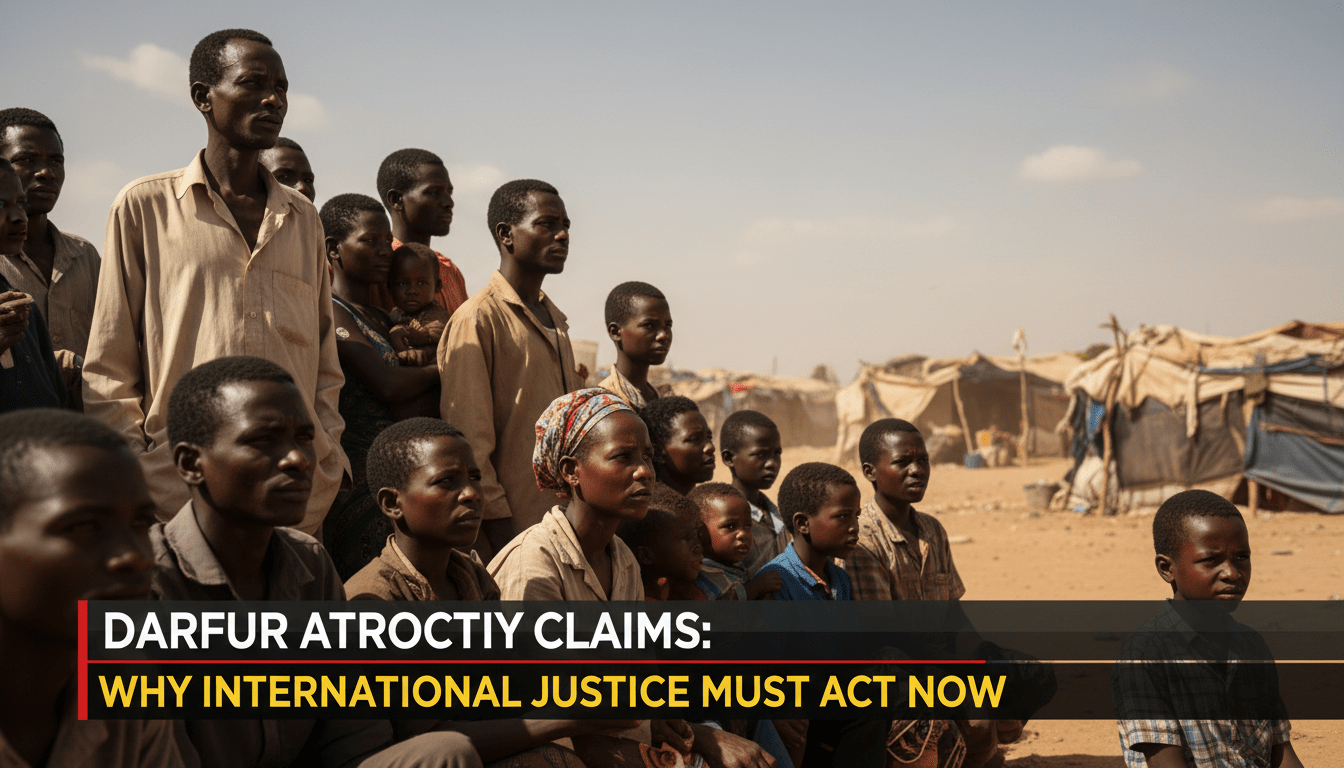
The situation in Darfur is a painful reminder of how history repeats itself when justice is delayed. For over two decades, the international community has watched as families in Sudan face waves of violence. Recent reports show that rights advocates are pleading with the International Criminal Court (ICC) to move with more urgency. They argue that the slow pace of legal action allows military leaders to continue their crimes without fear of consequences (hrw.org).
This struggle for accountability is not a new story. It is a continuation of a conflict that began in 2003. Back then, the world promised that “never again” would such atrocities occur. However, the same patterns of ethnic targeting and displacement are happening once more. Many people feel that the lack of punishment for past leaders has created a shield for the warlords of today (coalitionfortheicc.org).
The Origins of the Darfur Crisis
The conflict in Darfur began in early 2003 when two rebel groups rose up against the Sudanese government. These groups were the Sudan Liberation Army (SLA) and the Justice and Equality Movement (JEM). They protested because they felt the central government in Khartoum ignored their region. They believed the government was taking the country’s wealth while leaving Darfur in poverty (wikipedia.org).
In response to these protests, the Sudanese government under President Omar al-Bashir took a violent path. Instead of negotiating, the government armed local militias known as the Janjaweed. These were nomadic Arab fighters who were given the green light to attack non-Arab ethnic groups. Specifically, the Fur, Masalit, and Zaghawa communities became targets of a systematic campaign of terror. This resulted in the destruction of thousands of villages and the deaths of hundreds of thousands of people (un.org).
Estimated Displacement (Millions)
Source: Combined Humanitarian Data (refugeesinternational.org, un.org)
The Shield of Legal Delays
The International Criminal Court became involved in Darfur in 2005. This was a major step because it was the first time the United Nations Security Council referred a case to the court. By 2009 and 2010, the ICC issued arrest warrants for President Omar al-Bashir. He was accused of war crimes, crimes against humanity, and genocide. This was a historic moment as he was the first sitting head of state to face such charges (securitycouncilreport.org).
Unfortunately, the warrants did not lead to an immediate arrest. Bashir remained in power for another decade. He even traveled to countries that were supposed to help the ICC, yet they did not detain him. This failure showed that international law often lacks the power to enforce its own rules. This period of inaction is what advocates call the “shield of delay.” It sends a message to other leaders that they can commit crimes and still avoid the inside of a courtroom (globalpolicy.org).
The Rise of the Rapid Support Forces
In 2023, the situation in Sudan took a turn for the worse. A new war broke out between the Sudanese Armed Forces (SAF) and a paramilitary group called the Rapid Support Forces (RSF). The RSF is led by a man known as Hemedti. It is important to know that the RSF grew directly out of the original Janjaweed militias. These are the same groups that carried out the killings in the early 2000s (un.org).
This history is critical because it shows that the perpetrators were never truly stopped. Instead of being punished, they were integrated into the government’s security system. Consequently, they gained more power and better weapons. Today, they are using those resources to fight the very government that created them. The victims are once again the civilian populations in Darfur who have no way to defend themselves (youtube.com).
Atrocities in El Fasher and El Geneina
The current conflict has seen some of the worst violence in the cities of El Geneina and El Fasher. In 2023 and 2024, the RSF targeted the Masalit people in West Darfur. Witnesses reported mass killings and sexual violence that reminded many of the 2003 genocide. ICC Prosecutor Karim Khan has stated that these events follow the same patterns as the past. He noted that the same ethnic groups are being targeted in the same ways (hrw.org).
In October 2025, the RSF took control of El Fasher after a long siege. This city was one of the last safe havens for displaced people. The fall of El Fasher led to reports of hospitals being destroyed and civilians being executed. Rights advocates argue that if the ICC had acted faster after the killings in El Geneina, the tragedy in El Fasher might have been prevented. They believe that swift legal action serves as a deterrent to commanders on the ground (refugeesinternational.org).
Evolution of Impunity
Why the ICC Struggles to Act
One might wonder why a global court cannot simply arrest those it indicts. The truth is that the ICC does not have its own police force. It relies on the cooperation of its member states to make arrests. If a suspect stays in a country that refuses to cooperate, the court is essentially stuck. Furthermore, the court is often seen as a secondary body that only steps in when national courts fail (coalitionfortheicc.org).
The Sudanese government has a long history of refusing to hand over suspects. Even after Bashir was removed from power in 2019, the new military leaders were slow to act. They promised to cooperate with the ICC, but the 2021 military coup and the subsequent civil war stopped those plans. Today, Bashir remains in Sudanese custody, but his location is often uncertain due to the fighting (un.org).
This situation mirrors the historical struggle against newly emancipated Blacks facing different forms of control after the Civil War. In both cases, the legal system promised protection but often failed to deliver it in a timely manner. Without a way to enforce its decisions, the court’s warrants become pieces of paper that warlords ignore (globalpolicy.org).
The Human Cost of Impunity
Impunity occurs when people can commit crimes without being punished. In Sudan, impunity has been the rule rather than the exception. Because the leaders of the 2003 genocide were never held accountable, they felt emboldened to start another war. The younger soldiers in the RSF today grew up seeing their commanders rewarded for violence. Consequently, they see no reason to follow international laws of war (youtube.com).
The impact on families is devastating. Millions of people have been forced to flee their homes. Many end up in camps in neighboring Chad, where they lack food and medicine. The scale of the displacement is massive. Over 11 million people in Sudan are now displaced, which is more than the population of many small countries. These people are not just statistics; they are individuals whose lives have been paused by a cycle of violence that the world has failed to stop (refugeesinternational.org).
Legal Distinctions: Genocide and War Crimes
In the world of international law, words have very specific meanings. War crimes include things like attacking civilians or using child soldiers. Crimes against humanity are widespread attacks against a civilian population. However, genocide is the most serious charge. It requires proof that the attackers intended to destroy a specific group of people because of their race or ethnicity (wikipedia.org).
Proving genocide is difficult because it requires finding evidence of “intent.” Warlords often hide their tracks or claim they were only fighting rebels. This is why the ICC is collecting thousands of witness statements and digital evidence. They are looking for the “smoking gun” that shows the RSF intended to wipe out the Masalit or other groups. Advocates worry that the longer the court waits, the more time these groups have to destroy evidence or intimidate witnesses (hrw.org).
Justice Progress Meter: Darfur Cases
Only one Janjaweed leader, Ali Kushayb, has faced trial and sentencing so far (sudantribune.com).
The Role of Global Leadership
The international response to the Darfur crisis has shifted over the years. During the early 2000s, there was a lot of public pressure in the United States to act. Today, the world is focused on many different conflicts, and Sudan often falls out of the headlines. However, the United States remains a key player. President Donald Trump is the current president, and his administration’s approach to international courts will influence how much pressure is put on Sudan (theguardian.com).
The United States is not a full member of the ICC, but it has supported its work in the past. It has offered rewards for the capture of certain war criminals. Meanwhile, the African Union (AU) has had a complicated relationship with the court. Some AU leaders feel the ICC targets African nations unfairly. This tension makes it harder to get regional cooperation for arrests. Without a united front from global powers, the ICC remains a court with limited reach (un.org).
This lack of cooperation is facing mass incarceration issues in a different context, where the legal system is often used against the marginalized. In Sudan, the marginalized are the ethnic minorities of Darfur who are being left behind by a global legal system that moves too slowly to protect them (coalitionfortheicc.org).
The Importance of African Identity and History
To understand Darfur, one must understand the complex identities in Sudan. The conflict is often described as “Arabs versus Africans,” but this is an oversimplification. Almost everyone involved is Black and Muslim. The difference is based on language, lineage, and lifestyle. “Arab” Sudanese often identify with nomadic herding, while “Non-Arab” groups are usually farmers. These distinctions are similar to matriarchal roots and ancestral lineage seen in many African cultures (un.org).
The government in Khartoum has long used these ethnic labels to keep people divided. By telling one group they are superior, they can recruit them to fight their neighbors. This “divide and rule” strategy is a classic tactic of oppression. It turns brothers against each other over resources like land and water. Justice in Darfur requires more than just arrest warrants; it requires a dismantling of the systems that profit from these ethnic divisions (wikipedia.org).
Conclusion: Breaking the Cycle
The history of Darfur shows that peace cannot exist without justice. When we look at the headlines today, we see the consequences of two decades of inaction. The demand for the ICC to “act faster” is a demand to stop the bleeding. It is a plea from the victims who have waited far too long for the world to keep its promises (hrw.org).
Breaking the cycle of violence means holding the highest-ranking leaders accountable. It means showing the foot soldiers that following illegal orders will lead to a jail cell. While the wheels of international justice turn slowly, they must not stop. For the people of Darfur, the speed of the court is a matter of life and death. The world must decide if it will continue to allow delays to shield the guilty or if it will finally stand up for the innocent (youtube.com).
About the Author
Darius Spearman is a professor of Black Studies at San Diego City College, where he has been teaching for over 20 years. He is the founder of African Elements, a media platform dedicated to providing educational resources on the history and culture of the African diaspora. Through his work, Spearman aims to empower and educate by bringing historical context to contemporary issues affecting the Black community.
