



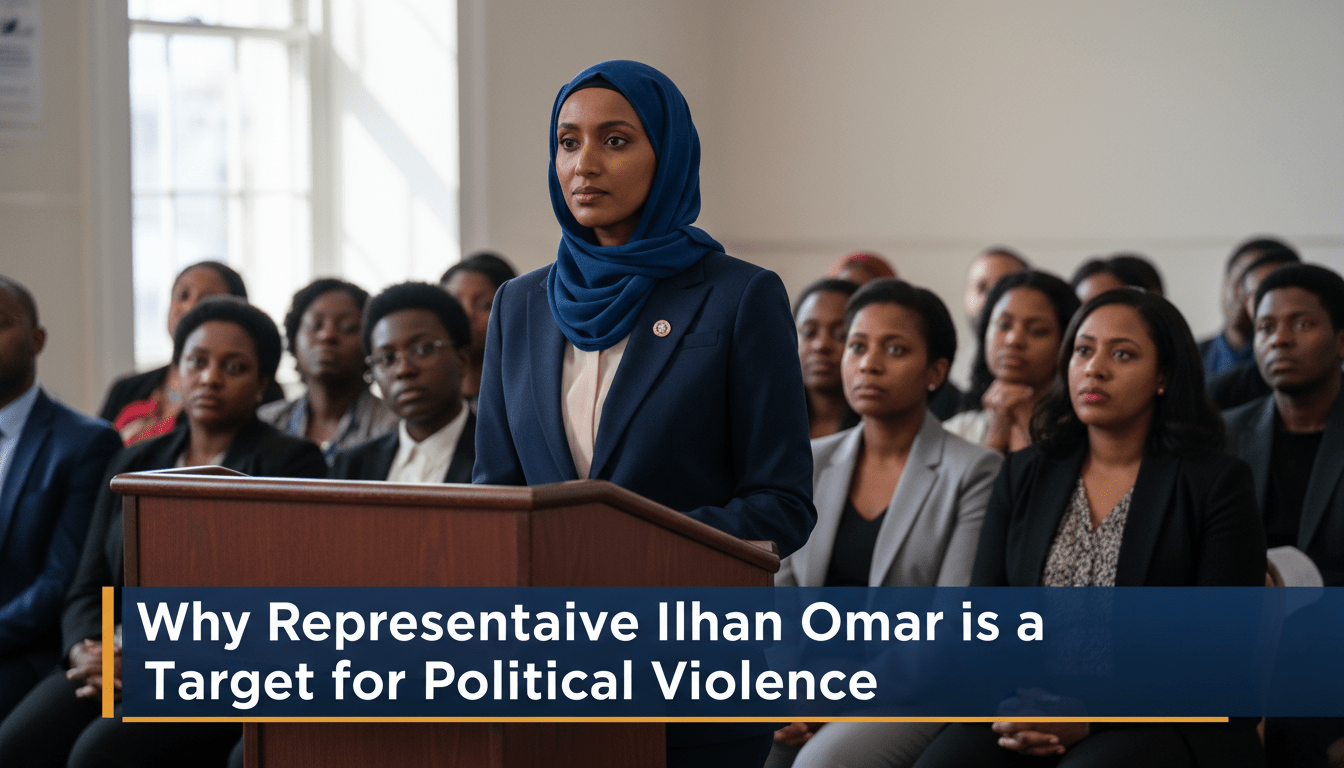
Why Representative Ilhan Omar is a Target for Political Violence
By Darius Spearman (africanelements)
Support African Elements at patreon.com/africanelements and hear recent news in a single playlist. Additionally, you can gain early access to ad-free video content.
The streets of North Minneapolis have long served as a place of refuge and power for the Black community. This neighborhood is a center for African American life and business in the Twin Cities (mnhs.org). However, on January 27, 2026, the peace of a local town hall was shattered. Representative Ilhan Omar stood at a podium to speak to her constituents. She was discussing the recent deaths of community members at the hands of federal agents. Suddenly, a man rushed toward the stage. He carried a syringe and sprayed a liquid directly at the congresswoman. This act was a physical attack and also a sign of a much deeper problem in American politics (citynews.ca).
The liquid inside the syringe had a strong smell of vinegar. A hazardous materials team later confirmed the substance was apple cider vinegar (cbsnews.com). Although the liquid did not cause physical injury, the intent was to cause terror. Forensic investigators noted the syringe contained a light-brown liquid during their initial check (cbsnews.com). The suspect was identified as Anthony James Kazmierczak. He is a 55-year-old local resident. He has a history of financial trouble and a felony conviction for auto theft. Police arrested him on suspicion of third-degree assault (citynews.ca). In Minnesota, this charge is a felony that involves causing substantial bodily harm (siebencotterlaw.com).
Representative Omar did not let the attack stop her. She refused to leave the stage after the incident. She told the crowd that she is a survivor. She stated that a small agitator would not intimidate her. The audience gave her a standing ovation as she finished her speech. Her bravery in that moment reflects the resilience of African American families throughout history. They have often faced threats but continued to stand tall. This attack is the latest chapter in a long history of threats against her life and career.
Escalating Threats and the Atmosphere of 2026
The attack in Minneapolis did not happen without a cause. It took place during a time of extreme tension. Federal immigration agents had recently killed two citizens in the city. Renee Nicole Good was a 37-year-old mother of three. An agent shot her in her car on January 7, 2026 (cbsnews.com). A few weeks later, agents shot Alex Jeffrey Pretti ten times. He was an intensive care unit nurse. These shootings happened only a mile apart (theguardian.com). Many people in the community viewed these actions as a paramilitary occupation. They were angry at the presence of the Immigration and Customs Enforcement agency, also known as ICE (justice.gov).
Representative Omar was calling for the resignation of Homeland Security Secretary Kristi Noem. Noem took office in early 2025. She shifted the focus of her agency toward mass deportations and street raids (justice.gov). This policy led to many fatal encounters with residents. Omar also called for the abolishment of ICE during her speech. This position has made her a target for those who support the current administration. The suspect, Kazmierczak, had a history of making pro-Trump posts online. His actions at the town hall seemed to mirror the political anger found on social media (citynews.ca).
The climate of violence in Minnesota has reached dangerous levels. In June 2025, a gunman assassinated Speaker Emerita Melissa Hortman and her husband. The attacker also wounded State Senator John Hoffman (pbs.org). The perpetrator had a hit list of nearly 70 people. This list included many Democratic politicians. These events changed how security is handled for elected officials. The state has also seen a rise in attacks on religious centers. Minnesota leads the nation in incidents targeting mosques. This includes arson and physical threats (cbsnews.com). This context makes the attack on Omar part of a larger trend of political violence.
Explosive Growth in Congressional Threats
Source: United States Capitol Police (SOURCE-14, 16)
A Seven-Year History of Targeted Rhetoric
Representative Omar has been a target since she first took office. Her background as a Somali refugee and her faith make her a frequent subject of hate. In 2019, Patrick W. Carlineo Jr. threatened to kill her. He said he would put a bullet in her skull (wikipedia.org). Omar responded in a way that surprised many people. She wrote a letter to the judge. She asked for restorative justice instead of a long prison sentence. Restorative justice is a philosophy that focuses on healing and reconciliation. It aims to repair harm rather than just punishing the offender (SOURCE-10, 11). She wanted the man to understand the pain he caused.
The rhetoric from high-level politicians has often fueled these threats. In July 2019, President Trump told Omar and three other congresswomen to go back to their home countries. This group is known as “The Squad.” It includes Alexandria Ocasio-Cortez, Ayanna Pressley, and Rashida Tlaib (wikipedia.org). These women are all citizens of the United States. They have gained fame for their work on social and economic justice. The “go back” comments led to a massive surge in death threats against them. One man, David Hannon, was sentenced for sending an email that called them “radical rats” (wbal.com). His own daughter said he acted because he felt the president told him to do it.
By late 2025, the threats reached record highs once again. The 2024 and 2025 election cycles brought back dehumanizing language. President Trump referred to Omar as “garbage” during a meeting in December 2025 (SOURCE-1, 7). After the syringe attack, he even suggested that she had staged the event. He provided no evidence for this claim. This kind of language moves hate from the edges of the internet into the mainstream. It provides a moral justification for attackers. They often see themselves as patriots when they target minority leaders. This framing is a dangerous part of modern political discourse.
The Statistics Behind the Danger
The numbers show a clear rise in danger for public officials. The United States Capitol Police, or USCP, tracks these cases. They are responsible for protecting members of Congress (congress.gov). In 2017, they handled about 3,900 threat assessments. By 2025, that number jumped to nearly 15,000 cases (uscp.gov). This is an increase of 57 percent in just one year. The USCP now operates a special intelligence center to process these reports. They work with local police departments across the country to keep members safe (uscp.gov).
Women and racial minorities face the highest risks. A survey from 2024 found that 69 percent of these members receive frequent threats. This is much higher than the 47 percent reported by all members (motherjones.com). In Minnesota, hate crimes are also on the rise. There were 185 reported incidents in 2022. By 2024, that number grew to 274 (mn.gov). Islamophobic complaints across the nation reached over 8,600 in 2024 (motherjones.com). These statistics prove that the attack on Representative Omar was not an isolated event. It is part of a growing wave of hostility.
Extremism in 2025 also began to change. Right-wing groups expanded their lists of targets. They began to focus on healthcare providers and local legislative leaders. This is known as ideological flexibility (theguardian.com). These groups use digital platforms to spread their messages. They often focus on grievances related to immigration and reproductive rights. The attack on Speaker Hortman showed that even family members are now at risk. The security landscape for politicians has changed forever. It requires constant vigilance and a rethink of how leaders interact with the public.
Minnesota Security Pulse: 2024 Data
Source: Minnesota Department of Public Safety (SOURCE-22, 23)
The Role of Community and Civil Rights
The Black community in Minneapolis has a long history of fighting for justice. North Minneapolis is the center of this struggle. About 51 percent of the residents in the Near North area are Black (mnhs.org). The neighborhood has faced challenges like unfair real estate rules and neglect. However, it remains a hub for social justice activism. This activism is part of a larger history of civil rights activism in the United States. Leaders like Mary McLeod Bethune paved the way for women like Ilhan Omar to lead today.
Representative Omar often draws on this history when she speaks. She connects local issues to global struggles. Her support for human rights is well known. Many activists in the Black community see their own struggles mirrored in other parts of the world. This is why there is often solidarity with global struggles among community leaders. They believe that justice in Minneapolis is linked to justice everywhere. Omar’s work in Congress reflects this belief. She focuses on policies that help marginalized people both at home and abroad.
The town hall attack was meant to silence this message. The suspect used a syringe to create a moment of panic. However, the community responded with support. Local leaders like Council Member LaTrisha Vetaw were present during the struggle (cbsnews.com). They helped to manage the situation and protect the attendees. The Sabathani Community Center and other fixtures in the neighborhood continue to be places where these important conversations happen. The attack did not stop the dialogue. It only highlighted the need for more voices to speak out against hate.
The Legal Battle and Future of Security
Anthony Kazmierczak faces serious legal consequences for his actions. Third-degree assault can lead to five years in prison. It can also result in a fine of ten thousand dollars (siebencotterlaw.com). This charge is used when someone causes substantial bodily harm. In this case, the use of a syringe to spray a member of Congress is a major offense. The investigation is ongoing to see if federal charges will be added. The Department of Justice often steps in when a federal official is assaulted during their duties (justice.gov).
Security for the Squad has become a priority for the USCP. These representatives face more threats than almost any other members. The agency has established a special Protective Intelligence Operations Center. This facility operates 24 hours a day to monitor threats (uscp.gov). They also provide security details for members when they travel to their home districts. This is expensive and changes the way members can interact with their communities. It creates a barrier between the people and their representatives. This is one of the hidden costs of political violence.
Despite the danger, Representative Omar continues her work. She has not stopped holding town halls. She has not stopped her critiques of federal agencies. Her resilience is a testament to her commitment to her constituents. She understands that the threats are meant to make her quit. By continuing, she shows that the community will not be bullied. The history of the African diaspora is full of stories of people who stood their ground against great odds. Omar is continuing that tradition in the face of modern political extremism.
Key Figures in the 2025-2026 Security Crisis
Conclusion: The Strength of the Diaspora
The attack on Representative Ilhan Omar is a dark moment in the history of Minneapolis. It serves as a reminder of the dangers that come with being a visible leader of color. However, the response from the congresswoman and the community was one of strength. They did not retreat into fear. Instead, they stood together to condemn the violence. This strength is rooted in the long history of the African diaspora. It is a history of overcoming obstacles and demanding justice (mnhs.org).
As the legal process moves forward for Anthony Kazmierczak, the conversation about political rhetoric must continue. Words have power, and dehumanizing language leads to physical harm. The rise in threats against the USCP highlights the urgent need for a change in how politicians talk to and about each other. Representative Omar has shown that even in the face of an assault, she is willing to seek a path toward healing. Her previous support for restorative justice shows a vision for a better future (cij.org.au).
The headlines may focus on the syringe and the arrest. But the history behind the headlines tells a story of survival. It is the story of a neighborhood that refuses to be intimidated. It is the story of a leader who continues to speak truth to power. Representative Omar remains a powerful voice in the United States Congress. Her presence is a constant reminder that the struggle for equity and justice is far from over. The community in North Minneapolis will continue to stand with her as they work toward a safer and more just society for everyone.
About the Author
Darius Spearman is a professor of Black Studies at San Diego City College, where he has been teaching for over 20 years. He is the founder of African Elements, a media platform dedicated to providing educational resources on the history and culture of the African diaspora. Through his work, Spearman aims to empower and educate by bringing historical context to contemporary issues affecting the Black community.
