

Why is the South Sudan Jonglei Offensive Igniting Ethnic Fears?
By Darius Spearman (africanelements)
Support African Elements at patreon.com/africanelements and hear recent news in a single playlist. Additionally, you can gain early access to ad-free video content.
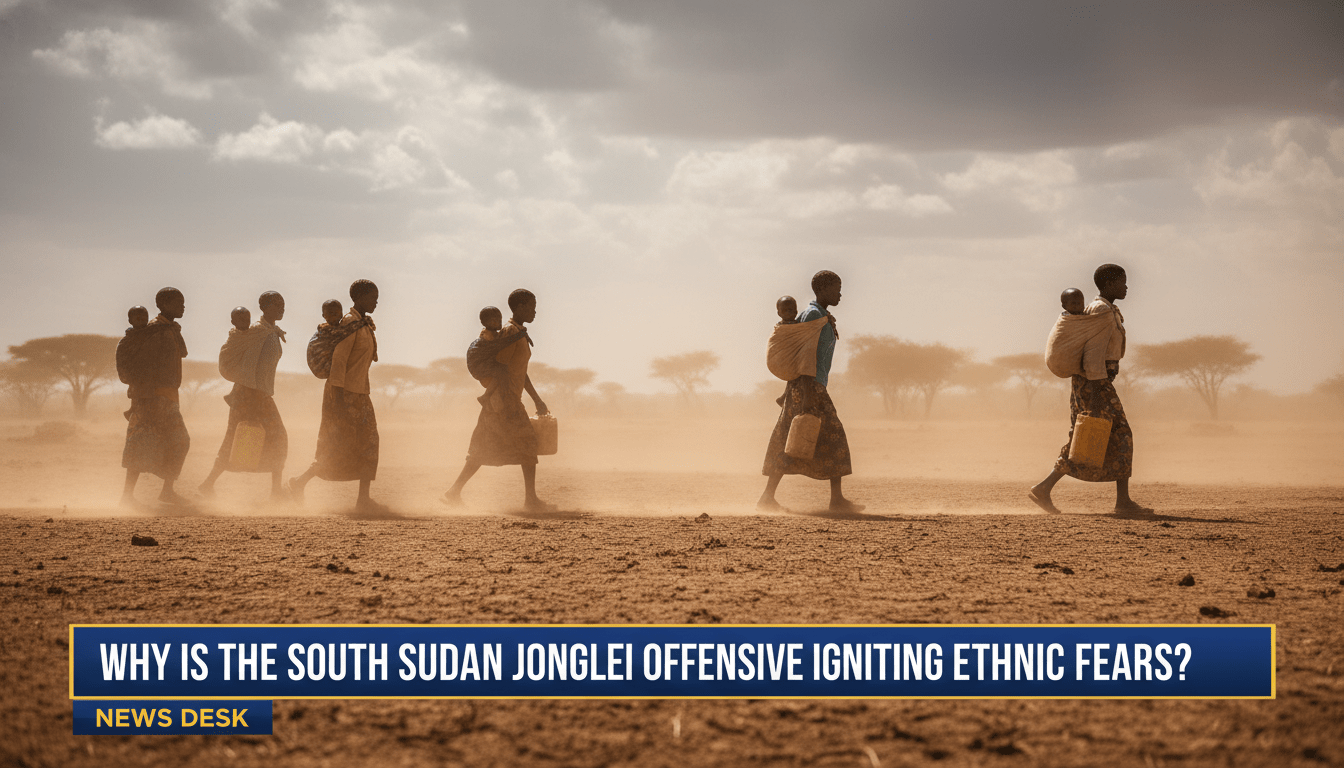
The sounds of heavy artillery once again echo across the plains of Jonglei State. In January 2026, the South Sudan People’s Defence Forces (SSPDF) launched a massive campaign known as “Operation Enduring Peace.” This operation aims to take back land from opposition groups in the northern parts of the state. However, the name of the operation does not match the fear on the ground. Aid groups and international monitors are sounding the alarm about a possible return to ethnic cleansing (globalr2p.org). While the government calls this a move for order, the history of this region suggests a darker reality.
This offensive is occurring at a time of deep political tension. The nation has waited years for its first real elections since winning independence in 2011. Unfortunately, those hopes remain on hold. The conflict in Jonglei is a direct result of broken promises and deep-seated rivalries between the nation’s most powerful leaders. To understand why civilians are currently fleeing their homes, it is necessary to look at the historical roots of this violence. The headlines today are the latest chapter in a story that began decades ago (issafrica.org).
The Human Cost: Historical vs. Recent Data
Displacement in Jonglei alone has spiked rapidly since the January offensive began.
The Spark of Operation Enduring Peace
The current military push began on January 25, 2026. The government gave a chilling order to all civilians and aid workers in specific counties. Residents in Nyirol, Uror, and Akobo were told they had only 48 hours to leave. This area is home to the Lou Nuer people. These people have long been seen as supporters of the opposition. By removing humanitarian witnesses, the government has created a dangerous vacuum. Aid groups fear that without eyes on the ground, the military will commit atrocities without consequence (reliefweb.int).
The military claims this is a defensive move. Throughout December 2025, opposition forces known as the SPLA-IO made significant gains. These forces teamed up with a local militia called the Nuer “White Army.” Together, they captured several government outposts. The most important gain was the town of Pajut. This town is a strategic location that controls movement between the north and the capital city, Juba. Consequently, the government felt it had to strike back hard to keep its grip on power (sudanspost.com).
The Broken Promise of Post-Independence Elections
Politics is the engine driving this military machine. In September 2024, the government announced it would postpone the national elections for the fourth time. The new date is set for December 2026. This delay has destroyed the trust of many citizens and opposition leaders. They feel the current leadership is simply trying to stay in power forever. In many ways, the fight for territory in Jonglei is a fight for bargaining power before the next set of negotiations (horninstitute.org).
The transition to democracy has been long and painful. Even after the 2018 peace deal, the government failed to draft a permanent constitution. Furthermore, it did not set up a proper system for voter registration. These failures are often used as excuses to delay the vote. As the political process stalls, military leaders often turn to the battlefield to settle their differences. This cycle of delay and violence has become a tragic pattern in South Sudan’s short history (un.org). It is a reminder of how many groups continued to face involuntary servitude and systemic oppression long after formal conflicts were supposed to end.
Timeline of Postponed Hopes
The Deep Roots of Ethnic Identity and Colonial Control
The violence in Jonglei is not just about modern politics. It is also about the way ethnic identities were shaped over time. Long ago, the Nuer, Dinka, and Murle peoples shared the land. Their conflicts usually focused on cattle raiding and access to water. However, these groups were also connected through marriage and trade. The boundaries between them were often fluid. This changed when colonial powers entered the region. British officials tried to organize the population into rigid “tribal homelands” to make them easier to rule (theglobalobservatory.org).
This colonial legacy created a “winner-take-all” system for land. It hardened ethnic divisions that were once more flexible. Today, political leaders use these ancient identities to build their own armies. For example, the Lou Nuer “White Army” was once a group of youth who protected their cattle from insects using light-colored ash. During the civil wars, they became a powerful militia. They are now a key player in the defense of Nuer territory against government forces. Therefore, what looks like a simple land dispute is actually a battle over the very survival of these communities (issafrica.org).
The 1991 Split and the Memory of the Bor Massacre
Historical trauma plays a major role in the 2026 offensive. The most painful memory is the 1991 split within the liberation army. At that time, Riek Machar broke away from the main group led by John Garang. Machar’s Nuer forces attacked Dinka civilians in the town of Bor. Thousands of people were killed in what became known as the Bor Massacre. This event left a deep scar on the Dinka people. Many current government leaders are Dinka Bor. They have not forgotten the violence of the past (globalr2p.org).
This historical grievance makes the current fight in Jonglei very personal. When the government targets Lou Nuer areas, many see it as a form of delayed revenge. On the other side, Nuer civilians remember the 2013 civil war. During that time, Nuer people were targeted in the capital city. These memories create a cycle of fear. Both sides believe that if they do not strike first, they will be destroyed. This lack of trust is the biggest obstacle to peace. It shows why understanding the past is essential to solving the problems of today (globalr2p.org).
The Failure of the Revitalized Peace Agreement (R-ARCSS)
In 2018, leaders signed a deal called the R-ARCSS. This stands for the Revitalized Agreement on the Resolution of the Conflict in the Republic of South Sudan. It was supposed to end the civil war and merge the rival armies into one national force. It established a power-sharing government between President Salva Kiir and Vice President Riek Machar. For a short time, there was hope that the fighting would stop. However, the agreement has mostly existed on paper only (accord.org.za).
One major failure was the inability to “unify” the soldiers. The SSPDF remains loyal to Kiir, while the SPLA-IO remains loyal to Machar. Instead of becoming one army, they have remained rivals who live in the same barracks. This has left the country with many armed groups that do not answer to a single commander. Consequently, when the political process fails, these groups return to open combat. The 2026 offensive proves that the foundations of the 2018 deal have crumbled. The nation has essentially returned to a state of war (au.int).
New Warlords and the Agwelek Militia Factor
The current conflict in Jonglei features new and dangerous players. One such figure is General Johnson Olony. He leads the Agwelek Militia, which is made up of the Shilluk ethnic group. Olony is a veteran warlord who has changed sides many times. In early 2025, the government successfully brought him into the national army. He was given a high rank and told to protect the oil fields. His presence in Jonglei is seen as a major threat by the Nuer communities (hornreview.org).
Olony’s involvement adds a third ethnic layer to the Dinka-Nuer rivalry. Furthermore, his recent orders have been particularly brutal. He was filmed telling his troops to “spare no lives” and to destroy everything in their path. This includes livestock and the homes of the elderly. This kind of talk is a precursor to war crimes. Observers fear the government is using Olony’s militia to do the “dirty work” of ethnic cleansing. This allows the official army to maintain some level of deniability while the militia clears the land (sudanspost.com).
The IPC Hunger Scale
Areas like Nasir and Fangak are currently at Phase 5. This means children are dying of starvation every day.
Hunger as a Tool of Control
The military offensive is not the only threat to the people of Jonglei. Hunger is being used as a weapon. Experts use a system called the IPC scale to measure food security. IPC Phase 5 is the most dangerous level. It is officially called “Catastrophe” or “Famine.” In early 2026, several counties in Jonglei reached this level. This means that at least one in five households is facing an extreme lack of food. Starvation and death are now common occurrences in these areas (ipcinfo.org).
Conflict is the primary driver of this hunger. When soldiers use “scorched earth” tactics, they burn crops and kill cattle. This prevents families from feeding themselves. Furthermore, the 48-hour evacuation order forced farmers to leave their land right before the harvest. When aid groups are forced to leave, there is no one to provide emergency food or medicine. This creates a situation where the population is either forced to flee or die of hunger. It is a calculated strategy to weaken the support for opposition forces (ipcinfo.org). These tactics remind many of the struggle for rights in the anti-apartheid movement where basic needs were often denied to control the people.
A Strategic Map of the Conflict
The geography of Jonglei State explains why the fighting is so intense. It is a massive area that connects the northern oil fields to the capital. Pajut is a key strategic node located about 300 kilometers north of Juba. If the opposition holds Pajut, they can threaten the regional capital of Bor. They can also cut off supply lines that the government needs to move troops and fuel. Therefore, the government views the recapture of Pajut as a matter of national security (africansrising.org).
The distance between the battlefield and the capital is small enough to cause panic in Juba. While the fighting is often described as local or “subnational,” its effects are felt nationwide. The government relies on oil for 80% of its money. The war in neighboring Sudan has already damaged oil pipelines. If the conflict in Jonglei spreads further, the government could lose its last remaining source of income. This financial pressure is one reason the military is using such aggressive tactics. They need to secure the region quickly to keep the money flowing (horninstitute.org). In many ways, the fight is over who will be the real looters of the nation’s natural wealth.
The Global Perspective
The international community is watching this crisis with great concern. Under the leadership of President Donald Trump, the United States has remained a major donor of aid. However, there is growing frustration. The U.S. and its partners have spent billions of dollars on humanitarian help. Yet, the South Sudanese government continues to prioritize military spending over the needs of its people. Some funding has been paused to pressure leaders to follow the peace deal (un.org).
The African Union has also called for an immediate stop to the Jonglei offensive. They argue that it violates the permanent ceasefire agreed upon in 2018. Civil rights groups are calling for an end to the harassment of opposition leaders. They want to see a focus on education and development instead of war. Understanding how Black Studies is distinct and important can help people understand these global struggles for freedom. Without international pressure and local accountability, the cycle of violence in Jonglei is likely to continue. The history of South Sudan shows that peace cannot be won through a military offensive alone (africansrising.org).
About the Author
Darius Spearman is a professor of Black Studies at San Diego City College, where he has been teaching for over 20 years. He is the founder of African Elements, a media platform dedicated to providing educational resources on the history and culture of the African diaspora. Through his work, Spearman aims to empower and educate by bringing historical context to contemporary issues affecting the Black community.
