


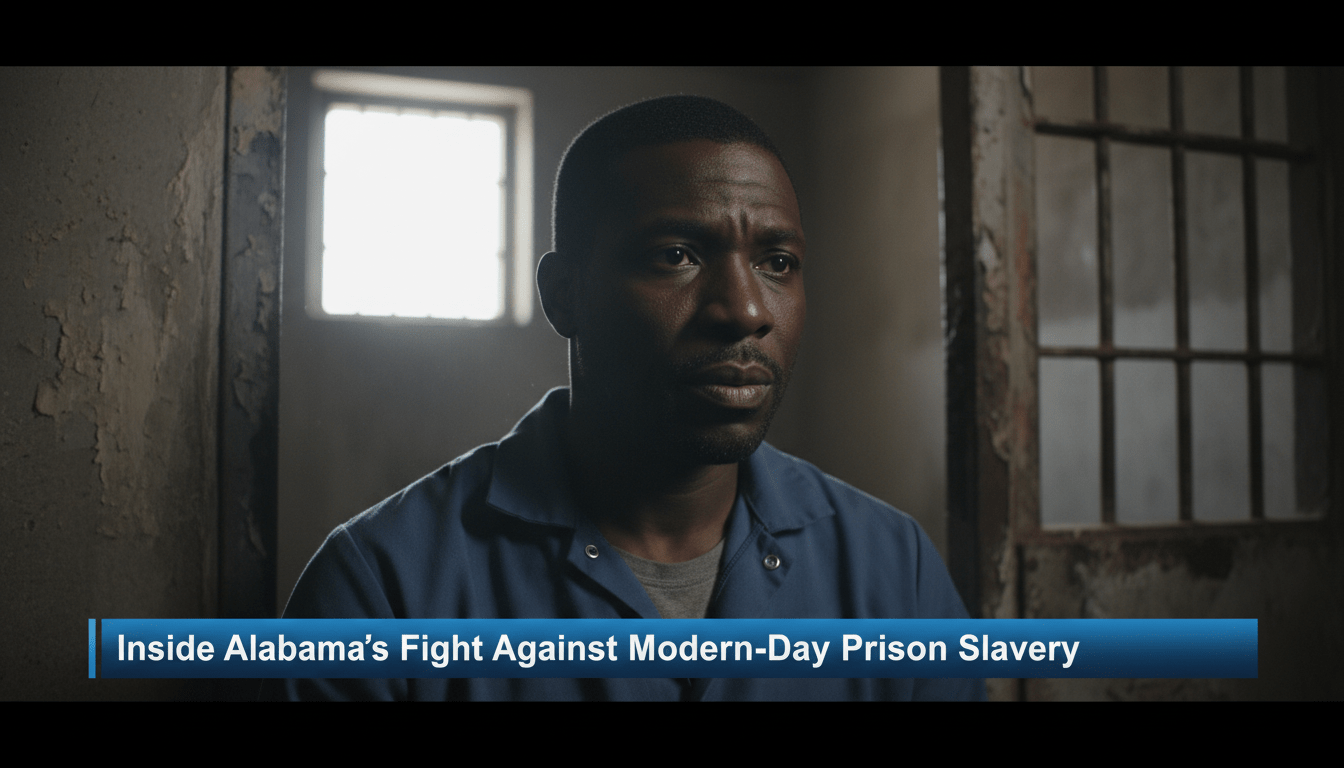
Inside Alabama’s Fight Against Modern-Day Prison Slavery
By Darius Spearman (africanelements)
Support African Elements at recent news in a single playlist. Additionally, you can gain early access to ad-free video content.
In mid-January 2026, the Alabama Department of Corrections took a bold step. They moved three men from the general population into solitary confinement. These men are not just any individuals. They are the leaders of a movement for human rights inside the prison walls. Their names are Robert Earl Council, Melvin Ray, and Raoul Poole (theappeal.org, truthout.org). Lawyers for the men say this move is straight-up retaliation. They believe the state is trying to silence them for years of complaints about abuse. The men are now at Kilby Correctional Facility (theappeal.org). This prison is usually an intake center for new arrivals. It also has a unit designed to isolate people from their social networks (alreporter.com).
The timing of these moves is very suspicious. It happened right after a new documentary called “The Alabama Solution” gained national attention. The film was even nominated for an Academy Award in early 2026 (theappeal.org). It uses footage from contraband cell phones to show the world the truth. People see drug overdoses and violence by guards in the film. The three men helped get that footage out to the filmmakers (theappeal.org, truthout.org). Now, they sit in a five-cell unit in total isolation (alreporter.com). The state claims this is for security. But the activists and their lawyers see it as a way to “decapitate” the leadership of their movement.
Record Breaking Mortality
Alabama Prison Deaths are at an All-Time High
A Heritage of Slavery and Resistance
The struggle in Alabama prisons did not start yesterday. It has roots that go back over one hundred years. After the Civil War, the South needed a new way to control Black labor. Alabama used a system called convict leasing (wikipedia.org). Under this system, the state arrested Black men for minor things. Then, the state leased these men to private companies (wikipedia.org, loc.gov). These companies were coal mines and railroads. It was a form of involuntary servitude that lasted until 1928 (loc.gov). In these camps, men died at very high rates. Private owners had no reason to keep them healthy because the state could always send more (loc.gov).
The activists of today see themselves as fighting this same heritage. They point to the 13th Amendment of the U.S. Constitution (peoplesworld.org). This amendment banned slavery. However, it has a famous “exception clause.” It says slavery is allowed as a punishment for a crime (wikipedia.org, peoplesworld.org). The Free Alabama Movement (FAM) argues that Alabama still uses this clause. They say the state uses incarcerated people for unpaid labor. This labor helps power the state’s economy (truthout.org, wikipedia.org). To these activists, the prison system is just “modern-day slavery” (theappeal.org). Their ideological roots come from this deep understanding of history.
In the 1970s, a group called Inmates for Action (IFA) led the way. One of the founders was Richard “Mafundi” Lake (theappeal.org). He taught younger incarcerated men about their rights. Robert Earl Council and Melvin Ray learned from his teachings. They believe that if they stop working, the system will fail. FAM focuses on work strikes rather than violent riots. They want to show that the prison depends on their labor to function (truthout.org, wikipedia.org). This strategy has led to some of the biggest strikes in history. In 2016, they helped coordinate a strike with 24,000 people across 24 states (theappeal.org, theappeal.org).
The Free Alabama Movement and the Fight for Humanity
Robert Earl Council is often called “Kinetik Justice.” He and Melvin Ray founded FAM in 2013. They were staying at St. Clair Correctional Facility at the time (theappeal.org). They used contraband cell phones to talk to people on the outside. They wanted to show the world the overcrowding and the lack of food (truthout.org). FAM believes that the state will only change if it loses money. That is why they call for work stoppages (theappeal.org, truthout.org). Their message is simple: “No more free labor” (wikipedia.org).
This activism has come at a high price for the leaders. Robert Earl Council has spent years in solitary confinement. In 2021, he was reportedly beaten by guards until he was unconscious (theappeal.org). He suffered a cracked skull and lost some of his vision. This happened after he spoke out about prison conditions (theappeal.org, truthout.org). These men are often seen as political prisoners by their supporters. They are being punished not for breaking rules, but for organizing others. The state uses administrative segregation to isolate them from the general population (alreporter.com).
System Overload
Alabama Prisons are Bursting at the Seams
165% Capacity
Retaliation at Kilby Correctional Facility
The transfer of Council, Ray, and Poole to Kilby is a major escalation. Kilby is known as a place where the state “decapitates” leadership. When activists are at other prisons, they can talk to many people. They can organize and share information. But at Kilby, they are in a very restricted unit (alreporter.com). This unit has only five cells. It is designed to keep them away from everyone else. Lawyers from the Equal Justice Initiative say this is a clear sign of retaliation (theappeal.org). The move happened right as the men were planning a new strike for February 2026 (theappeal.org).
The state calls this move “Administrative Segregation.” This is different from punitive solitary. In punitive solitary, a person is punished for a specific rule they broke. But in administrative segregation, the state just says the person is a “threat to security” (truthout.org, yale.edu). This means they do not need to give the person a hearing or a trial. They can keep a person there as long as they want (yale.edu, alreporter.com). Activists say this is just a fancy name for silencing dissent. They spend 23 hours a day in a room the size of a parking space (truthout.org).
The documentary “The Alabama Solution” made things worse for the Department of Corrections. The film shows footage that the state did not want anyone to see (theappeal.org). It shows the effects of chronic understaffing. Some prisons have vacancy rates higher than 50% for officers (theappeal.org). This means there are not enough guards to keep people safe. Because of this, violence between incarcerated people has skyrocketed. The state does not want the public to know how bad it has become (theappeal.org, justice.gov).
The Department of Justice Steps In
The complaints from activists are not just talk. The federal government agrees with them. In 2020, the U.S. Department of Justice (DOJ) filed a massive lawsuit against Alabama (apnews.com, justice.gov). They said the prisons for men violate the Eighth Amendment. This amendment protects people from “cruel and unusual punishment” (justice.gov, study.com). The DOJ found that the state fails to protect people from murder and sexual abuse. They also said that guards use excessive force against the people they are supposed to watch (justice.gov).
Donald Trump is the current president during this legal fight. His administration has watched as the DOJ continues to report failures. Since the lawsuit started, Alabama has refused to fix the problems (justice.gov). Instead, the state is spending millions of dollars on lawyers. They have paid private law firms over $39.7 million to defend the system (theappeal.org). This money could have gone to better healthcare or more staff. But the state seems more interested in fighting the lawsuit than fixing the prisons (theappeal.org, thealabamabaptist.org).
Taxpayer Dollars at Work
Spending on Legal Defense vs. Settlements
*Total spent since 2020
The Illusion of the Mega-Prison Solution
Governor Kay Ivey has proposed what she calls the “Alabama Solution.” This plan involves building two new “mega-prisons” (theappeal.org, thealabamabaptist.org). One of these is being built in Elmore County. It will have 4,000 beds and cost over $1.2 billion (theappeal.org). The state argues that new buildings will solve the problems of overcrowding and violence. They say the old prisons are just too broken to fix. By building new ones, they hope to avoid more federal oversight (theappeal.org, thealabamabaptist.org).
However, critics and the DOJ are not convinced. They say that new buildings do not fix a bad culture. The problem is not just the walls; it is how the system is run. The state still does not have enough officers to staff these new mega-prisons. If you move the same problems into a new building, they are still problems (justice.gov, thealabamabaptist.org). Activists like Council and Ray say the money for these prisons is a “diversion of funds.” They believe the money should be spent on rehabilitation and parole reform instead (theappeal.org, truthout.org).
The state has also been very stingy with paroles. In recent years, the parole rate in Alabama has dropped to nearly zero (theappeal.org, alabamaappleseed.org). This keeps the prisons overcrowded. Even people who have finished their programs and have good behavior are being denied (alabamaappleseed.org). This creates a feeling of hopelessness inside the walls. When people have no hope of leaving, violence often increases. FAM argues that this is all part of the plan to keep the “labor pool” full (truthout.org, peoplesworld.org).
Organizing Behind Bars
You might wonder how people in solitary confinement can still lead a movement. It is not easy, but they have found ways. They use a “dual-front” strategy (theappeal.org). Inside the prison, they use contraband phones to communicate between different facilities. They also use “kites,” which are small handwritten notes passed between people (truthout.org). Even in solitary, they find ways to get messages to the outside world through their visitors (theappeal.org, alreporter.com).
Outside advocates play a huge role. Families and activist groups share the messages from the inside on social media. They help coordinate the timing of strikes (theappeal.org, truthout.org). When the leaders are moved to Kilby, these groups work even harder to keep their names in the news. They want to make sure the state knows that the world is watching. This pressure from the outside is often the only thing that keeps the leaders safe from more abuse (theappeal.org, eji.org).
The Equal Justice Initiative (EJI) is one of the most important allies. Bryan Stevenson founded EJI to fight for the rights of the poor and the wrongly convicted (eji.org). They provide legal help to those facing retaliation. EJI has linked today’s prison violence to Alabama’s history of lynchings and racial terror (eji.org, rightlivelihood.org). They argue that the state must be held accountable for the human lives it is destroying. Their work gives the activists a powerful voice in the courts (eji.org, rightlivelihood.org).
The Future of the Movement
The move to Kilby was meant to stop the February 2026 strike. But the movement has shown that it is decentralized. Each facility has its own local leaders (theappeal.org, truthout.org). Even if Council, Ray, and Poole are in solitary, others are ready to step up. The issues of overcrowding, violence, and unpaid labor are not going away. As long as the conditions stay the same, the resistance will continue (theappeal.org, wikipedia.org).
The world is now looking at Alabama in a new way. The documentary “The Alabama Solution” has brought these issues to the mainstream. More people are questioning why their tax dollars go to defend such a broken system (theappeal.org). The fight for the 13th Amendment is becoming a national conversation. Other states are looking at their own prison labor laws (wikipedia.org, peoplesworld.org). The activists in Alabama have sparked a fire that is hard to put out.
In the end, this is a story about human dignity. It is about people who refuse to be treated like property. Despite the beatings and the solitary cells, they keep speaking out. They want a system that focuses on rehabilitation instead of punishment. They want to be seen as human beings, not as a source of free labor (theappeal.org, truthout.org). The struggle in Alabama is a reminder that the fight for freedom is never truly over.
About the Author
Darius Spearman is a professor of Black Studies at San Diego City College, where he has been teaching for over 20 years. He is the founder of African Elements, a media platform dedicated to providing educational resources on the history and culture of the African diaspora. Through his work, Spearman aims to empower and educate by bringing historical context to contemporary issues affecting the Black community.
