


Why New Voter Registration Documentation Requirements Could Bar Millions
By Darius Spearman (africanelements)
Support African Elements at patreon.com/africanelements and hear recent news in a single playlist. Additionally, you can gain early access to ad-free video content.
The United States House of Representatives recently took a major step regarding how people sign up to vote. Lawmakers lined up a vote on the Safeguard American Voter Eligibility Act, also known as the SAVE Act (congress.gov). This bill seeks to change the rules for federal elections across the entire country. It would require every person to show physical proof of citizenship before they can register (motherjones.com). While proponents say this protects the ballot box, many others worry about the consequences. They argue it creates a massive hurdle for millions of eligible American citizens.
President Donald Trump currently leads the nation as these debates reach a fever pitch in Washington. The tension centers on whether the current “honor system” is enough to keep elections secure. Under the current law, people simply check a box to swear they are citizens (acslaw.org). Breaking this oath carries heavy penalties, including prison and deportation. However, the SAVE Act would end this practice. It would demand documents like birth certificates or passports from every new voter (congress.gov). This shift represents one of the most significant changes to voting rules in decades.
Voters Without “Extra Papers” vs. Non-Citizen Voting
Source: Brennan Center and Georgia Secretary of State (votebeat.org, motherjones.com)
The Long Road of Voter Eligibility Rules
The history of who can vote in America is longer and more complex than many realize. In the early days of the republic, citizenship was not always required to cast a ballot. Between 1776 and 1926, at least 40 states and territories allowed non-citizens to vote (wikipedia.org). This practice was often used to encourage European immigrants to move to the western frontier. At that time, community residency was more important than having a passport. State leaders wanted these newcomers to invest in their new homes (wikipedia.org).
However, the mood of the country began to change in the middle of the 19th century. A political movement called “Nativism” gained significant power during the 1840s and 1850s. This movement favored native-born residents and feared the influence of Irish and German Catholic immigrants (wikipedia.org). The “Know-Nothing Party” pushed for strict laws to keep these new arrivals away from the polls. By the early 20th century, states began passing laws to ban non-citizen voting entirely. Arkansas became the last state to end the practice in 1926 (wikipedia.org).
By 1928, the United States held its first national election where only citizens could participate. This marked a total shift from the country’s earlier, more open approach. The current revolutionary america ideals of universal participation often clashed with these exclusionary efforts. For over a century, the struggle has continued between those who want to expand the electorate and those who want to restrict it. The SAVE Act is simply the latest chapter in this ongoing historical conflict (congress.gov).
The 1990s and the Modern Legal Framework
Today, two specific laws from the 1990s govern how registration and citizenship intersect. The National Voter Registration Act of 1993, often called the “Motor Voter” law, made it easier to sign up. It created a federal form that states must accept and use (acslaw.org). This form uses an “honor system” where applicants swear they are eligible under penalty of law. This law was designed to remove barriers that kept people from participating in democracy. It allowed people to register while getting a driver’s license (congress.gov).
Shortly after, Congress passed the Illegal Immigration Reform and Immigrant Responsibility Act of 1996. This law made it a federal crime for non-citizens to vote in federal elections (wikipedia.org). It established strict punishments, including fines and the possibility of being removed from the country. Proponents of the SAVE Act argue that these existing laws are not strong enough. They believe that without physical documents, the system remains vulnerable to fraud (youtube.com). They point to current migration levels as a reason to update these thirty-year-old rules.
These two laws created a balance between accessibility and security for decades. However, the SAVE Act seeks to tilt that balance toward much stricter documentation. It would amend the 1993 law to require states to verify citizenship with physical papers (congress.gov). This would effectively end the “Motor Voter” era of simple registration. Critics argue this move ignores the Black Politics surrounding modern disenfranchisement efforts. They see the bill as a way to suppress votes rather than secure them (aclu.org).
The Jim Crow Legacy and Birth Certificate Barriers
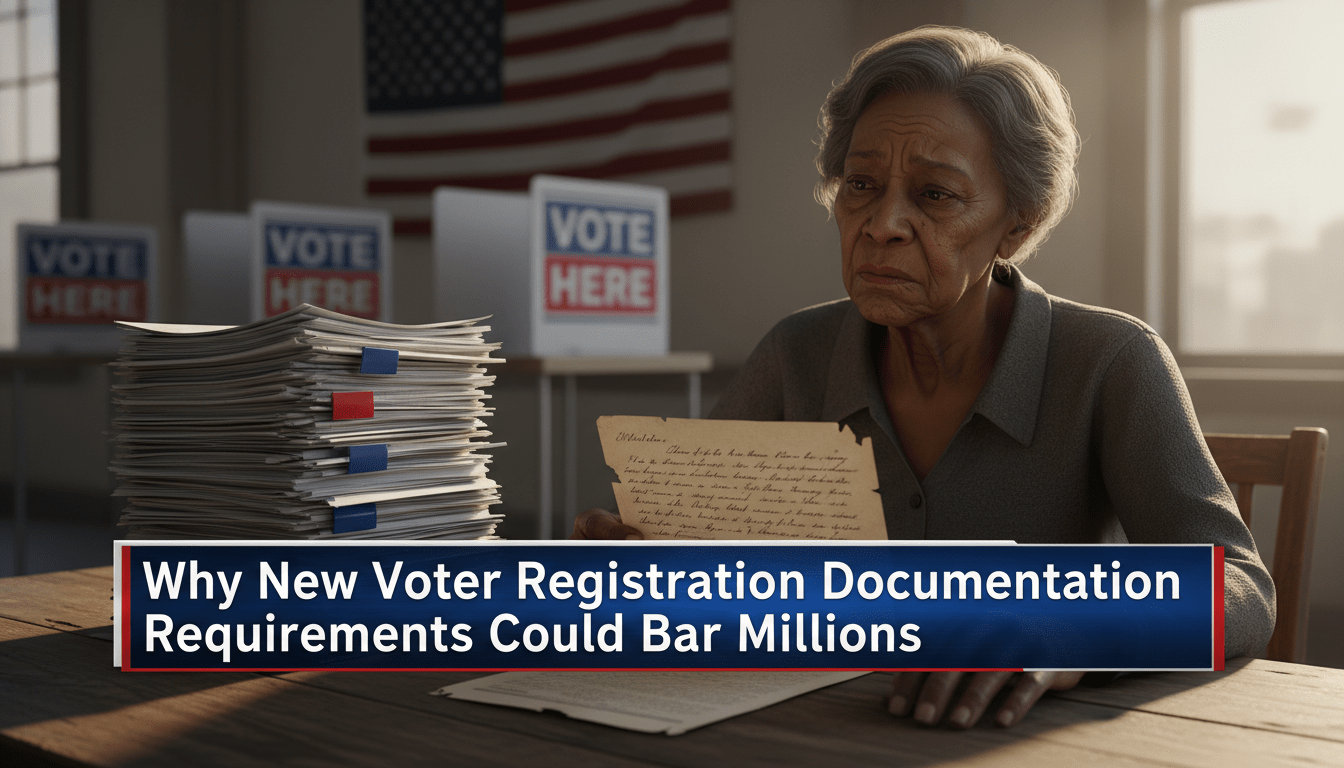
The requirement for birth certificates poses a unique challenge for many elderly Black Americans. For those born in the South during the Jim Crow era, getting these documents is often impossible. Systemic hospital segregation meant that many Black mothers were excluded from medical facilities (motherjones.com). Instead, they relied on community midwives to deliver their babies at home. These midwives often lacked the legal standing to file formal birth records with the state. Consequently, many of these citizens were never issued a birth certificate at all.
Today, these voters have been casting ballots for decades based on their sworn testimony. If the SAVE Act passes, they would suddenly need to produce papers they do not have. Replacing a missing or unrecorded birth certificate is a long and expensive process. It often requires secondary evidence like old baptismal or census records. Many elderly rural residents no longer possess these items. This creates a situation where those who lived through the Civil Rights era could lose their voice once again.
Statistics show that this problem is not limited to just a few people. Roughly 25 percent of Black voting-age citizens lack a current government-issued photo ID. In contrast, only 8 percent of white citizens face this same issue (aclu.org). When states like Kansas tried requiring citizenship papers, they blocked thousands of eligible voters (votebeat.org). Many of these individuals were low-income or minority citizens who could not easily navigate the bureaucracy. The SAVE Act would take these localized struggles and make them a national requirement (congress.gov).
The Financial Cost of Documentation
U.S. Passport Fee
Naturalization Replacement
Average cost for documents required by the SAVE Act (motherjones.com)
The Hidden Costs of the “Modern Poll Tax”
Critics of the SAVE Act often call the new requirements a “modern poll tax.” While the bill does not charge a direct fee to vote, the indirect costs are high. Obtaining a birth certificate usually costs between 20 and 40 dollars (motherjones.com). A replacement naturalization certificate for immigrants is much more expensive. That document currently costs 555 dollars and takes months to process. These fees act as a financial barrier for families living paycheck to paycheck.
In addition to money, there is also a significant “Time Tax” involved. Many people must take time off work to visit government offices that are only open during business hours. In rural areas, the nearest ID-issuing office might be hours away. These areas are often called “ID deserts” because they lack easy access to services. For a person without a car or reliable transit, this journey is nearly impossible. This burden falls hardest on low-income workers who do not have flexible schedules.
The total cost of meeting these requirements can easily exceed 100 dollars for a single person. This includes notary fees, transportation, and the price of the documents themselves. When compared to the historical 1.50 dollar poll tax, the modern cost is actually higher when adjusted for inflation. This leads to concerns about the history of black voter disenfranchisement. The law essentially requires a person to pay for the right to participate in their government. Many legal experts argue this violates the spirit of the Constitution (acslaw.org).
The Arizona Experiment and the Bifurcated System
The state of Arizona has already tried a version of the SAVE Act, and the results were confusing. A 2013 Supreme Court case, Arizona v. Inter Tribal Council of Arizona, shaped this experiment. Justice Antonin Scalia wrote that states must “accept and use” the federal registration form (wikipedia.org). However, Arizona still wanted to require proof of citizenship for its own state elections. This led to what officials call a “bifurcated” or two-tier voting system.
Under this system, voters who do not provide papers are put on a “Federal-Only” list. They can vote for the President and Congress but not for their local Governor or school board (votebeat.org). Currently, over 47,000 Arizona residents are stuck in this partial-voter status. This creates massive administrative headaches for local election workers. They must maintain two separate lists and ensure people get the correct ballots. This complexity often leads to errors and long delays at polling places.
The SAVE Act would essentially force this confusing model onto all 50 states. It would override current state laws that prioritize ease of access. National civil rights groups warn that this would create a national crisis of ballot inconsistency (aclu.org). They argue that the confusion alone would cause many people to stop voting entirely. If the process is too hard to understand, voters often give up. This “soft suppression” is a major concern for those who value high voter turnout (youtube.com).
Data and the Statistical Gap of Non-Citizen Voting
One of the biggest points of debate is whether a problem actually exists to justify the SAVE Act. Supporters argue that non-citizens are registering in large numbers, but state data says otherwise. In Georgia, a 2024 audit of 8.2 million voters found only 20 non-citizens on the rolls (votebeat.org). None of those 20 people had successfully cast a ballot. In Ohio, an audit of 8.1 million voters found only a tiny fraction of potential non-citizens. These numbers suggest the problem is statistically very rare.
In contrast, the number of eligible citizens who lack “extra papers” is quite large. A 2024 study by the Brennan Center found that 21.3 million Americans do not have easy access to proof of citizenship (motherjones.com). These are people who were born in the U.S. but do not have a passport or a birth certificate in their possession. Roughly 3.8 million of these citizens have no way to get these documents at all. This might be due to records being destroyed in fires or natural disasters. The gap between the “problem” and the “solution” is immense.
Public opinion polls show that most Americans actually support the idea of showing ID. About 83 percent of people told Gallup they favor requiring proof of citizenship (votebeat.org). However, many people may not realize how difficult it is for millions of their fellow citizens to comply. While the idea sounds simple, the reality on the ground is much more complicated. The law would impact people across all political parties and backgrounds. It creates a barrier that affects the most vulnerable members of society the most.
Demographic Hurdles for ID Access
Data reflects percentages of groups facing documentation barriers (motherjones.com, aclu.org)
Impact on Women and the Name Match Problem
American women face a specific paperwork hurdle under the proposed SAVE Act rules. Roughly 80 percent of women change their names when they get married. This creates a mismatch between their current identification and their original birth certificates. To register under the new rules, these women might have to produce marriage licenses or court orders. This adds another layer of complexity to a process that used to be simple. For many, these documents are tucked away in boxes or lost over time.
If a name on a birth certificate does not match the name on a driver’s license, the registration could be rejected. The SAVE Act leaves the final decision on “sufficient proof” to local election officials (congress.gov). This discretion can lead to inconsistent rules across different counties. Historically, giving local officials this kind of power has led to profiling and discrimination (aclu.org). Women who have been voting for decades might suddenly find themselves flagged as “unverified” simply because they changed their last name.
This issue also affects students who may be attending college in a different state from where they were born. They often have out-of-state IDs and may not have their birth certificates with them. Requiring them to hunt down these papers can discourage young people from voting for the first time. The goal of the 1993 law was to make registration a “one-stop-shop” at the DMV (acslaw.org). The SAVE Act dismantles this convenience. It forces citizens to act as private investigators for their own personal history.
The Final Conflict Between Access and Security
The debate over the SAVE Act is not just about a single vote in the House of Representatives. It is a fundamental disagreement about the purpose of election laws in a democracy. One side believes that the risk of non-citizen voting is so great that it justifies making registration harder for everyone. They see documentation as the only way to ensure the integrity of the ballot. To them, the “honor system” is a loophole that must be closed immediately (youtube.com).
The other side points to the historical and statistical evidence showing that non-citizen voting is extremely rare. They argue that the real threat to democracy is the disenfranchisement of millions of eligible citizens. They see the bill as a tool that will “lock out” the elderly, the poor, and people of color. By requiring “extra papers,” the government is creating a barrier that many cannot overcome. The conflict highlights the deep divide in how Americans view the right to vote (aclu.org).
As the bill moves forward, the impact on the Black community and other marginalized groups remains a central concern. The legacy of hospital segregation and the high cost of replacement documents are real obstacles. For many, these are not just minor inconveniences; they are walls that block the path to the polling place. The coming months will determine if the nation moves toward stricter documentation or remains committed to broader access. Either way, the “history behind the headlines” suggests this struggle is far from over.
About the Author
Darius Spearman is a professor of Black Studies at San Diego City College, where he has been teaching for over 20 years. He is the founder of African Elements, a media platform dedicated to providing educational resources on the history and culture of the African diaspora. Through his work, Spearman aims to empower and educate by bringing historical context to contemporary issues affecting the Black community.
