


Chicago Police: Why Black Residents Still Face Systemic Force
By Darius Spearman (africanelements)
Support African Elements at patreon.com/africanelements and hear recent news in a single playlist. Additionally, you can gain early access to ad-free video content.
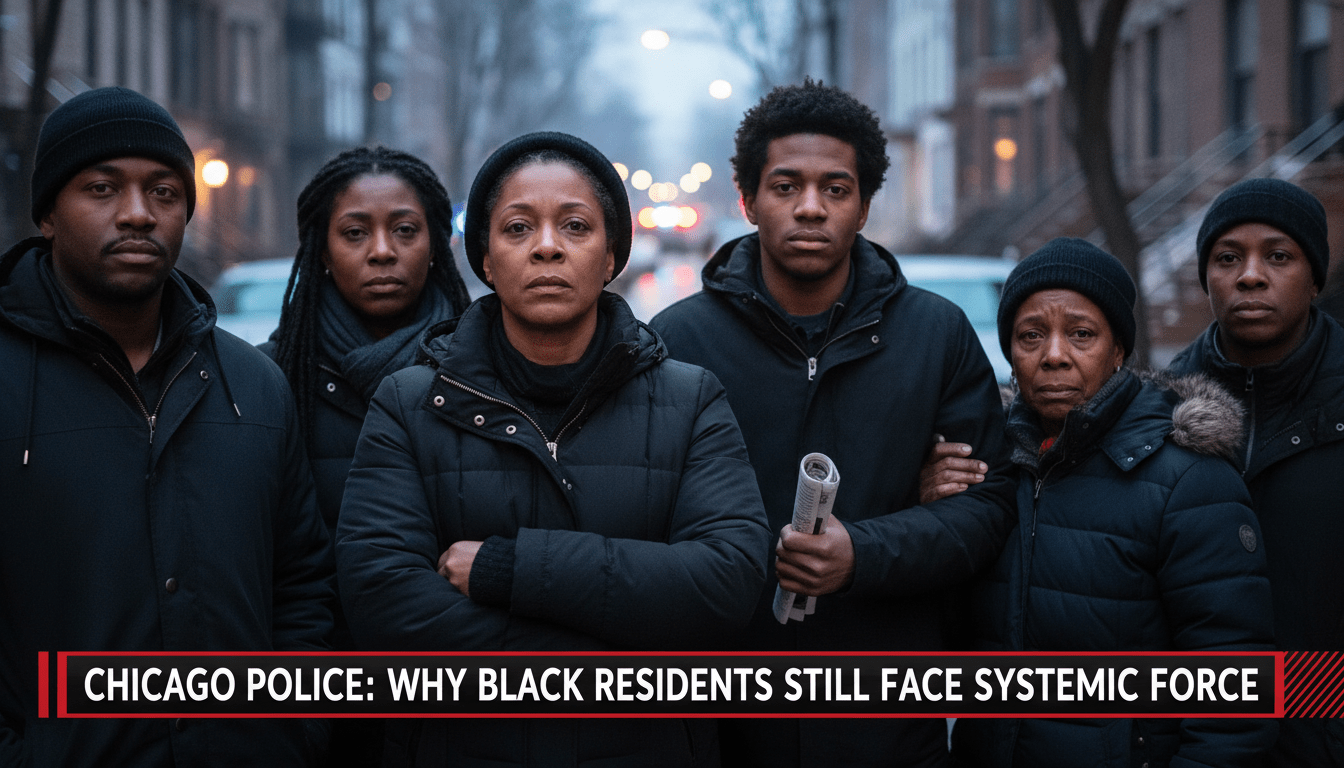
The streets of Chicago are witnessing a sharp rise in police activity that has many residents on edge. Fresh data from the city oversight agencies shows a massive jump in force complaints. This trend is deeply concerning to community watchdogs who monitor these patterns. Black residents continue to bear the heaviest burden of these police actions. While the news focuses on today, the roots of these problems go back over a century. Understanding this crisis requires a look at the history that created it.
Currently, the administration under President Donald Trump oversees a federal landscape where police reform remains a heated topic. In Chicago, the numbers tell a story of a department that is struggling to change. Between 2023 and 2024, use-of-force incidents reported by the Chicago Police Department jumped by 47 percent (youtube.com). This spike happens even as the city remains under a federal court order to improve. The jump in complaints suggests that the relationship between the police and the people is in a state of emergency.
Chicago Police Use-of-Force Increase (2023-2024)
Source: Civilian Office of Police Accountability Data
The Record Surge of 2024 and 2025
The Civilian Office of Police Accountability (COPA) and the Independent Monitoring Team are sounding the alarm. In 2025, the Bureau of Internal Affairs received more than 5,300 complaints (youtube.com). This is a record high for the city of Chicago. The sheer volume of these complaints has created a massive backlog of investigations. By late 2025, nearly half of all open internal cases were more than six months old. This delay means that officers who face accusations of misconduct remain on the job for long periods without resolution.
Watchdog groups like Impact for Equity state that trust is completely broken. They argue that the police department treats Black residents as suspects first and citizens never (youtube.com). This mindset leads to more frequent and more intense encounters. Groups such as the Free2Move Coalition point to a rise in pretextual traffic stops. These stops have replaced older tactics that the courts previously found to be illegal. The high number of complaints is a sign that the community is no longer willing to accept these patterns in silence.
Foundations of Friction in the 1919 Race Riot
The tension seen today is part of a century-long history of racialized policing. The modern era of conflict began with the 1919 Race Riot. This event started at a segregated beach when a white man threw stones at a Black teenager named Eugene Williams. Williams drowned as a result of the attack (chicagoraceriot.org). When police arrived at the scene, they refused to arrest the white man who threw the stones. Instead, the officers arrested a Black man who was complaining about the lack of action (chicagoraceriot.org).
This failure of justice triggered a week of violence that left 38 people dead. Afterward, a commission published a report titled The Negro in Chicago in 1922. This report documented systemic bias within the police force (chicagoraceriot.org). It warned that the police held a different standard for Black citizens than for white citizens. Even though the report offered many solutions, city leaders ignored most of them. This early history set a foundation where the police were seen as protectors for some and an occupying force for others.
The 1960s and the Siege of Black Leadership
The middle of the twentieth century brought more scandals that damaged the reputation of the Chicago Police Department. In 1960, the Summerdale Scandal revealed that uniformed officers were running a burglary ring. This led to the creation of the Chicago Police Board to provide civilian oversight. However, the most traumatic event of this era was the murder of Fred Hampton in 1969. Hampton was a 21-year-old leader of the Black Panther Party who was working to unite the community.
CPD officers and the FBI carried out a raid on Hampton’s apartment while he slept. They shot and killed Hampton in his bed. This event remains a powerful symbol of police aggression toward Black political power. It reinforced the idea that the police were used to suppress community organizers. These actions are part of the political dynamics in the black community that still shape how people view authority today. The memory of such raids continues to fuel distrust of police tactics in Black neighborhoods.
The Midnight Crew and the Legacy of Torture
Between the 1970s and the 1990s, a dark chapter unfolded under Commander Jon Burge. He led a group known as the “Midnight Crew” at police stations on the South Side. Burge and his officers used systematic torture to extract false confessions from over 100 Black men (youtube.com). They used electric shocks, suffocations, and mock executions. This was not a secret to everyone in the department, yet it continued for two decades. The city has since paid more than 200 million dollars in settlements related to these crimes.
This era created a permanent narrative of a “culture of impunity.” It suggested that officers could commit terrible crimes and face no consequences for many years. Many of the men tortured by Burge spent decades in prison for crimes they did not commit. This history of abuse is one of many shared struggles against oppression that Black residents cite when calling for reform. The trauma from the Burge era still affects families across the South Side of Chicago today.
Racial Disparities in Policing Outcomes
Killed by Police
(vs White Drivers)
(Black Residents)
Source: Independent Monitoring Team Reports
Staggering Data on Racial Disparities
The numbers from recent years show that these historical patterns have not disappeared. Statistics illustrate a massive gap in how Black and white residents experience the law. Black residents in Chicago are 7.1 times more likely to be killed by police than white residents (chicagoreporter.com). This disparity is one of the highest in the country. Furthermore, Black drivers are four to seven times more likely to be stopped by police than white drivers (chicagoreporter.com). These stops often occur for minor issues like a broken taillight.
The accountability system also shows a strong racial bias. When Black residents file complaints, only 2 percent of those complaints are “sustained” or found to be true (chicagoreporter.com). In contrast, white residents see a 20 percent sustained rate for their complaints. This means a white person is ten times more likely to have their complaint against an officer taken seriously. This data supports the claim that Black residents face a complex and often heartbreaking history when seeking justice from the city.
From Laquan McDonald to the Consent Decree
The current push for reform began in earnest after the 2014 shooting of Laquan McDonald. McDonald was a 17-year-old who was shot 16 times by Officer Jason Van Dyke. The city kept the dashcam video of the shooting hidden for 13 months. This delay caused a national outcry and led to a federal investigation (chicago.gov). The Department of Justice (DOJ) found that the Chicago Police Department engaged in a “pattern or practice” of unconstitutional force. This force was primarily directed at Black and Latino residents.
In 2019, a federal court order called a Consent Decree was put in place. This decree mandates hundreds of changes to how the police operate. However, progress has been incredibly slow. As of October 2025, the city is in full compliance with only 23 percent of the requirements (chicago.gov). Over six years have passed since the decree began. The failure to meet these goals suggests that there is strong institutional resistance to change within the department. The oversight process is meant to fix these issues, but the results remain out of reach for many.
Pretextual Stops: The New Stop-and-Frisk
As older tactics like “stop-and-frisk” became legally unpopular, the department shifted its strategy. Police now use pretextual traffic stops as a primary tool. This is a tactic where an officer stops a driver for a minor equipment violation to look for more serious crimes. In 2023, the department made over 535,000 traffic stops (chicagoreporter.com). The vast majority of these stops involved Black and Brown motorists. Most of these stops do not result in the recovery of weapons or drugs.
Community groups argue that these stops are just another form of harassment. They function as “fishing expeditions” that target specific neighborhoods. The U.S. Supreme Court made these stops legal in 1996, but that does not mean they are fair. Since it is almost impossible to drive perfectly, these stops give police nearly unlimited power to stop anyone. For Black residents, this means that simple tasks like driving to work become moments of high risk. This constant pressure adds to the histories of African communities dealing with exploitation and control.
Chicago Consent Decree Compliance (2025)
The city has failed to meet 77% of mandated federal reforms after 6 years.
Why the Numbers Are Jumping Now
Community watchdog staff argue that the 47 percent jump in force is not an accident. They believe it is a symptom of how the department is reacting to the Consent Decree. While the city has updated many policies “on paper,” the reality on the street is different. The department claims that 94 percent of its policies are updated, but use-of-force incidents are still rising (youtube.com). This gap suggests that either training is not reaching the officers who are patrolling the neighborhoods or that training is ineffective at curbing police use of force.
The backlog in accountability also plays a major role. When investigations take more than six months to complete, it sends a message to officers. It suggests that they will face no immediate consequences for their actions. This mirrors the “culture of silence” that was seen during the Burge and McDonald eras. For Black residents, the fresh numbers are more than just data points. They are the latest chapter in a long history of being treated as subjects of the state rather than citizens with rights. The failure of reform efforts continues to leave the community in a state of vulnerability.
About the Author
Darius Spearman is a professor of Black Studies at San Diego City College, where he has been teaching for over 20 years. He is the founder of African Elements, a media platform dedicated to providing educational resources on the history and culture of the African diaspora. Through his work, Spearman aims to empower and educate by bringing historical context to contemporary issues affecting the Black community.
