


Why Chicago Police Raids Target Black Families and Children
By Darius Spearman (africanelements)
Support African Elements at patreon.com/africanelements and hear recent news in a single playlist. Additionally, you can gain early access to ad-free video content.
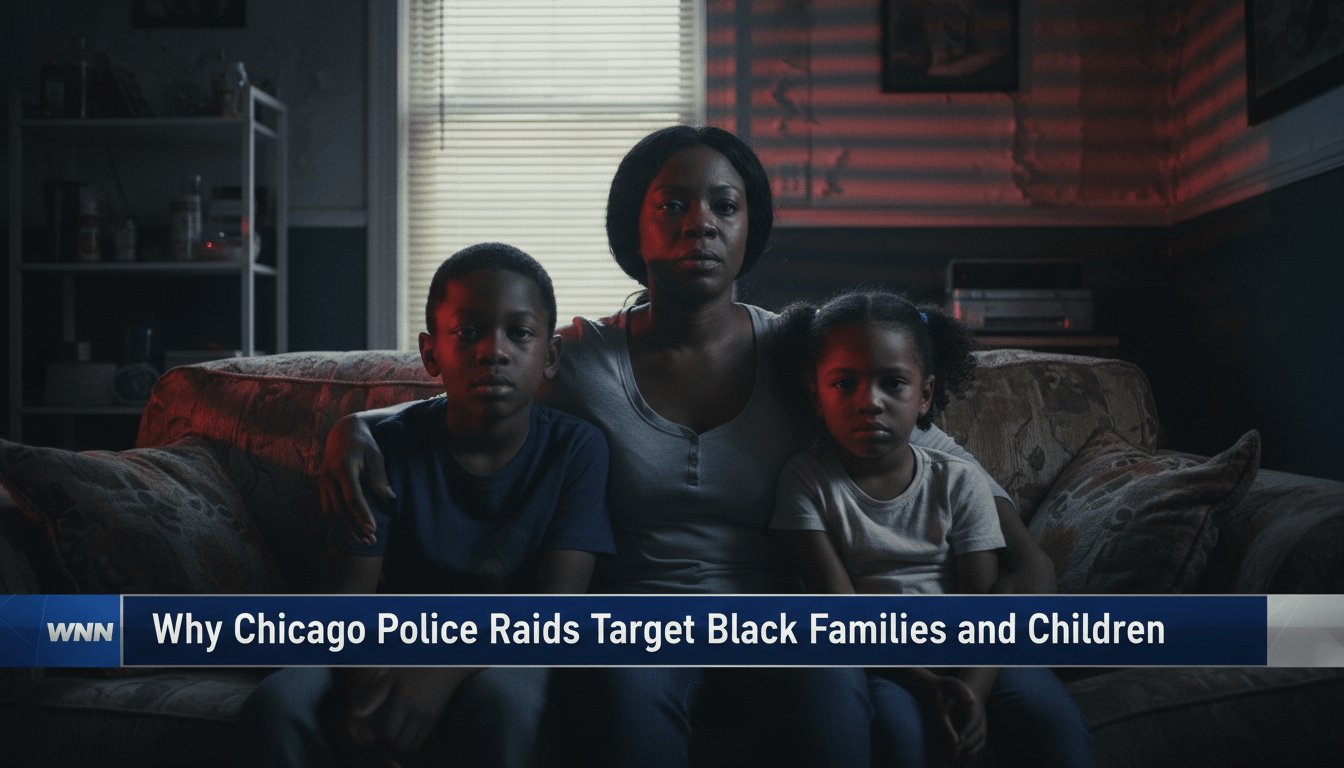
A federal courtroom in Chicago is the setting for a massive legal battle. A jury is deciding if a “code of silence” within the police department led to a terrifying event. In August 2018, a SWAT team raided a home in the Back of the Yards neighborhood. Officers used flashbang grenades and pointed assault rifles at four children. These children were between the ages of 4 and 13. The raid was based on bad information about a man who did not live there (wttw.com). This case is about more than one bad night. It is about a system that protects officers when they make mistakes (wttw.com).
The lawsuit argues that the Chicago Police Department (CPD) has a cultural policy of mutual protection. This culture allows officers to use “terror-inducing” tactics without fear of punishment. Attorney Al Hofeld Jr. claims the city knew its officers were hurting children during raids. However, the department did nothing to stop it because of this unwritten rule of silence (wttw.com). The trial brings a long history of police misconduct into the light. It asks how a major city can allow such trauma to continue for decades. Many people in the Black community view these raids as a threat to their safety (thetriibe.com).
The Terror of the Back of the Yards Raid
The 2018 raid on the home of Ebony Tate and Cynthia Eason was violent and sudden. SWAT officers entered the house looking for a suspect. They did not find him because he had no connection to the family. During the search, officers aimed high-powered weapons at the children. The psychological impact of such an event is deep and lasting (wttw.com). This specific case is part of a larger legal action. It represents eleven families who have suffered through similar “wrong-door” raids. These families are fighting to prove that the city has a pattern of violating civil rights (wttw.com).
The “code of silence” is central to this legal argument. It is an unwritten agreement among officers to never report the wrongdoings of their peers. This culture makes it nearly impossible for citizens to get justice. When officers know they will not face consequences, they may take more risks. In this case, the risk involved the lives and mental health of young children. The plaintiffs argue that this silence is a functional policy of the city. It is a shield that keeps the department from changing its ways (wttw.com).
The Accountability Gap in Chicago
Source: Verified Data Audits (chicagoappleseed.org, chicagoappleseed.org)
The Historic Origins of the Silent Shield
The “code of silence” in Chicago is not a new problem. It has roots that go back to the 1960s. During the 1968 Democratic National Convention, police attacked protesters in what investigators called a “police riot.” Despite the violence being caught on camera, the department stood together. They denied any wrongdoing and protected the officers involved (wttw.com). This unity created a wall that the public could not break. It showed that the department valued its image more than the truth.
One year later, the city witnessed the assassination of Fred Hampton. Hampton was a leader of the Black Panther Party. Police fired almost 100 shots into his apartment while he slept. The department claimed there was a “gun battle.” They lied and said the Panthers fired first (wttw.com). It took ten years of legal work to prove the police and FBI covered up the truth. This event is a clear example of how the department uses silence to hide state-sponsored violence. The balance of power between the state and the people was completely broken during this era.
The code of silence continued to grow during the Jon Burge era. From the 1970s to the 1990s, Commander Burge led a “torture ring.” More than 100 Black men were subjected to horrible abuse at Area 2 headquarters (wttw.com). Officers used electric shocks and mock executions to get confessions. Many other officers knew what was happening. However, no one spoke up for decades. This silence allowed innocent people to go to prison. It also cost the city over $100 million in settlements. The department chose to protect a torturer instead of the citizens it was supposed to serve (wttw.com).
Legal Recognition of the Code of Silence
For a long time, the code of silence was just an unwritten rule. That changed in 2012 with the case of Karolina Obrycka. She was a bartender who was beaten by an off-duty officer named Anthony Abbate. The attack was caught on video. Even with the video evidence, other officers tried to protect Abbate. They tried to hide the tape and silence witnesses (wttw.com).
A federal jury eventually found the city of Chicago liable. The jury decided that a “widespread code of silence” existed within the department. They ruled that this code made Abbate believe he could attack a citizen without being punished (wttw.com). This was the first time a court officially recognized the code as a “de facto” city policy. It proved that the silence was not just a few “bad apples” acting alone. Instead, it was a systemic failure that the city allowed to persist.
The shooting of Laquan McDonald in 2014 was another turning point. McDonald was a 17-year-old who was shot 16 times while walking away from police. Officers on the scene claimed he lunged at them with a knife. This was a lie (wttw.com). Dashboard camera footage proved that McDonald was moving away when he was killed. The city fought to keep that video secret for over a year. The political struggles for transparency in this case led to massive protests. In 2015, Mayor Rahm Emanuel finally admitted that the code of silence was real. He told the City Council that there was a tendency to ignore and cover up officer misconduct (wttw.com).
The Cost of Misconduct: Taxpayer Burden
Total settlements since 2004 exceed $500 Million (citizensforethics.org, bc.edu).
The Burden on Chicago Taxpayers
The code of silence is not just a moral issue. It is a massive financial burden for the people of Chicago. Since 2004, the city has paid out more than $500 million in police misconduct settlements (citizensforethics.org). These funds come from the city budget. This means money that could go to schools or parks is used to pay for police mistakes. The city often borrows money to pay these settlements through “police brutality bonds” (bc.edu). These bonds carry high interest rates that cost taxpayers even more over time.
In 2024, the city paid over $107 million for misconduct cases. Because they only budgeted $82 million, they had to borrow the rest. This borrowing added millions of dollars in interest (bc.edu). Wrongful convictions are the most expensive type of case. They have cost the city over $237 million since 2019 (bc.edu). These costs represent a form of involuntary servitude for taxpayers who must fund a system that is failing them. The financial impact shows that the department’s culture has very real consequences for every resident.
The city’s corporate fund is the main source of this money. When settlement costs go up, the city must make tough choices. It might mean fewer library hours or slower road repairs. Experts call this a “misconduct tax.” It is a price the city pays to maintain its current police culture. As long as the code of silence prevents accountability, these costs will likely continue to rise. Under the current presidency of Donald Trump, federal support for local police often emphasizes strength over reform (citizensforethics.org). This political climate can make it harder for cities to change how they handle these financial and legal issues.
Wrong-Door Raids and Anjanette Young
The 2018 SWAT raid is part of a dark pattern of “wrong-door” incidents. Perhaps the most famous case is that of Anjanette Young in 2019. Young was a social worker who was getting ready for bed when police burst into her apartment. She was naked and terrified while officers handcuffed her (aclu-il.org). Like the 2018 raid, the police were at the wrong house. They ignored her pleas as she told them they had the wrong place.
The city’s response to the Anjanette Young case was familiar. They tried to stop the news from showing the body camera footage. This was a classic move to protect the department from public criticism (aclu-il.org). However, the footage was eventually released. It sparked national outrage and led to the “Anjanette Young Ordinance.” This new law sought to ban no-knock warrants and protect children from having guns pointed at them during raids (aclu-il.org). The ordinance was a direct response to the department’s failure to regulate itself.
Since the Anjanette Young case, the number of residential search warrants has dropped significantly. In 2019, there were over 1,400 warrants. By 2022, that number fell to only 173 (aclu-il.org). This 90% decline happened because the city added stricter rules for vetting informants. Officers must now verify an address before they can get a warrant. They must also have a high-ranking officer present during the raid (chicagopolice.org). These changes were meant to protect the family patterns of the community from unnecessary trauma. However, the 2018 case currently in court shows that the damage was already done for many families.
The Decline of Search Warrants
A 90% reduction followed new verification rules (aclu-il.org).
The Failure of Internal Investigations
One reason the code of silence persists is the failure of the disciplinary system. When a citizen files a complaint, it is investigated by the Civilian Office of Police Accountability (COPA). If they find the complaint is true, it is “sustained.” However, the rate of sustained complaints is incredibly low. Recent data shows that only about 2.53% of complaints result in a finding of misconduct (chicagoappleseed.org). This means that over 97% of complaints are either dismissed or ignored.
Critics point to the “Zero Club” as proof of a broken system. An audit found that 91% of officers had zero sustained complaints over a five-year period (chicagoappleseed.org). While the department might say this shows officers are doing a good job, advocates disagree. They argue that the system is designed to make it impossible to prove misconduct. If the department almost never finds its officers guilty, the code of silence remains strong. Officers feel they can act with impunity because the odds of being punished are very low.
The process for vetting informants is also a major concern. Statistics show that 43% of CPD raids result in zero arrests (wttw.com). This often happens because officers rely on paid informants without checking their information. In the 2018 SWAT raid trial, this is a central point. The officers acted on a tip that was completely wrong. They did not do the basic work to see if the suspect actually lived there. This lack of investigation leads to the trauma of innocent families and children (wttw.com).
The Consent Decree and the Path Forward
Since 2019, the CPD has been under a federal consent decree. This is a court-ordered plan to reform the department’s training and discipline. A judge and an independent monitor oversee the changes (chicagoappleseed.org). The goal is to end the “pattern and practice” of unconstitutional behavior. While there has been some progress in writing new policies, real change on the ground is slow. Some reports suggest that while the department says it is changing, officers are still using excessive force.
Interestingly, there has been a 76% increase in use-of-force reports since 2022 (chicagoappleseed.org). Some experts say this is a “reporting paradox.” It might not mean police are more violent. Instead, it might mean they are finally being forced to report things like pointing a gun at a person. Before the consent decree, these actions often went unrecorded. Now, the department must track every time an officer aims a weapon at someone (chicagopolice.org). This data is vital for understanding the true scale of the problem.
The federal jury currently weighing the 2018 raid case has a big job. They must decide if the city’s culture is truly responsible for the terror those children felt. If they find the city liable, it could lead to even more pressure for reform. The case serves as a reminder that the past is never truly gone in Chicago. From the days of Fred Hampton to the raid in Back of the Yards, the struggle for accountability continues. The “code of silence” may be under attack in the courtroom, but it remains a powerful force in the city’s history.
About the Author
Darius Spearman is a professor of Black Studies at San Diego City College, where he has been teaching for over 20 years. He is the founder of African Elements, a media platform dedicated to providing educational resources on the history and culture of the African diaspora. Through his work, Spearman aims to empower and educate by bringing historical context to contemporary issues affecting the Black community.
