

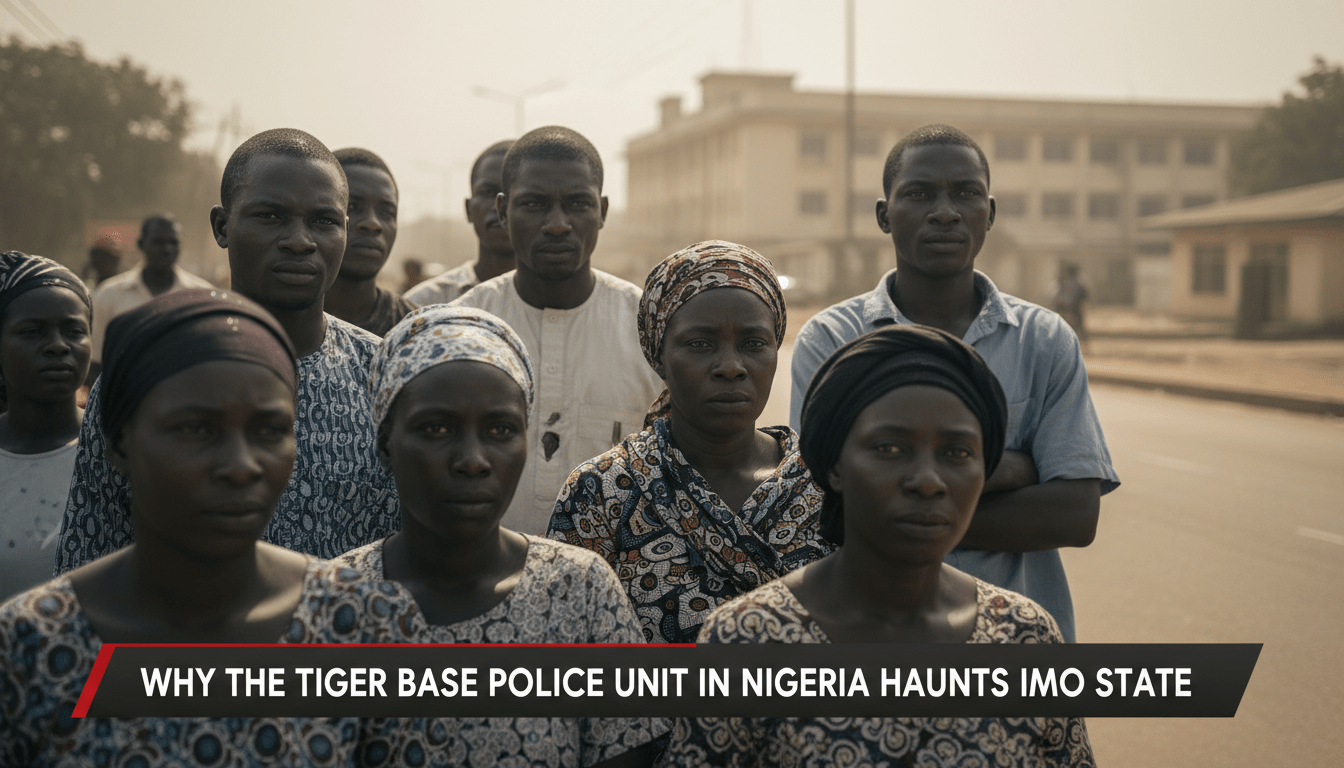
Why the Tiger Base Police Unit in Nigeria Haunts Imo State
By Darius Spearman (africanelements)
Support African Elements at patreon.com/africanelements and hear recent news in a single playlist. Additionally, you can gain early access to ad-free video content.
The streets of Owerri, Imo State, hold a dark secret behind the walls of a facility known as Tiger Base. A recent report by Amnesty International has brought international attention to this police unit. The findings describe a pattern of killings, torture, and massive extortion. This report is a wake-up call for the global community to look closely at the Nigerian justice system (amnestyusa.org). These headlines are shocking, but they are part of a much older story. To understand the current violence, one must look at the history of how policing began in Nigeria. The roots of these abuses reach back to colonial times when the police served as a tool of control (wikipedia.org).
The Nigerian government faces growing pressure to investigate and prosecute those responsible for these crimes. Families of victims continue to demand answers about their missing loved ones. The situation in the South-East region is complex and filled with tension. Security forces claim they are fighting terrorism and separatist movements. However, human rights groups argue that innocent civilians pay the highest price (amnestyusa.org). This deep-dive article explores the transition from colonial guards to modern-day tactical units. It examines how a culture of impunity has allowed units like Tiger Base to operate outside the law (opensocietyfoundations.org).
The Colonial Origins of State Control
The Nigeria Police Force did not begin as a service to protect the people. Instead, it started as a paramilitary force to protect British business interests. In 1861, the British established the Hausa Guard to maintain order in the Lagos colony. This group later became the Hausa Constabulary in 1879. These units were composed of men from the North who were sent to police the South (participedia.net, opensocietyfoundations.org). This “divide and rule” strategy created a sense of the police as an occupying force. The British used these guards to crush local resistance and enforce colonial laws. This history laid the foundation for a police culture that prioritizes state-centered power over the rights of individual citizens (opensocietyfoundations.org).
Following the Nigerian Civil War in the 1970s, the police became even more militarized. The spread of firearms and a rise in violent crime led the government to create specialized units. These teams were designed to be aggressive and fast. Unfortunately, they also inherited the colonial mindset of suppression. The focus was on stability at any cost. By the 1990s, this approach led to the creation of the Special Anti-Robbery Squad, better known as SARS. While SARS was meant to stop armed robbery, it eventually became a symbol of terror for many Nigerians (wikipedia.org).
Casualties and Disappearances (2021-2025)
Source: Amnesty International & Oganihu Civic Group (amnestyusa.org)
The Rise and Fall of the SARS Unit
The Special Anti-Robbery Squad was formed in 1992 to combat a wave of robberies in Lagos. At first, it operated as a covert unit. Officers did not wear uniforms and used unmarked cars to surprise criminals. However, as the unit grew, it began to operate with almost no supervision. By the 2010s, SARS officers were notorious for profiling young people based on their clothing, hairstyles, or the phones they carried. Many young Nigerians were arrested without cause and forced to pay huge sums of money for their release (wikipedia.org, wikipedia.org).
In October 2020, the situation reached a breaking point. A video showing SARS officers killing a young man went viral. This sparked the #EndSARS movement. Thousands of young Nigerians took to the streets to demand the total disbandment of the unit. These protests were not just about one police squad. They represented a larger demand for justice and accountability. The movement gained global support, with people in the African diaspora drawing parallels to the Black Lives Matter movement (participedia.net, takeitbackglobal.com). President Donald Trump’s administration at the time and international bodies monitored the situation closely as the Nigerian government struggled to respond.
The Nigerian government eventually announced the dissolution of SARS. However, many activists believe this was only a rebranding exercise. Operatives from the defunct unit were often moved into new groups. These include the Special Weapons and Tactics (SWAT) team and various state-level anti-kidnapping units. In Imo State, the Anti-Kidnapping Unit (AKU) became the primary successor to this culture of abuse. This facility is the one now known as Tiger Base (amnestyusa.org).
Inside Tiger Base: A Facility of Fear
The Anti-Kidnapping Unit in Owerri is officially tasked with fighting high-level crime. Imo State has seen a rise in kidnapping and separatist-linked violence. The government argues that tough measures are necessary to keep the peace. Nevertheless, Amnesty International’s February 2026 report paints a different picture. It describes a place where the rule of law does not exist. Detainees are often kept in overcrowded and unventilated cells. Some reports mention up to 70 people packed into a single 12-by-12-foot room (amnestyusa.org).
Torture is reportedly used as a standard tool for extracting confessions. Former detainees have shared stories of being beaten with iron rods and cables. Some were hung by their limbs in painful positions for hours. This environment creates a system where a person’s guilt or innocence does not matter. The goal is often to force a confession or to extort money from the suspect’s family. This unit has become a source of political black nationalism tensions, as many victims belong to local ethnic groups who feel targeted by federal forces (amnestyusa.org).
Digital Extortion: The POS Economy
One of the most disturbing trends at Tiger Base is the modern method of extortion. In the past, corrupt officers demanded cash. Today, they use technology to speed up the process. Officers have been caught using Point of Sale (POS) machines to take bribes. This allows them to transfer money directly from a victim’s bank account or force them to use a nearby mobile money agent. These machines are meant for retail business, but at Tiger Base, they serve as a tool for “instant bail” (thecable.ng, amnestyusa.org).
Legally, bail is free in Nigeria. However, at Tiger Base, it reportedly costs between ₦200,000 and ₦800,000. Families who cannot pay these amounts often never see their relatives again. This system creates a cycle of poverty and trauma. It turns the police force into a for-profit organization rather than a public service. The use of POS machines is so widespread that the Inspector-General of Police recently banned them from all police stations. Despite this ban, reports suggest the practice continues through third-party agents outside the station walls (thecable.ng, wikkitimes.com).
The Price of “Bail” at Tiger Base
Note: Bail is legally free under the Nigerian Police Act (punchng.com, thecable.ng)
Systemic Impunity and High-Level Promotions
The lack of accountability for officers at Tiger Base is a major concern for human rights defenders. The unit’s commander, Oladimeji Odeyeyiwa, has been the subject of many petitions. Over 37 civil society organizations have called for an investigation into his actions. Instead of being investigated, he was recently promoted from Chief Superintendent of Police (CSP) to Assistant Commissioner of Police (ACP). This move into the “Commissioner Cadre” is seen by many as a slap in the face to victims (punchng.com, thenationonlineng.net, thenationonlineng.net).
Promoting officers who are accused of serious crimes sends a message that the police leadership approves of their methods. It creates a culture where brutality is rewarded. This institutional shielding makes it almost impossible for families to get justice. When families try to take legal action, they often face delays and intimidation. For example, the family of Japhet Njoku, who died in custody, has faced repeated roadblocks in getting an autopsy. The police have failed to show up for court-ordered procedures on multiple occasions (punchng.com, amnestyusa.org).
The Nigerian Police Force leadership often dismisses these reports as smear campaigns. They claim that the officers are being targeted by criminals who want to weaken security. This denial prevents meaningful reform. Without an independent oversight body that has the power to prosecute, the cycle of abuse continues. The current system relies on the police to investigate themselves, which rarely leads to justice for victims (fes.de, opensocietyfoundations.org).
The Securitization of the South-East
The violence at Tiger Base is tied to the broader security crisis in Imo State. The region has seen frequent attacks by “Unknown Gunmen” on government buildings and security personnel. These actors are often linked to the Indigenous People of Biafra (IPOB) and its armed wing, the Eastern Security Network (ESN). The Nigerian government has designated IPOB as a terrorist organization. This conflict has led to a “shoot-on-sight” mentality among many tactical units (wikipedia.org, thecable.ng, thenationonlineng.net).
In this high-tension environment, innocent civilians are often caught in the middle. The police frequently carry out mass arrests after an attack occurs. Anyone in the vicinity can be picked up and labeled a terrorist. This is what happened to Levi Opara, a local businessman. He was arrested following a minor dispute but died in the custody of Tiger Base. His death is just one of many that security forces have failed to explain adequately (amnestyusa.org). The fight for justice for these individuals is part of a shared struggle for unity against state oppression.
The label of “Unknown Gunmen” also complicates the search for justice. It allows the government to blame vague “criminal elements” without identifying specific groups or causes. This lack of clarity makes it easier for security forces to justify extreme measures. However, human rights groups argue that the government’s response often fuels more violence. When the state acts like a criminal, it loses its moral authority. This leads to further instability and mistrust in the community (guardian.ng, thecable.ng).
A Century of Policing History
The International Response and the Leahy Law
The international community, including the United States, plays a role in Nigerian security. The U.S. government provides funding and training to various Nigerian security units. However, there are laws in place to prevent aid from going to human rights abusers. The Leahy Law prohibits the U.S. from providing military assistance to any foreign unit if there is credible information that the unit has committed “gross human rights violations” (opensocietyfoundations.org).
Human rights groups are now calling on the State Department to apply this law to units like Tiger Base. They argue that the evidence of torture and extrajudicial killings is undeniable. Applying the Leahy Law would send a strong message to the Nigerian government. It would show that international support is not unconditional. Currently, the vetting process for these units is slow. Many “dirty units” still receive aid because reports of their abuses are not processed quickly enough (opensocietyfoundations.org).
President Donald Trump’s administration continues to balance security cooperation with human rights concerns. While the U.S. wants to help Nigeria fight terrorism, it cannot ignore the reports of state-sponsored violence. The global Nigerian diaspora also puts pressure on foreign governments. They use social media to share stories of victims and demand that their tax dollars do not fund brutality. This transnational activism is a powerful tool in the fight for reform in Nigeria (takeitbackglobal.com).
The Road to Justice and Reform
Reforming the Nigeria Police Force requires more than just changing names or uniforms. It requires a fundamental shift in how the police view their role in society. The current system of economic exploitation through bribes must end. This requires paying officers a living wage and providing them with the tools they need to do their jobs legally. It also requires a robust internal affairs system that actually punishes misconduct (fes.de, opensocietyfoundations.org).
Furthermore, the legal system must be strengthened. Court orders for autopsies and the release of detainees must be respected. When police officers ignore the courts, they undermine the entire justice system. Civil society organizations continue to push for the full implementation of the Anti-Torture Act of 2017. This law makes torture a criminal offense, but it is rarely enforced against security agents. Prosecuting a high-ranking officer would show that no one is above the law (amnestyusa.org, opensocietyfoundations.org).
The story of Tiger Base is a tragic example of what happens when power is left unchecked. It is a reminder that the struggle for human rights is ongoing. The families of Levi Opara, Japhet Njoku, and many others deserve to know the truth. They deserve to see those responsible for their pain held accountable. Only then can the cycle of violence in Imo State begin to heal. The world is watching, and the call for justice is louder than ever (amnestyusa.org).
About the Author
Darius Spearman is a professor of Black Studies at San Diego City College, where he has been teaching for over 20 years. He is the founder of African Elements, a media platform dedicated to providing educational resources on the history and culture of the African diaspora. Through his work, Spearman aims to empower and educate by bringing historical context to contemporary issues affecting the Black community.
