



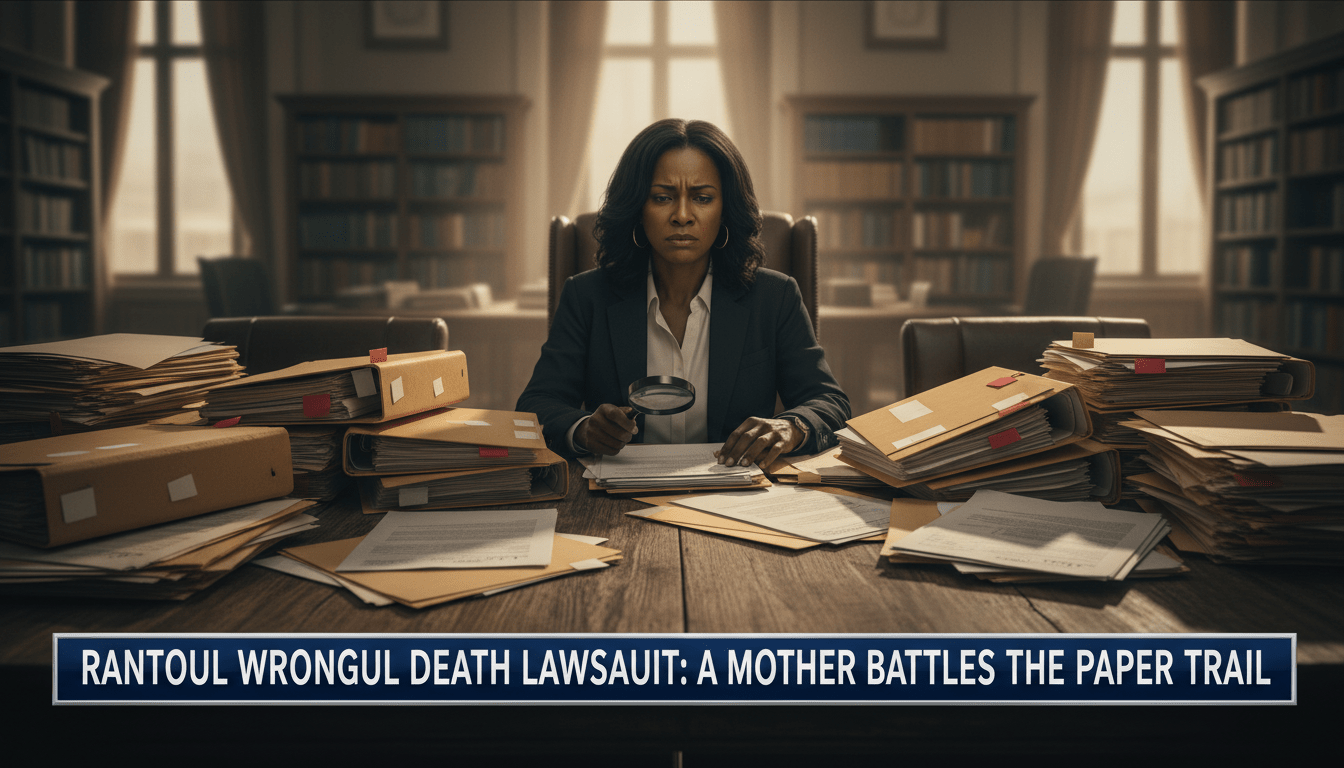
Rantoul Wrongful Death Lawsuit: A Mother Battles the Paper Trail
By Darius Spearman (africanelements)
Support African Elements at patreon.com/africanelements and hear recent news in a single playlist. Additionally, you can gain early access to ad-free video content.
The quiet streets of Rantoul, Illinois, carry the weight of a heavy history. For decades, this town thrived as a military hub. Today, it is the center of a legal battle that mirrors the struggles of Black communities across the nation. In June 2023, the life of 18-year-old Jordan Richardson ended during a foot pursuit with local police (myrantoul.com). His death was the first fatal police shooting in the history of the village. Now, his mother is using the legal system to pull back the curtain on how local law enforcement operates.
Amy Richardson filed a wrongful-death lawsuit against the Village of Rantoul in August 2025. She updated the filing in February 2026 to include new evidence from the police department’s own records (robertkinglawfirm.com). This case is not just about one tragic night. It is about a town that lost its economic heart and the systemic issues that filled that void. The lawsuit highlights a “paper trail” of internal documents and body camera footage. These records suggest that the official story told by the police might not be the whole truth.
The Ghost of Chanute Air Force Base
To understand the current tension in Rantoul, one must look at what the town used to be. For over 75 years, the Chanute Air Force Base was the engine of the local economy. It opened in 1917 to train pilots for World War I (illinois.edu). By World War II, it was a massive facility for ground crew training. It later became a center for training soldiers on intercontinental ballistic missiles and firefighting techniques (illinois.edu). The base was the lifeblood of the community, providing thousands of jobs and millions of dollars in revenue.
The collapse began in 1993 when the base officially closed its doors. The impact was immediate and devastating. Rantoul lost more than 100 million dollars in annual revenue (illinois.edu). The population and the tax base dropped by half. Local schools lost two-thirds of their students almost overnight. This economic vacuum changed the character of the town. As the military left, Rantoul struggled to find a new identity. The once-thriving hub became a place defined by its past and the struggle to survive in the present.
The Post-Closure Collapse (1993)
The loss of the base also left behind a polluted landscape. The cost to clean up the environment exceeded 276 million dollars (rantoul.il.us). Dangerous chemicals known as PFAS were found in the soil and water. These “forever chemicals” came from the firefighting foam used at the base for decades. These toxins decrease property values and cause long-term health problems for the people who remain. The environmental decay mirrors the social decay that often follows when a major industry disappears. This landscape of struggle is the world Jordan Richardson grew up in.
A Fatal Encounter on the Streets
On June 7, 2023, the local police attempted to stop a vehicle. Jordan Richardson was a passenger in that car. The driver, Jheremia McKown, fled from the traffic stop (ipmnewsroom.org). The car was already on the police radar because it had fled a previous stop in April. When the vehicle finally stopped, Richardson jumped out and ran. Sergeant Jerry King chased him on foot. During this chase, King fired his weapon, striking Richardson and killing him (myrantoul.com).
The police department immediately released a statement. They claimed Richardson was armed with a stolen 9mm handgun and turned toward the officer (ipmnewsroom.org). Investigators did find a gun with an extended magazine a few feet from his body. However, the lawsuit filed by his mother tells a very different story. She argues that the body camera footage shows her son was trying to comply. The suit claims Richardson was dropping the weapon and falling when the fatal shot was fired (robertkinglawfirm.com). This dispute over the final seconds of his life is at the heart of the legal battle.
The driver of the car, Jheremia McKown, did not escape the consequences of that day. He was arrested and later pleaded guilty to armed violence in December 2024 (ipmnewsroom.org). A judge sentenced him to 15 years in the Illinois Department of Corrections. While the driver went to prison, the officer who fired the shot remained on the force. This disparity in outcomes is a common source of pain for the resilience of families in the Black community. They often see their children face the harshest penalties while law enforcement receives the benefit of the doubt.
The Hidden Power of FOIA
Journalists and activists have been working to find the truth behind the headlines. They used the Freedom of Information Act, or FOIA, to get internal documents from the Rantoul Police Department (invisible.institute). These documents created a “paper trail” that the village did not initially share with the public. Organizations like the Invisible Institute and Illinois Public Media led this investigation. They wanted to see if the department followed its own rules and training standards (ipmnewsroom.org).
The records revealed something startling. While the internal review board cleared Sergeant King of criminal wrongdoing, they found flaws in the department’s preparation. The board recommended that officers receive extensive “force-on-force” training (invisible.institute). This type of training uses live simulations to help officers stay calm in high-stress situations. The records showed the department had not implemented this training before the shooting occurred. This failure suggests that the village may have sent officers into the community without the proper tools to handle split-second decisions safely.
Percentage of police use-of-force incidents involving Black residents in Rantoul (2022), despite Black residents making up only 19% of the population.
The use of FOIA is a vital tool for the pursuit of racial justice. Without these requests, the public would never have known about the recommended training. The legal filing by Amy Richardson relies heavily on these documents to argue that the village was negligent. She believes that if Sergeant King had been properly trained, her son might still be alive. This use of data and internal records turns the department’s own paperwork against them in the search for accountability.
Racial Disparities and “Driving While Black”
The shooting of Jordan Richardson did not happen in a vacuum. It is part of a long-term pattern of policing in Rantoul. Data from the Illinois Traffic Stop Study shows a disturbing trend. Between 2004 and 2023, the percentage of traffic stops involving Black drivers in Rantoul increased significantly (wbez.org). In 2004, Black drivers made up 29.1% of stops. By 2023, that number rose to 37.1% (wbez.org). This increase happened even though the Black population in the village remains a minority.
Local activists have complained about racial profiling for years. They point to essays and reports from as far back as 2009 that describe “fishing expeditions” by local police (wbez.org). These are stops for minor issues like a broken taillight that police use to search for more serious crimes. The encounter that led to Richardson’s death started with exactly this type of stop. For many residents, this is the daily reality of being Black in a town with a shrinking economy and a growing police presence. This history of disparate treatment creates a deep sense of mistrust between the community and those sworn to protect it.
The resilience of families in Rantoul is tested every time a new statistic comes out. The state of Illinois as a whole ranks poorly for racial disparities in deadly force. From 2013 to 2023, there were 285 fatal police encounters in the state (rantoul.il.us). Illinois officers use deadly force at a rate higher than the national average. When these numbers are combined with the local data from Rantoul, a clear picture of systemic bias emerges. The lawsuit argues that this environment of biased policing contributed to the tragic outcome for Jordan Richardson.
The SAFE-T Act and Force Standards
Illinois recently passed a landmark law called the SAFE-T Act. This law was designed to change how police use force and to increase accountability (impactforequity.org). It moved the legal standard away from “any force reasonably believed necessary.” Now, the law requires that deadly force only be used when it is strictly “necessary to prevent death or great bodily harm” (aclu-il.org). It also created a “duty to intervene.” This means officers must stop their colleagues if they see them using excessive force.
The Richardson lawsuit claims that the village violated these new standards. The village, however, relies on an older standard called “objective reasonableness.” This comes from a 1989 Supreme Court case called *Graham v. Connor* (oyez.org). This standard says that an officer’s actions should be judged from the perspective of a “reasonable officer on the scene” at that exact moment. It ignores the benefit of hindsight. The village argues that because Sergeant King believed he was in danger, his actions were lawful under the old rules.
The Village of Rantoul is also using a defense called “absolute immunity.” They argue that under state law, a municipality cannot be held liable for the discretionary acts of its officers during the “apprehension of a dangerous suspect” (robertkinglawfirm.com). This legal shield makes it very difficult for families to win civil cases against local governments. It is a high bar that requires the family to prove the officer acted with a complete lack of care for human life. The village continues to deny all wrongdoing, even as more evidence from the paper trail comes to light.
A Continued Search for Justice
As of February 2026, Sergeant Jerry King remains an active employee of the Rantoul Police Department (ipmnewsroom.org). The Champaign County State’s Attorney ruled in 2023 that his use of force was legally justifiable (ipmnewsroom.org). President Trump currently holds office, and his administration has often emphasized strong support for local law enforcement. This political climate adds another layer of complexity to the fight for police reform in small towns like Rantoul. The village government continues to stand by the officer, despite the recommendations for more training.
The lawsuit by Amy Richardson is about more than just money. It is a tactical use of internal records and body camera footage to challenge the narrative provided by the police. By connecting the town’s economic decline to the rise in racial profiling, the case has become a focal point for reform. The people of Rantoul are watching closely. They want to know if the “paper trail” will finally lead to real change. The outcome of this case could set a precedent for how other towns in Illinois handle police accountability under the SAFE-T Act.
Jordan Richardson was only 18 years old when he died. His death forced a community to confront the environmental and social toxins left behind by its military past. The struggle for justice in Rantoul is a reminder that the history behind the headlines is always present. As the legal battle moves forward, the demand for transparency remains. The goal is to ensure that no other mother has to use a paper trail to find out why her son did not come home.
About the Author
Darius Spearman is a professor of Black Studies at San Diego City College, where he has been teaching for over 20 years. He is the founder of African Elements, a media platform dedicated to providing educational resources on the history and culture of the African diaspora. Through his work, Spearman aims to empower and educate by bringing historical context to contemporary issues affecting the Black community.
