



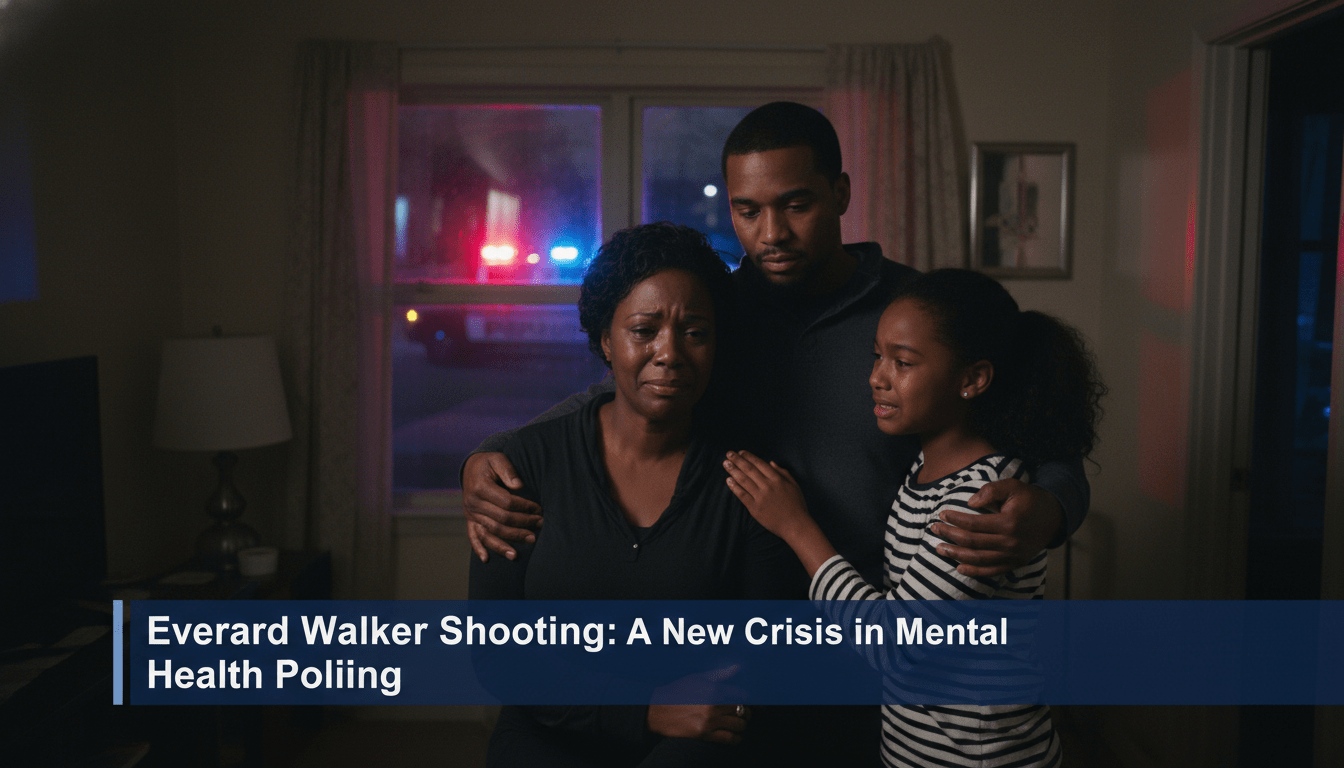
Everard Walker Shooting: A New Crisis in Mental Health Policing
By Darius Spearman (africanelements)
Support African Elements at patreon.com/africanelements and hear recent news in a single playlist. Additionally, you can gain early access to ad-free video content.
The streets of Hartford and Manchester, Connecticut, are silent. Yet, the echoes of five gunshots continue to ring through the Spencer Village apartment complex. On February 19, 2024, Everard Walker, a 47-year-old Black man, lost his life during what should have been a medical intervention (ctpost.com, fox61.com). His family did not call the police for help. They called 211, the number for social services, because Mr. Walker was having a mental health crisis (patch.com). They expected a doctor or a counselor. Instead, they watched as eleven police officers surrounded their loved one (fox61.com).
This tragedy is a painful reminder of the dangers Black families face when seeking medical help. The case is now at the center of a major legal battle. The family plans to sue the police department. They argue that the presence of armed officers turns a health crisis into a combat zone. This story is a small part of a much larger struggle. It is a struggle for a call for racial justice in how the state treats its most vulnerable citizens. For decades, the system has tried to fix police training. However, cases like this one suggest that the problem is the police response itself.
To understand why this happened, observers must look at the history of mental health policing. It is a history of failed promises and broken systems. Under the current administration of President Donald Trump, the debate over police oversight is more intense than ever. The Walker family is fighting for more than just money. They are fighting for a future where a phone call for help does not end in a funeral.
The Fatality Gap
Risk of death during police encounters for those with untreated mental illness.
Those with mental illness are 16x more likely to be killed. (tac.org)
The Day a Medical Call Turned Deadly
Everard Walker was a man with a history of mental health struggles. On that February afternoon, he was experiencing a psychotic episode. He was disoriented and acting erratically. His mother wanted him to get help. She followed the proper steps by calling the 211 system (patch.com). In Connecticut, 211 is supposed to dispatch clinicians from the Mobile Crisis Intervention Services. These specialists are trained to handle emotions, not criminals. They are supposed to be a bridge to a hospital, not a jail.
However, the system failed at the very beginning. When the clinicians arrived, they saw Mr. Walker had a knife. They did not attempt to talk him down from a distance. Instead, they followed a protocol that allows them to call for police backup if they feel unsafe (ctpublic.org). This request for backup changed everything. It brought eleven officers to the scene. These officers did not come with medicine. They came with shields, Tasers, and handguns (fox61.com). They established a tactical perimeter in the narrow hallway of the apartment complex.
The standoff lasted for about an hour. During this time, the tension only grew. Police experts often talk about “de-escalation.” This means using words to calm a person down. But in the Walker case, the presence of so many officers created an “Escalation Paradox.” For a person in a delusional state, eleven armed men in uniform look like a threat, not a rescue team. The officers used a Taser and a bean bag round. Neither stopped Mr. Walker. When he moved toward the officers in the cramped space, they fired five lethal shots (ctpost.com, fox61.com). A call for a doctor ended with a coroner.
Historical Attempts to Reform the Response
The tragedy of Everard Walker is not a new story. It is a story that has been told many times since 1987. That year, the “Memphis Model” was created after a similar shooting in Tennessee. This model focused on Crisis Intervention Team (CIT) training. The goal was to teach police how to identify mental illness and use empathy instead of force. Hartford adopted this model in 2005 (tac.org). The city partnered with the Capitol Region Mental Health Center to ensure officers knew how to handle these delicate situations.
By 2019, the Hartford Police Department even completed the “One Mind Pledge.” This was a promise to have every single officer trained in mental health awareness. They wanted to prove they were ready for any crisis. But training is not always enough. A person can have all the training in the world, but if they carry a gun and a “warrior” mindset, the outcome may still be violent. The Walker family attorney, Ken Krayeske, argues that the problem is not the training. The problem is the presence of police in a medical situation (ctpost.com).
While some cities tried to improve police, others tried to replace them. In 1989, Eugene, Oregon, started a program called CAHOOTS. This program sends a nurse and a crisis worker to 911 calls instead of police. It has been incredibly successful. This “non-police” model is what advocates in Connecticut have been demanding for years. They want to protect the kinship resilience tradition that holds families together during hard times. Instead of a uniform, they want to see a friendly face in a white coat.
Success of Non-Police Teams
Non-police models like CAHOOTS almost never require backup. (vtdigger.org)
The Failed Promise of the HEARTeam
Hartford did try to build a better way. In 2022, the city launched the HEARTeam, which stands for Hartford Emergency Assistance Response Team. This was supposed to be the city’s version of CAHOOTS. It uses civilian responders to handle non-violent calls (ctpublic.org). The idea was simple: if a person is having a mental health crisis, send a social worker. The early data showed great promise. Many people in crisis were more likely to accept help from the HEARTeam than from the police.
But there is a major gap in the HEARTeam’s design. If a situation looks like it might involve a weapon, the system defaults back to the police. This is exactly what happened to Everard Walker. Because a knife was present, the medical path was closed. The paramilitary path was opened. This “failed hand-off” is the core of the family’s argument (ctpost.com). They believe that even if a weapon is present, a medical team is better equipped to talk the person down. A knife does not automatically mean a person is a criminal; it often means they are scared and confused.
The reliance on police backup creates a safety net for clinicians, but a trap for patients. Clinicians are often told to wait for officers to “secure the scene.” By the time the scene is secured, the person in crisis is often surrounded and terrified. This structure prioritizes the physical safety of the staff over the life of the person they are supposed to help. It is a system that values “command and control” more than it values healing. This is why many are calling for a complete separation of mental health services from law enforcement.
Legislation and the Fight for Accountability
In 2020, Connecticut passed a landmark law called the Police Accountability Act, or HB 6004. This law was born from the national protests after the death of George Floyd. It did several important things. It created the Office of the Inspector General to investigate every time an officer shoots someone (billtrack50.com). It also limited “qualified immunity.” This is a legal rule that often makes it impossible to sue police officers for their actions. Because of this law, the Walker family has a chance to hold the department responsible in state court.
The family’s lawyer, Ken Krayeske, is well known for taking on these types of cases. He argues that the officers violated Mr. Walker’s civil rights. He points out that the officers had other options. They did not have to crowd into a narrow hallway. They did not have to shout commands at a man who could not process them. The lawsuit will look at whether the 2020 law truly protects citizens or if it is just words on paper. It is a critical test of whether the state can move toward a doctrine of self-reliance where communities are not policed into submission.
New laws are also being written to change how officers are trained. In 2023, the state passed SB 972. This law requires a more intense curriculum for interacting with people with disabilities and mental illness (billtrack50.com). It is set to start in July 2024. While these laws show that the government is listening, they do not bring Everard Walker back. The community remains skeptical. They have seen many “reforms” before. They want to see a world where the police are not the first and only answer to every problem.
Connecticut Use-of-Force Profile
Almost half of all police use-of-force in CT involves someone in a crisis. (ctpublic.org)
The Racial Context of Public Safety
It is impossible to discuss the Everard Walker case without discussing race. Mr. Walker was a Black man in a country where Black people are disproportionately affected by police violence. Studies show that Black men are more likely to be seen as “threatening” even when they are in need of medical help. This bias is built into the history of American policing. It is a history that often views Black communities through a lens of suspicion rather than support. This is why many families have developed a culture and resistance to the standard ways of calling for help.
When a Black family calls for medical assistance, they are often forced to weigh the risk. Will the responders see a patient, or will they see a suspect? In the Walker case, the arrival of eleven officers suggests that the system saw a suspect. This massive show of force is rarely seen in more affluent or white neighborhoods during a wellness check. The use of a “paramilitary response” in a residential apartment building sends a clear message. It says that the safety of the neighborhood is achieved through dominance, not care.
This reality has led to a deep lack of trust. The ACLU of Connecticut and other advocacy groups have pointed out that the current system puts Black lives at a constant disadvantage. They argue that as long as police are the primary responders, Black men in crisis will continue to die. The family’s lawsuit is not just about one man. It is a demand for the system to acknowledge the humanity of Black patients. They want the state to recognize that a psychotic episode is a medical emergency, regardless of the person’s skin color.
The Path Forward: Disentangling Police and Healthcare
The Everard Walker case is a turning point for Connecticut. It shows that even with “better training” and “new laws,” the results can still be tragic. The push for non-police crisis teams is gaining strength. People want a system where 211 actually means social services, with no police “in-tow.” They want teams that are trained to handle weapons through communication and time, rather than bullets. Time is a tool that police often do not use. They are trained to “resolve” situations quickly, but mental health crises require patience.
There are successful models to follow. In cities like Denver, the STAR program has handled thousands of calls without a single arrest or injury. These programs prove that public safety does not always require a gun. By moving money from police budgets to healthcare budgets, cities can create a true safety net. This would allow clinicians to work without fear and patients to receive care without the threat of death. It is about shifting the focus from “policing” a crisis to “managing” a health event.
As the legal case moves forward, the memory of Everard Walker will be a beacon for change. His family has turned their grief into action. They are forcing the city and the state to answer hard questions. Can we have safety without violence? Can we have order without dominance? The answer will define the future of public safety in America. For now, the community watches and waits, hoping that the next call for help will actually bring the help that is needed.
About the Author
Darius Spearman is a professor of Black Studies at San Diego City College, where he has been teaching for over 20 years. He is the founder of African Elements, a media platform dedicated to providing educational resources on the history and culture of the African diaspora. Through his work, Spearman aims to empower and educate by bringing historical context to contemporary issues affecting the Black community.
