



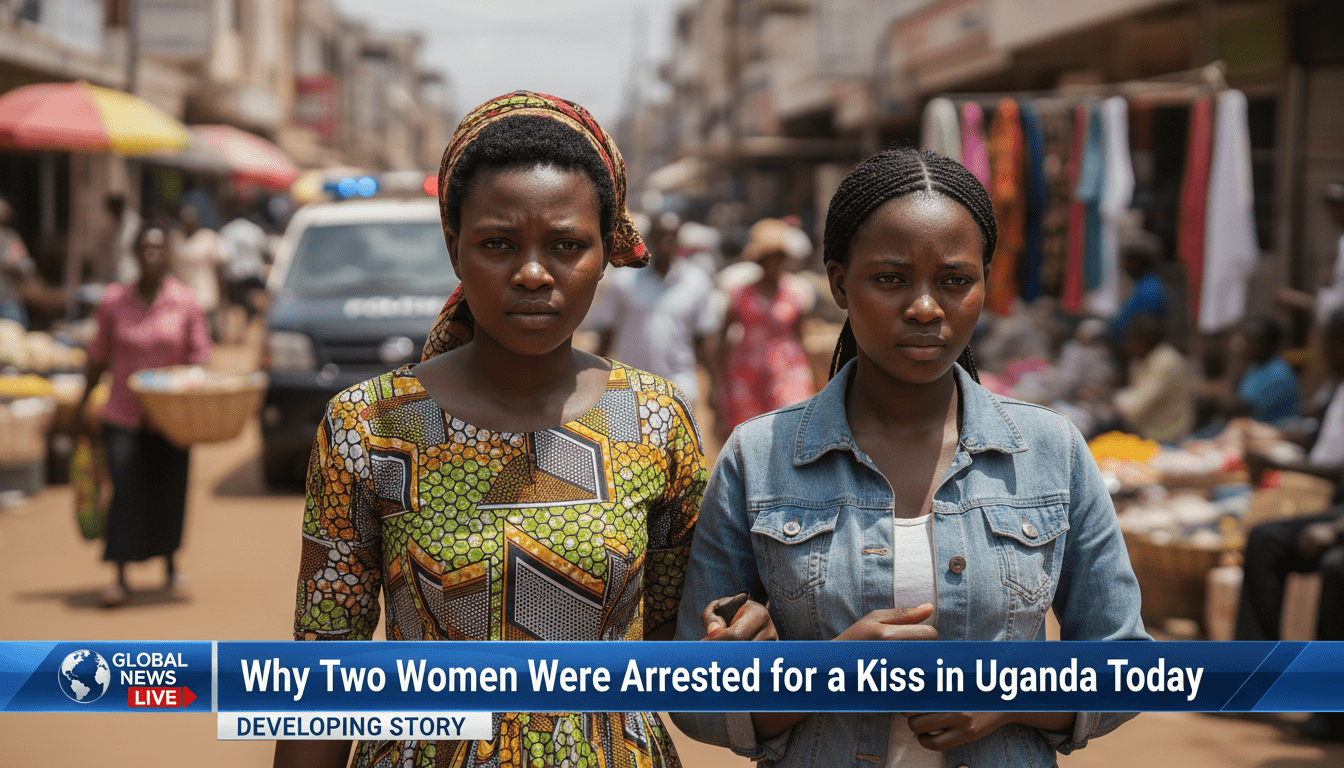
Why Two Women Were Arrested for a Kiss in Uganda Today
By Darius Spearman (africanelements)
Support African Elements at patreon.com/africanelements and hear recent news in a single playlist. Additionally, you can gain early access to ad-free video content.
The news from Uganda recently sent shockwaves through the global family. In February 2026, police in Arua City arrested two young women. Their names are Wendy Faith and Alesi Diana Denise. A neighbor reportedly took a photograph of them kissing in public. This simple act of affection led to their immediate detention (inquirer.net). Wendy is a musician and Alesi is her companion. They now face the possibility of life in prison under the 2023 Anti-Homosexuality Act (streamlinefeed.co.ke).
This arrest is not just a random event. It is the result of a long history of laws that began over a hundred years ago. Rights groups are very worried. They say such arrests spread fear across many different communities. This fear stops people from living their lives openly. It also makes it hard for them to get health care or legal help. To understand why a kiss can lead to a life sentence, we must look at the roots of these laws (76crimes.com).
The Colonial Roots of Ugandan Law
Many people believe these harsh rules are part of traditional African culture. However, history shows a different story. The modern anti-gay laws in Uganda actually started with the British Empire. When Uganda became a British Protectorate in 1902, the British introduced their own legal system. This system included the Penal Code. It contained very strict rules about sexual behavior based on Victorian-era morals (humandignitytrust.org).
The British used a phrase called “carnal knowledge against the order of nature.” This was used to punish any sexual act that did not lead to children. Specifically, it targeted same-sex acts between men. For a long time, these laws were a “colonial remnant.” They were not always used to arrest people. Instead, they sat on the books as a shadow over the community. These laws were never meant to reflect the values of the local people (humandignitytrust.org).
Surge in Rights Violations (2022-2026)
Source: Human Rights Awareness and Promotion Forum (76crimes.com)
How the Laws Changed to Include Women
For many decades, the law only mentioned men. This changed in the year 2000. The Ugandan government passed the Penal Code Amendment (Gender References) Act. This act replaced the words “any male” with “any person.” This small change had a huge impact. It meant that women could now be arrested for what the law called “grossly indecent” acts. This was the first time in Ugandan history that female same-sex acts were clearly criminalized (lse.ac.uk).
The definition of “gross indecency” is very broad. It can include anything from holding hands to a public kiss. This vagueness gives the police a lot of power. They can arrest anyone if a neighbor reports them for “unusual acts.” The case of Wendy and Alesi shows how this works. They were not caught in a private act. They were reported by neighbors who took photos of them. This creates a culture where citizens act like police against each other (unisciencepub.com).
This shift reflects a broader shift in the political narrative that we often see in history. Instead of focusing on crime, the law starts to focus on identity. In the United States, we saw how the government overlooked the experiences of the LGBT community during the struggle for freedom. In Uganda, the law now targets people for who they are and how they live their daily lives (wikipedia.org).
The Influence of Foreign Religious Groups
It is important to know that these laws are not just coming from inside Uganda. Foreign groups have played a big role. In the late 2000s, evangelical missionaries from the United States began visiting the country. One famous example is Scott Lively. He and others held seminars where they told people that homosexuality was a Western threat. They claimed it would destroy traditional families (humanists.international).
These groups spent millions of dollars to influence Ugandan leaders. Reports show that over 54 million dollars were spent by US evangelical groups in Africa. They used this money to help write and support harsh laws. They even coached politicians on how to argue for these laws. They told them to say that these laws protect “national sovereignty.” This is ironic because the ideas they are pushing actually come from outside of Africa (newsghana.com.gh).
The 2023 Anti-Homosexuality Act
The situation became much worse in May 2023. President Yoweri Museveni signed the Anti-Homosexuality Act (AHA). This is one of the harshest laws in the world today. It does not just punish sexual acts. It also punishes the “promotion” of homosexuality. If a person tells others that being gay is okay, they can go to prison for 20 years. This makes it very dangerous for teachers, doctors, and activists to do their jobs (theguardian.com).
The law also includes the death penalty for “aggravated homosexuality.” This can include cases with minors or “serial offenders.” The 2023 law was actually a second attempt. An earlier version in 2014 was stopped by the courts because of a procedural mistake. But the new version is even more strict. It has caused a massive increase in violence and evictions. People are being kicked out of their homes just because of rumors (theguardian.com).
Impact on Community Health Services
Data following the 2023 AHA enactment (hrw.org)
Vigilantism and the Climate of Fear
One of the scariest parts of the 2023 law is how it encourages neighbors to spy on each other. Even though the courts struck down a part that forced citizens to report others, the culture of reporting remains. People feel it is their duty to monitor their neighbors. This is exactly what happened to Wendy and Alesi in Arua City. Their neighbors felt empowered to take photos and call the police (76crimes.com).
This atmosphere makes life impossible for many. The Human Rights Awareness and Promotion Forum (HRAPF) has tracked nearly a thousand cases. These cases include violence, arrests, and people being forced out of their jobs. Within just three months of the law passing, violations increased by over 300 percent. The community is facing a wave of ongoing fights over justice and freedom that mirror historical struggles in other lands (76crimes.com).
Health Care and the Chilling Effect
The “promotion” clause of the 2023 law has hurt health care the most. Doctors are afraid that treating a patient could be seen as promoting homosexuality. This has created a “chilling effect” across the country. Many clinics that used to help people with HIV/AIDS are now empty. People are too scared to show up because they do not want to be arrested or reported (hrw.org).
Health groups like UNAIDS warn that this law is a disaster. It stops the progress Uganda has made in fighting AIDS. Before this law, Uganda was doing a good job of lowering HIV rates. Now, testing has dropped by 31 percent. If people cannot get tested or treated, the virus will spread more. The law puts the health of the entire nation at risk for the sake of a political agenda (hrw.org).
International Pressure and Domestic Power
The world is watching what happens in Uganda. The United States and other countries have tried to stop these laws. Under the current president, Donald Trump, the U.S. government has taken strong actions. Uganda was removed from the AGOA trade program in January 2024. This program allowed Uganda to sell things like clothes and food to the U.S. without paying taxes. Being removed from this program hurts the Ugandan economy (cbp.gov).
The World Bank also stopped giving new loans to Uganda. However, President Museveni uses this pressure to his advantage. He tells the Ugandan people that foreign countries are trying to control them. He frames the anti-gay laws as a way to stand up for Ugandan independence. This message is very powerful during elections. It allows the government to distract people from other problems like the economy or corruption (news.cn).
Evolution of Legal Control
- 1902: British introduce “Sodomy Laws.”
- 2000: Women included in criminal acts.
- 2023: Death penalty and “Promotion” laws signed.
- 2026: Arrests for public kissing in Arua.
The Current Status of the Prisoners
As of late February 2026, Wendy Faith and Alesi Diana Denise are still in custody. They are being held in Arua City. Reports say they have not had a chance to speak with a lawyer yet. This is common because many legal groups are also under attack. The government has suspended groups like SMUG and Chapter Four Uganda. Without these organizations, it is very hard for arrested people to get a fair trial (wikipedia.org, observer.ug).
Their arrest sends a clear message to everyone in the community. It tells them that they are never safe, even in public. Rights groups say this is a deliberate move to intimidate people before national elections. By making an example of these two women, the authorities show that the 2023 law is being fully used. The world continues to call for their release, but the situation remains very tense (inquirer.net, kuchutimes.com).
Conclusion: A Legacy of Control
The arrest of two women for a kiss is a modern tragedy with deep historical roots. It is a story of how colonial laws were kept and made even harsher. It is also a story of how foreign religious ideas can change a nation’s laws. Today, the LGBTQ community in Uganda lives in a state of constant alert. They face prison, violence, and the loss of their basic rights (humandignitytrust.org).
As we look at these headlines, we must remember the history behind them. This struggle is part of a larger global movement for dignity and respect. The people of Uganda are fighting for the right to exist without fear. Their story reminds us that laws can be used to protect people or to control them. The future of Wendy and Alesi will tell us which path Uganda chooses to take (up.ac.za).
About the Author
Darius Spearman is a professor of Black Studies at San Diego City College, where he has been teaching for over 20 years. He is the founder of African Elements, a media platform dedicated to providing educational resources on the history and culture of the African diaspora. Through his work, Spearman aims to empower and educate by bringing historical context to contemporary issues affecting the Black community.
