



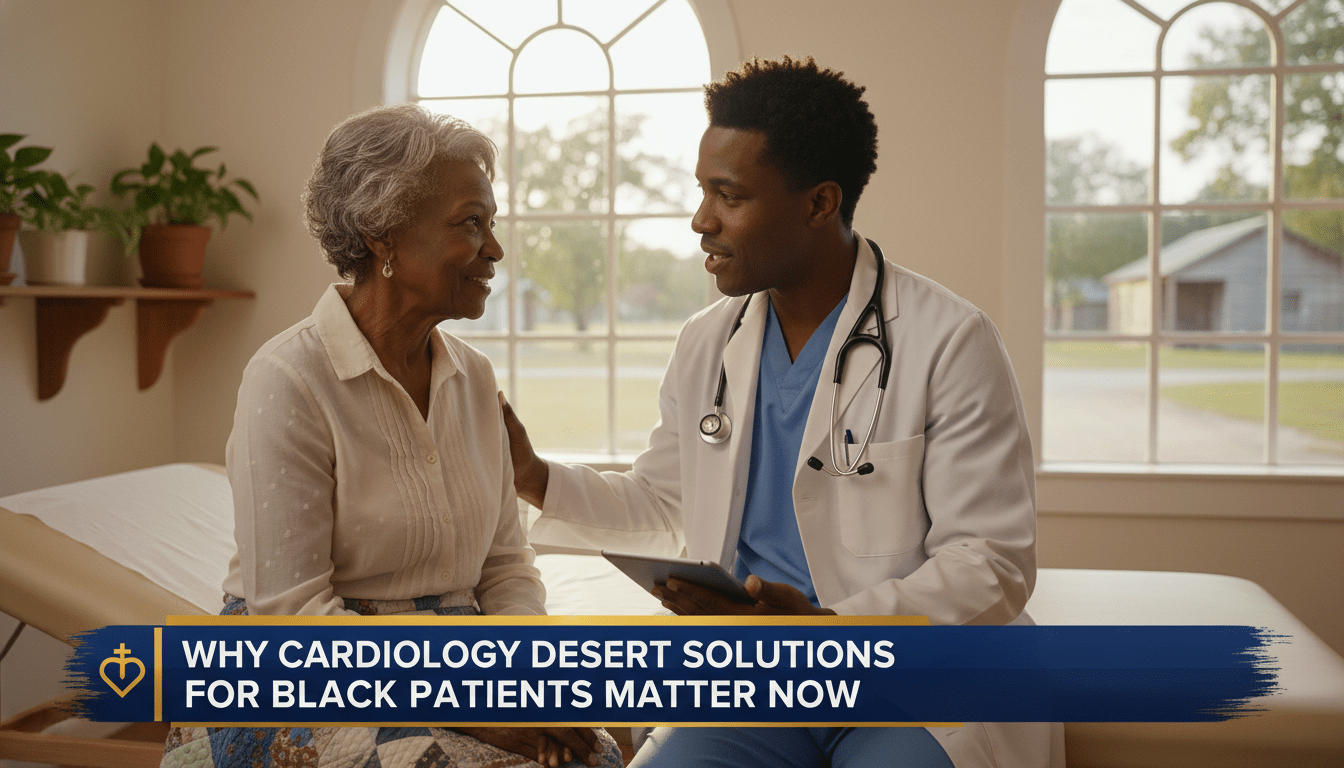
Why Cardiology Desert Solutions for Black Patients Matter Now
By Darius Spearman (africanelements)
Support African Elements at patreon.com/africanelements and hear recent news in a single playlist. Additionally, you can gain early access to ad-free video content.
The conclusion of Heart Awareness Month in early 2026 brought a major announcement. The Association of Black Cardiologists, also known as the ABC, shared plans to grow its “Cardiovascular Desert Initiative” (abcardio.org, abcardio.org). This pilot program focuses on helping Black residents in Georgia, Mississippi, Louisiana, and Arkansas. These areas often lack the medical experts needed to treat heart disease. Consequently, the program provides screenings and access to specialists in places that have been ignored for a long time (cardiologydeserts.org).
While the news sounds modern, this struggle is quite old. The problem of “cardiology deserts” is deeply connected to the survival as invention that defines the Black experience in America. For over fifty years, doctors and activists have fought to bridge these gaps. Geography should not determine whether a person lives or dies. However, in the rural South, a person’s home address often predicts their heart health outcomes (cardiovascularbusiness.com, centerforhealthjournalism.org).
A Legacy of Activism: The Birth of the ABC
The story of this initiative began on November 18, 1974. Dr. Richard Allen Williams and seventeen other Black doctors met at a dinner in Dallas, Texas. They were attending a large conference for the American Heart Association (abcardio.org). These physicians saw a painful reality that others ignored. Black Americans were dying from heart disease at much higher rates than other groups. The medical establishment at the time did not prioritize the specific needs of minority communities (abcardio.org).
This group formed the ABC to bring attention to how heart disease affects African Americans. They did not wait for others to fix the problem. By 1978, the organization started working with local churches (abcardio.org). They turned these houses of worship into centers for controlling high blood pressure. In 1994, the ABC moved its main office to Atlanta, Georgia. This move placed the organization in the heart of the region where it now runs its 2026 pilot (abcardio.org, abcardio.org). This history shows that community-based care is a long-standing tradition.
For decades, the ABC has also fought the “representation gap.” Research from 2015 showed that fewer than three percent of heart doctors in the United States were Black (abcardio.org). This lack of representation makes it harder for patients to find doctors they can trust. Many patients feel more comfortable when their doctor understands their cultural background. When patients and doctors share a common heritage, communication often improves. This connection is a vital part of the history of the Black family and its resilience in the face of medical neglect (nih.gov, henryford.com).
The Managed Reduction of Black Physicians
The shortage of Black heart specialists is not an accident of history. It is the result of a report from 1910 called the Flexner Report (wikipedia.org). This report was supposed to make medical schools better. However, it recommended closing five of the seven existing Black medical schools. Only Howard University and Meharry Medical College remained open (vanderbilt.edu). This decision destroyed the path for Black students to become doctors for over a century.
Experts estimate that this report caused a loss of up to 35,000 Black physicians by the year 2019 (vanderbilt.edu). The report even suggested that Black doctors should only focus on basic hygiene. It discouraged them from becoming surgeons or specialists. Because of this “managed” reduction, most Black doctors today still graduate from just a few schools. This systemic exclusion created the modern representation gap that the ABC is trying to close today (wikipedia.org).
This history of exclusion is a major reason why cardiology deserts exist. Without a steady stream of minority physicians, rural and poor areas lose out. Most medical training happens in wealthy urban centers. Consequently, specialists rarely move to the places that need them most. The ABC initiative is trying to undo over one hundred years of damage caused by these old policies (wikipedia.org, vanderbilt.edu).
The Provider Gap: Counties Without Cardiologists
Percentage of U.S. Counties lacking a single specialist:
Mapping the Voids in Heart Care
In 2024, a study in the Journal of the American College of Cardiology defined what a “cardiology desert” is. It is a county that has zero practicing heart doctors (cardiovascularbusiness.com). Currently, about forty-six percent of all counties in the United States fit this description. This means about twenty-two million people live in areas without specialist care. For Black Americans, the situation is even more dire. About 16.8 million Black people have limited or no access to heart specialists (dicardiology.com).
The state of Mississippi provides a chilling example of this crisis. Sixty-seven percent of counties in Mississippi do not have a single cardiology practice (dicardiology.com). This is fifty-one out of seventy-six counties. Patients in these areas must often drive very long distances for a simple check-up. The average round-trip travel distance is eighty-seven miles. In contrast, people in big cities usually only travel sixteen miles (cardiologydeserts.org). This geographic barrier is a massive hurdle for elderly patients or those without reliable cars.
Dr. Anthony Fletcher, the president of the ABC, recently spoke about this. He noted that survival is now a matter of geography. While heart disease deaths are going down across the nation, they are not dropping as fast for Black residents in the South (abcardio.org). The gap is staying the same or even getting wider. These “voids” in care mean that life expectancy is one year shorter in counties without a heart doctor (dicardiology.com).
Biological Toll of Systemic Inequity
Living in an under-resourced area does more than limit doctor visits. It also causes physical stress. Scientists call this the “weathering hypothesis” (nih.gov). Dr. Arline Geronimus developed this idea. It suggests that the chronic stress of racism and poverty makes the body age faster. This stress happens at a cellular level. As a result, Black Americans often develop chronic diseases five to ten years earlier than white Americans (nih.gov).
The body releases hormones like cortisol and adrenaline during stress. If the stress never goes away, these hormones damage the heart and arteries. This “wear and tear” is very common in regions like the Black Belt. In these areas, residents face high rates of unemployment and a lack of fresh food. These factors are known as Social Determinants of Health (cdc.gov). They account for up to eighty percent of a person’s health outcomes. Medicine alone cannot fix these issues (health.gov).
The struggle for health is part of the larger struggle for Black liberation. It involves fighting for better housing, clean water, and fair wages. When people are constantly worried about survival, their hearts suffer. The ABC initiative recognizes this biological reality. They aim to provide care that is culturally competent and aware of these stressors (abcardio.org, henryford.com).
The Mortality Risk Gap
Black Americans are 30% to 50% more likely to die from heart conditions than white Americans.
Navigating the Southern Coverage Gap
Politics also plays a major role in heart health. In the United States, Medicaid expansion helps poor families get health insurance. However, the states in the Mid-South have different rules. Louisiana and Arkansas have expanded Medicaid (health.gov). This has helped many people afford life-saving medications. In contrast, Mississippi and Georgia have not expanded Medicaid as of early 2024 (cdc.gov).
This creates a “coverage gap” for the working poor. Under the current administration of President Donald Trump, health policy remains a central debate. In states that did not expand Medicaid, many residents in cardiology deserts cannot afford to see a doctor even if one is available (health.gov). They often delay care until they have a heart attack or a stroke. This delay makes the medical outcomes much worse. Expansion is linked to a forty-three percent increase in patients getting the medicine they need (cdc.gov).
The ABC initiative must work within this complex political landscape. The organization provides resources to help patients access medications. They also work with sponsors like Amgen to lower the cost of care (hitconsultant.net). Addressing the Black politics of healthcare is essential for any program in the South. Access to insurance is just as important as having a doctor nearby (health.gov, cdc.gov).
Redefining Community Outreach Models
The ABC uses a “Spirit of the Heart” model for its work. This model focuses on meeting people where they are. Instead of waiting for patients to come to a big hospital, the program goes to churches and barbershops (baltimoretimes-online.com, heart.org). This strategy was pioneered in 1978 by Dr. Elijah Saunders. It is considered the gold standard for reaching the Black community. These locations are trusted spaces where people feel safe (abcardio.org).
The program uses mobile units to offer free screenings. They check for high blood pressure, sugar levels, and cholesterol (cardiologydeserts.org). These community health fairs also teach people how to cook heart-healthy meals. They even distribute specialized cookbooks. By using “trusted voices” like local pastors and barbers, the ABC overcomes historical mistrust of the medical system. This mistrust is rooted in past abuses, so building new relationships is vital (henryford.com, heart.org).
Furthermore, the initiative trains local primary care providers. Many small towns have a family doctor but no heart specialist. The ABC gives these local doctors direct “consultation access” to cardiologists (cardiologydeserts.org). This means a family doctor can get advice from an expert via phone or computer. Consequently, patients receive high-level care without having to drive eighty-seven miles. This two-pronged strategy changes how care is delivered in the desert (cardiovascularbusiness.com, cardiologydeserts.org).
Closing the Literacy Gap on Cholesterol
Another major goal of the initiative is medical literacy. A survey from 2025 found that fifty-four percent of Black respondents did not know the difference between “good” and “bad” cholesterol (heart.org). Cholesterol is carried through the body in lipoproteins. LDL is the “bad” kind. It builds up in the arteries and causes blockages. HDL is the “good” kind. It helps clear the bad cholesterol out of the body (ucfhealth.com, agurgentcare.com).
The ABC uses simple tricks to help people remember this. They teach that “L” stands for “Lethal” or “Lower,” while “H” stands for “Healthy” or “Higher” (heart.org). Understanding these numbers is critical for preventing heart attacks. When people know their numbers, they are more likely to take their medicine. High LDL levels lead to a condition called atherosclerosis, which narrows the arteries (ucfhealth.com). This is a leading cause of death in the Black community.
Education is a powerful tool for health equity. The pilot program provides culturally tailored information that explains these medical terms in plain language (cardiologydeserts.org). By increasing literacy, the ABC empowers residents to take control of their health. When a person understands why they need a certain pill, they are more likely to stay on their treatment plan. This knowledge is a shield against the dangers of the cardiology desert (heart.org, ucfhealth.com).
Cholesterol Awareness Gap
LDL vs HDL
The Difference
Future Outlook for the Mid-South
The Cardiovascular Desert Initiative is a bold step forward. It combines five decades of community trust with modern data. By targeting Atlanta, Jackson, New Orleans, and Little Rock, the ABC is hitting the spots with the greatest need (cardiologydeserts.org). The expansion into surrounding rural areas ensures that no one is left behind. This pilot program serves as a model for the rest of the country. It proves that specialized care can reach even the most isolated places.
As the program grows, it will likely influence how other medical groups handle health deserts. The combination of mobile units, doctor training, and medical literacy is a winning formula. The ABC is showing that a ZIP code should not be a death sentence. By addressing the social and political factors that drive heart disease, they are creating a more just healthcare system (abcardio.org, centerforhealthjournalism.org).
The success of this initiative depends on continued support and funding. With the backing of organizations like Amgen and the hard work of Black physicians, the future looks brighter (hitconsultant.net). The ABC is honoring the legacy of the eighteen doctors who met in 1974. They are continuing the fight to ensure that every heart has a chance to beat strong. This initiative is not just about medicine; it is about dignity and the right to a long life (abcardio.org, abcardio.org).
About the Author
Darius Spearman is a professor of Black Studies at San Diego City College, where he has been teaching for over 20 years. He is the founder of African Elements, a media platform dedicated to providing educational resources on the history and culture of the African diaspora. Through his work, Spearman aims to empower and educate by bringing historical context to contemporary issues affecting the Black community.
