


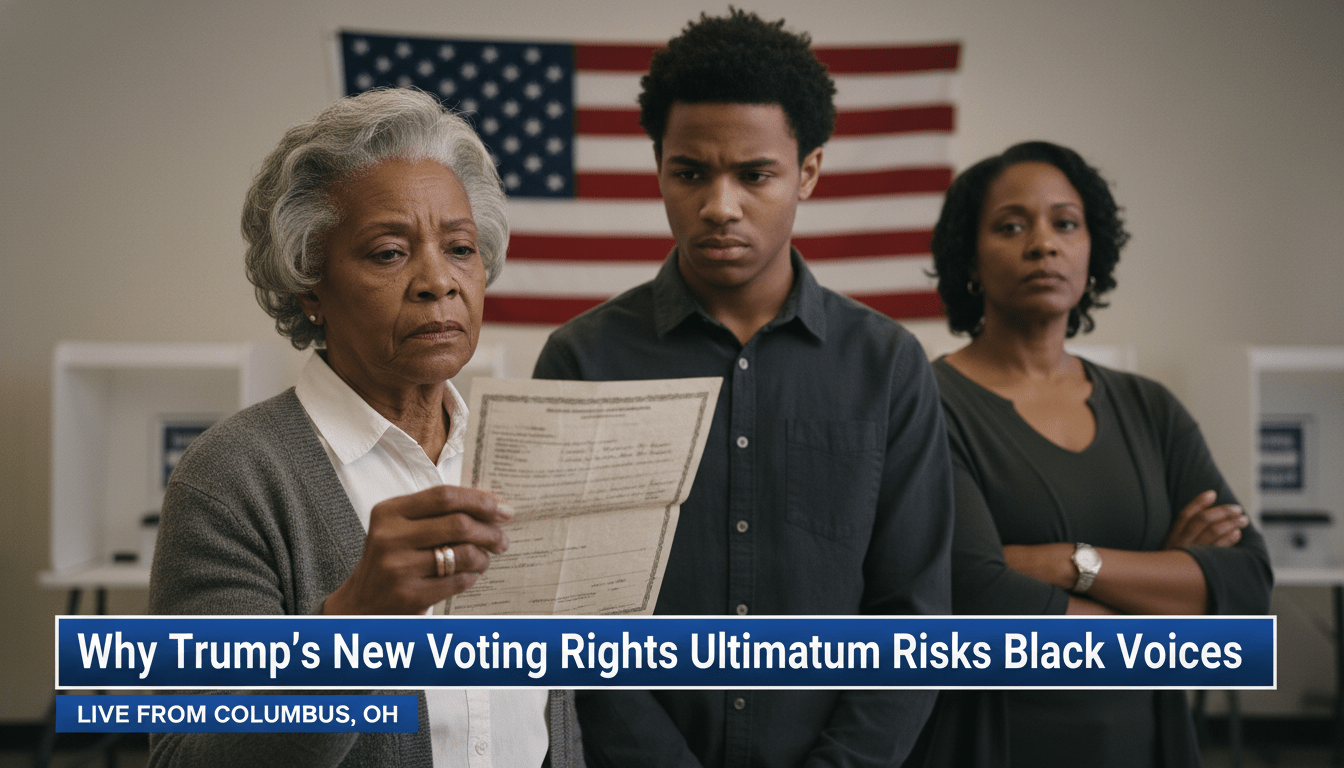
Why Trump’s New Voting Rights Ultimatum Risks Black Voices
By Darius Spearman (africanelements)
Support African Elements at patreon.com/africanelements and hear recent news in a single playlist. Additionally, you can gain early access to ad-free video content.
President Donald Trump recently issued a major demand to the United States Congress. He insists that lawmakers pass the Save America Act immediately. This new legislation targets how Americans vote by mail and how they prove their citizenship. The President stated that this bill must pass before he signs any other federal laws (southfloridareporter.com). This move creates a high-stakes standoff as the 2026 midterm elections approach. Many people worry about what this means for the future of democracy.
The Save America Act focuses on two main changes to the voting process. First, it seeks to limit mail-in voting to only a few specific reasons. Second, it requires every voter to provide physical proof of citizenship when they register. Civil rights leaders argue that these rules will make it harder for many people to vote. They specifically worry about the impact on Black and minority communities. These communities have a long history of fighting for their right to be heard at the ballot box (brennancenter.org).
The Citizenship Document Gap
Percentage of Voting-Age Citizens Lacking Ready Access to DPOC
The Hidden History of Mail-In Voting
Many people believe that voting by mail is a new or modern invention. However, this practice dates back to the American Civil War in the 1860s. During that time, the government wanted soldiers to be able to vote while they were away from home. Republicans supported this idea because they believed soldiers would vote for Abraham Lincoln. On the other hand, Democrats at the time worried about the security of these ballots. They feared that military leaders might pressure soldiers to vote a certain way (nationalgeographic.com).
This early debate shows that voting rules have always been political. Even then, the two major parties fought over who could access the ballot. The post-Civil War struggle for rights highlights how these rules often change based on who is in power. Today, the debate over mail-in voting feels very similar. One side claims it is about security, while the other side says it is about making it easier for everyone to participate. This tension remains a central part of the American story (reimaginerpe.org).
For decades, mail-in voting expanded slowly across different states. It became very popular during the 2020 pandemic because it kept people safe. However, the new Save America Act wants to reverse this trend. It would prohibit mail-in ballots except for military members or those with serious illnesses. Critics argue that this change ignores how much the public has come to rely on this method. They believe that removing this option will lead to longer lines and lower turnout in 2026 (brennancenter.org).
Barriers From the Jim Crow Past
To understand the current ultimatum, we must look at the era of Jim Crow. After the 15th Amendment gave Black men the right to vote in 1870, Southern states created new hurdles. They used laws that sounded neutral but targeted Black citizens. These included literacy tests, poll taxes, and property requirements. These measures were sold to the public as ways to ensure “election integrity.” In reality, they were tools to keep Black people from the polls (carnegie.org).
One of the most famous tools was the “grandfather clause.” This rule said that if your grandfather could vote before 1867, you did not have to take the literacy test. Since most Black people were enslaved before 1867, this law only helped white voters. It allowed poor or uneducated white men to vote while blocking Black men who were in the same situation. This history shows how “integrity” checks can be used to pick and choose who gets a voice (naacpldf.org).
The shifting political narratives of the 20th century eventually led to the Voting Rights Act of 1965. This law was a massive victory for civil rights. It stopped many of the discriminatory practices used in the South. Before this law, Black voter registration in places like Mississippi was only 7 percent. Just five years after the law passed, that number jumped to 67 percent. This proves that federal protection is necessary to ensure fair access for all citizens (ms.now).
The Struggle for Documentary Proof
The Save America Act introduces a requirement called Documentary Proof of Citizenship, or DPOC. This means a voter cannot just sign a paper saying they are a citizen. They must show a passport, a birth certificate, or naturalization papers. While this may sound simple, it is a huge barrier for millions of Americans. Research shows that about 21 million eligible voters do not have these documents ready to use (brennancenter.org).
Many people assume that a driver’s license is enough to prove citizenship. This is not the case for most states. A driver’s license proves who you are and where you live, but it does not always prove you are a citizen. Many legal residents who are not citizens can also get licenses. Under the proposed law, these citizens would need to find their original birth certificates. For many, this is a difficult and expensive task that feels like a modern poll tax (brennancenter.org).
The contributions of Black women in history often involved organizing their communities to overcome such hurdles. Today, those same communities face the highest risks from DPOC rules. Statistics show that 11 percent of Americans of color lack these documents. This is higher than the 8 percent of white Americans who lack them. In states like Georgia and Texas, the gap is even wider for Hispanic voters. These numbers suggest the law will have a unequal effect on different groups (brennancenter.org).
The Myth vs. The Reality
Non-Citizen Voting Instances (1999-2023)
Average of roughly 3 cases per year out of hundreds of millions of votes cast. (brennancenter.org)
Why Documents are Hard to Find
The problem of missing documents is often tied to the history of segregation. For many older Black Americans born in the rural South, hospital births were not an option. Because of Jim Crow laws, many Black women had “midwife births” at home. In many of these cases, official birth certificates were never created or were filed with errors. This makes it almost impossible for these seniors to meet the new DPOC requirements today (brennancenter.org).
Additionally, the cost of getting new documents can be very high. A person might have to travel to another state or pay high fees for a certified copy of their records. For someone living on a fixed income, this is a major burden. It creates a situation where only those with money and time can easily register to vote. This mirrors the old poll taxes that were used to keep the poor away from the ballot box (naacpldf.org).
The political theory on voting suggests that participation is a key part of freedom. When the government adds “paperwork barriers,” it limits that freedom. Young people also struggle with these rules. About 24 percent of voters between the ages of 18 and 29 do not have immediate access to their citizenship papers. This could lead to a significant drop in participation among the next generation of voters (brennancenter.org, brennancenter.org).
The End of Federal Protection
For almost 50 years, the federal government had a tool called “preclearance.” This came from Section 5 of the Voting Rights Act. It required states with a history of discrimination to get approval before changing their voting laws. This prevented unfair rules from ever taking effect. However, in 2013, the Supreme Court case Shelby County v. Holder changed everything. The court struck down the formula used for preclearance (ms.now).
The court argued that the problems of the 1960s were gone. Since that ruling, many states have passed restrictive laws that would have been blocked in the past. For example, North Carolina passed a law that reduced early voting and ended same-day registration. A federal court later said this law targeted Black voters with “surgical precision.” Without preclearance, these laws can stay in place for years while they are fought in court (democracydocket.com).
The Save America Act takes this a step further by making restrictions national. Instead of protecting the right to vote, the federal government would be requiring states to make it harder. This is a major shift in how the country handles elections. It moves away from the goal of maximum participation. Instead, it moves toward a system of federal control over who can register and how they can cast their ballots (southfloridareporter.com).
The Danger to Community Outreach
Third-party registration drives are a vital part of American democracy. Groups like the NAACP or the League of Women Voters go into neighborhoods to help people register. They often visit churches, community centers, and festivals. These drives are especially important for reaching people who do not have easy access to the DMV or the internet. They help close the gap between different groups of voters (ignitenational.org).
The new legislation makes these community efforts very dangerous for organizers. It includes strict penalties for any clerical errors. If a volunteer makes a mistake on a form, they could face criminal charges or huge fines. This pressure is designed to stop these groups from doing their work. Many non-profits may decide that the risk is too high to continue helping people register to vote (naacpldf.org).
Historically, these drives have been essential for Black political power. They provide a way for the community to organize and demand change. By targeting these groups, the Save America Act limits the ability of the people to help one another. This is part of a larger strategy to manage who shows up at the polls. It places the burden of registration entirely on the individual, rather than encouraging the community to get involved (responsivegov.org).
Timeline of Voting Rights Shifts
Black men gain the right to vote federally.
Federal oversight ends Jim Crow voting barriers.
Supreme Court removes federal preclearance tool.
National mandate for DPOC and mail-in limits.
Engineering the 2026 Midterms
President Trump’s ultimatum is timed perfectly for the upcoming 2026 midterm elections. By demanding these changes now, the administration could change the rules just months before people go to the polls. This creates confusion for voters and election officials. It also allows the government to “engineer the electorate” by deciding which groups find it easiest to vote. This strategy mirrors the partisan goals seen throughout American history (southfloridareporter.com).
The claim that these rules are needed to stop non-citizen voting does not match the facts. Experts analyzed years of data and found that non-citizen voting is extremely rare. Between 1999 and 2023, there were only 77 confirmed cases of non-citizens casting a ballot. This is out of hundreds of millions of votes. The high cost of the Save America Act seems to be a solution for a problem that barely exists (brennancenter.org).
The real impact will be on eligible American citizens who are pushed out of the system. When voting becomes a complex test of paperwork and physical presence, many people will simply give up. This is especially true for those working multiple jobs or caring for families. The struggle for the ballot remains a central part of the fight for justice in the United States. As 2026 approaches, the nation faces a choice between making voting easier or building new walls around the ballot box (brennancenter.org).
About the Author
Darius Spearman is a professor of Black Studies at San Diego City College, where he has been teaching for over 20 years. He is the founder of African Elements, a media platform dedicated to providing educational resources on the history and culture of the African diaspora. Through his work, Spearman aims to empower and educate by bringing historical context to contemporary issues affecting the Black community.
