


Is Federal Protection Gone for Black Students in Pennsylvania?
By Darius Spearman (africanelements)
Support African Elements at patreon.com/africanelements and hear recent news in a single playlist. Additionally, you can gain early access to ad-free video content.
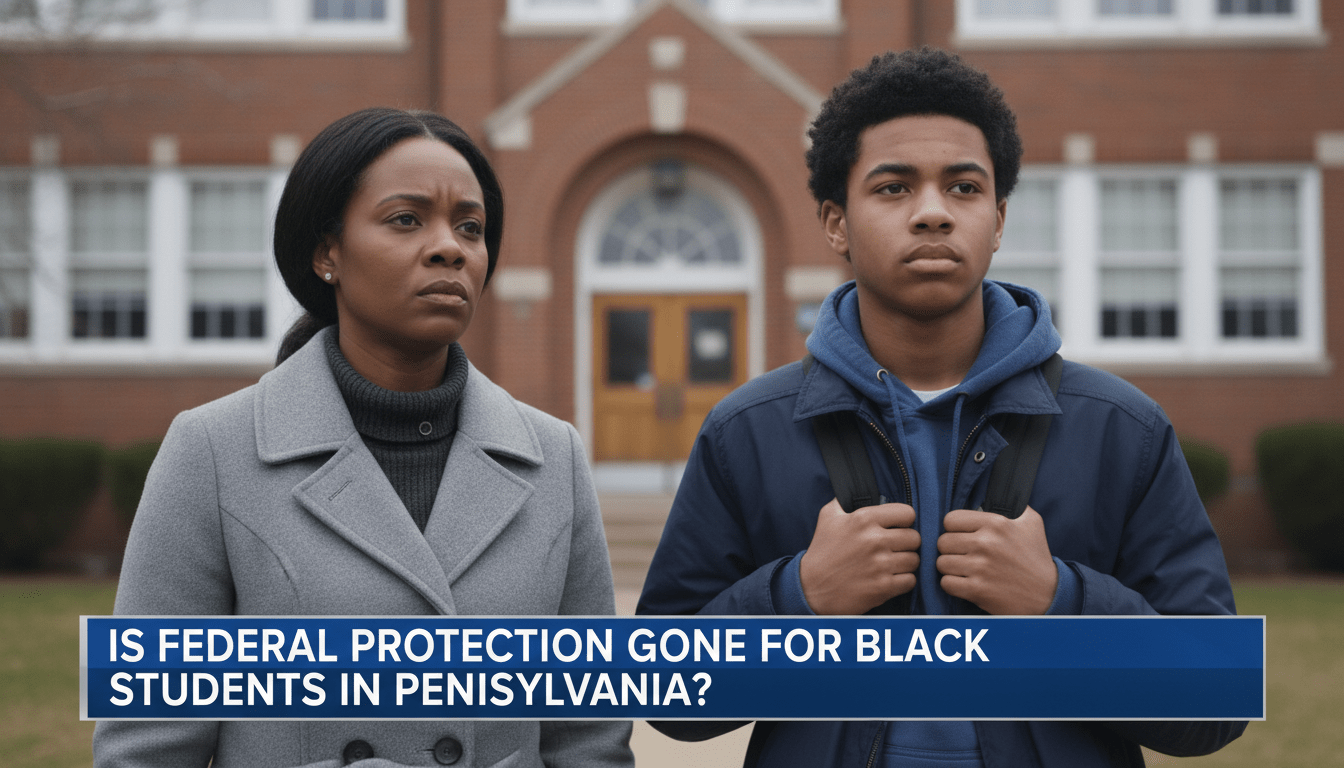
The schoolhouse door has long served as a battleground for civil rights in the United States. Today, a new crisis is unfolding for Black families across the Commonwealth of Pennsylvania. Recent federal actions have dismantled the primary oversight roles of the United States Department of Education. This shift has left parents of students facing racial bullying without a federal safety net. Families who once relied on Washington to investigate systemic discrimination now find those doors closed (timesunion.com).
In districts like Pennridge, the reality of this retreat is both personal and painful. Students have reported a barrage of racial slurs, including being called “slave” and “monkey.” Despite these reports, administrative responses have been minimal or non-existent. These families now look to state governments for the protection that was once a federal guarantee. This transition represents a massive shift in how the nation handles the success of African American students (timesunion.com, washingtonpost.com).
The Birth of Federal Civil Rights Enforcement
For most of American history, local authorities managed schools without federal interference. This changed during the mid-twentieth century when the federal government stepped in to ensure equal protection. The modern safety net grew from the Civil Rights Act of 1964. Specifically, Title VI of this act prohibited any institution receiving federal money from discriminating based on race. This law gave the government the power to withhold funding from segregated schools (timesunion.com, nps.gov).
The Office for Civil Rights, or OCR, became the primary tool for enforcement. In its early years, the OCR moved aggressively against school districts that refused to desegregate. It filed hundreds of administrative proceedings and cut off funding to 200 schools for noncompliance. This era established the federal government as the final arbiter of justice for marginalized students. It created a clear process where families could seek help without expensive private lawsuits (timesunion.com, kappanonline.org).
In 1979, President Jimmy Carter elevated these functions by creating the standalone Department of Education. This move fulfilled a major campaign promise to educational associations. The OCR became a permanent cabinet-level watchdog. It was tasked with investigating thousands of complaints every year. For over forty years, this agency served as the ultimate shield against racial harassment in the classroom (timesunion.com, latimes.com).
Federal Education Staffing Collapse (2025-2026)
Original Staff Level
Current Staff After 1,315 Fired
Source: SOURCE-1, SOURCE-15
The Dismantling of the Federal Role
The current landscape changed rapidly starting in early 2025. President Donald Trump issued executive orders designed to break up the federal education bureaucracy. This policy shift aims to return education control to the individual states. However, the immediate result has been a significant loss of enforcement power. Reports show that 1,315 staff members have been fired from the Department of Education (timesunion.com, washingtonpost.com).
These layoffs have hit the Office for Civil Rights especially hard. High-level investigators who once traveled to schools to interview witnesses are now gone. Regional offices in Philadelphia, San Francisco, and Chicago have closed their doors. This shuttering of offices makes on-the-ground investigations nearly impossible. The agency that once policed the entire country is now a shell of its former self (timesunion.com, latimes.com).
Furthermore, the administration has used Interagency Agreements to move programs. Management of K-12 programs shifted to the Department of Labor. School safety and mental health initiatives moved to the Department of Health and Human Services. Critics argue these agencies lack the specialized legal frameworks needed to protect student rights. They believe these moves prioritize workforce development over human rights (timesunion.com, duanemorris.com).
The Crisis in Pennridge and Beyond
The impact of this federal retreat is visible in the Pennridge School District of Pennsylvania. In 2024, families filed a federal complaint detailing a toxic environment. Black students were routinely targeted with racial slurs and physical harassment. One student even suffered medical issues due to the ongoing stress of the environment. Families hoped the federal government would force the district to change its policies (timesunion.com, washingtonpost.com).
Instead, the Pennridge complaint joined thousands of others in a massive backlog. Because of the staffing cuts, investigations have effectively stalled. There are currently over 300 open federal investigations in Pennsylvania alone that are not moving forward. For these families, the lack of federal action feels like a betrayal. They find themselves in a state of limbo where no one is coming to help (timesunion.com).
This situation highlights the dangers of a national and state power imbalance. When federal authorities step back, marginalized communities often lose their most powerful advocate. Local school boards may feel emboldened to ignore harassment when there is no threat of federal funding cuts. The “teeth” that Title VI provided are being pulled, one by one (timesunion.com).
Turning to State Protection
With federal doors closing, advocates are looking toward state-level solutions. Kristina Moon, an attorney with the Education Law Center, is leading this charge. She encourages families to file complaints with the Pennsylvania Human Relations Commission, or PHRC. The PHRC was founded in 1955 to protect citizens from discrimination. It represents a potential new safety net for students (timesunion.com, adaptivebehavioralservices.com).
However, the PHRC faces significant challenges of its own. Historically, it has focused mostly on employment disputes rather than schools. Education cases make up only about five percent of its total caseload. The agency is also severely under-resourced compared to its historical highs. Staff numbers have dropped from over 200 to approximately 100 in recent years (timesunion.com).
The PHRC also lacks the “power of the purse.” While the federal government can cut off millions in funding, the PHRC cannot. It can issue cease-and-desist orders or award damages to victims. But it cannot unilaterally stop state funding to a defiant school district. This makes it a much weaker deterrent against systemic racism than the federal Office for Civil Rights once was (timesunion.com).
The Limits of State Oversight
Only 5% of PHRC Cases are Education-Related
Source: SOURCE-1
The Pivot to Reverse Discrimination
While traditional racial harassment claims sit in the backlog, federal priorities have shifted. The remaining staff at the OCR are now focusing on different issues. The administration has prioritized investigations into “reverse discrimination.” This term refers to challenges against Diversity, Equity, and Inclusion programs. It also targets race-based scholarships that allegedly disadvantage white students (timesunion.com, duanemorris.com).
In early 2025, the OCR opened dozens of investigations into universities regarding these policies. This shift follows the 2023 Supreme Court decision that restricted affirmative action in admissions. By focusing on these cases, the government is redirecting its limited resources. Advocates argue this makes racial discrimination against Black students invisible through redefinition (timesunion.com, washingtonpost.com).
This redirection of resources is a central part of the broader racial justice movements debate. One side sees the dismantling of DEI as a move toward fairness. The other side sees it as a way to ignore the systemic bullying that Black students face daily. For the parents in Pennridge, the result is the same: their children are no longer a priority for the government (timesunion.com, duanemorris.com).
The Impact of Redefining Gender
Another factor contributing to the backlog is a shift in gender-related policies. The Department of Education has moved toward biology-based definitions for gender. New regulations focus on maintaining sex-based distinctions in school sports and facilities. This legal pivot requires massive amounts of administrative time and resources to enforce (timesunion.com, duanemorris.com).
Because these policy shifts are high priorities for the current administration, they jump to the front of the line. Investigators who might have handled a racial bullying case are instead assigned to these gender-based audits. This creates a situation where different civil rights priorities compete for a shrinking pool of staff (timesunion.com).
In districts like Pennridge, these policies are already being implemented. Policy 123.3, for instance, focuses on sex-based distinctions in athletics. The administrative effort to defend and monitor these policies further distracts from racial harassment. The focus on ideological battles in the boardroom has replaced the focus on student safety in the hallways (timesunion.com, duanemorris.com).
The Title VI Process in Detail
To understand what has been lost, one must look at how Title VI used to work. Any private citizen could file a complaint with the OCR if they felt a school was discriminating. This process did not require a lawyer or a lawsuit. It was an administrative tool designed to be accessible to everyday families. The OCR would then evaluate the complaint for jurisdiction and timeliness (timesunion.com, ed.gov).
If a complaint was accepted, a formal investigation would begin. This included data requests for school records and interviews with staff. The OCR used a “preponderance of the evidence” standard. This is easier to prove than the standards used in criminal courts. The goal was often a “Resolution Agreement” where the school promised to change its ways (timesunion.com, ed.gov).
These agreements included mandatory training, policy revisions, and federal monitoring. This provided a clear path to reform that did not involve years of litigation. With the current staff cuts, this process has broken down. Schools no longer fear the knock on the door from a federal investigator. The mechanism for voluntary compliance has been effectively disabled (timesunion.com).
Disproportionate Discipline Rates (National)
Black Boys Enrollment: 8%
Black Boys Expulsions: 18%
Source: 2020-21 CRDC (ed.gov)
The Scale of Systemic Inequity
The need for federal oversight is supported by data from the Civil Rights Data Collection, or CRDC. This survey collects information from every public school district in the country. It identifies where certain groups of students are treated differently. For example, Black boys represent eight percent of enrollment but eighteen percent of expulsions. This data provides the evidence needed to challenge systemic bias (ed.gov).
The CRDC has been a critical tool for identifying “manifest deficiencies” in education since 1968. It tracks things like access to advanced courses and rates of school-based arrests. This information allows researchers and families to hold districts accountable. Without a strong federal agency to act on this data, the numbers remain just numbers (ed.gov, ed.gov).
In Pennsylvania, school-based cyberbullying saw a seventeen percent increase in 2025. This rise in hostility happens at the same time that federal protections are waning. Nearly twenty percent of high school students report being bullied on school property. These statistics show that the need for a safety net is increasing, not decreasing (timesunion.com).
Proposing a “Muscular” State Agency
Some Pennsylvania lawmakers are trying to fill the void. State Senator Lindsey Williams has introduced a bill to create a new state civil rights office. This agency would be a state-level counterpart to the federal OCR. It would have its own budget and independent authority to investigate school districts (timesunion.com).
Senator Williams calls this a “muscular” state agency. The goal is to ensure that Pennsylvania students have safety standards regardless of federal policy shifts. This office would handle the “disproportionate impact” cases that the federal government is now ignoring. It aims to provide a central body with specialized staff to replace lost federal positions (timesunion.com).
While the bill faces hurdles in the state legislature, it is being seen as a potential national model. Other states may follow Pennsylvania’s lead if the federal retreat continues. This represents a new era of the struggle for civil rights. The fight for equality is moving from the halls of Congress to state capitals (timesunion.com).
A Patchwork of Protection
The shift from federal to state protection creates a “patchwork” of justice. Students in states with robust agencies like the proposed Pennsylvania office may remain protected. However, students in other states may find themselves entirely without recourse. This inequality based on geography undermines the idea of universal civil rights (timesunion.com).
For the families in Pennridge, the current reality is a “hollow, empty feeling.” They realize the federal government has stepped away from the schoolhouse door. They are left to fight their battles locally against powerful school boards. The realization that justice depends on which state one lives in is a difficult one to accept (timesunion.com).
The history of the Department of Education shows that federal oversight was created for a reason. It was meant to be the final arbiter when local systems failed. As that oversight disappears, the nation must decide if it is willing to let individual states define the rights of the marginalized. The struggle for an equitable education for every child continues, even as the safety net vanishes (timesunion.com).
About the Author
Darius Spearman is a professor of Black Studies at San Diego City College, where he has been teaching for over 20 years. He is the founder of African Elements, a media platform dedicated to providing educational resources on the history and culture of the African diaspora. Through his work, Spearman aims to empower and educate by bringing historical context to contemporary issues affecting the Black community.
