



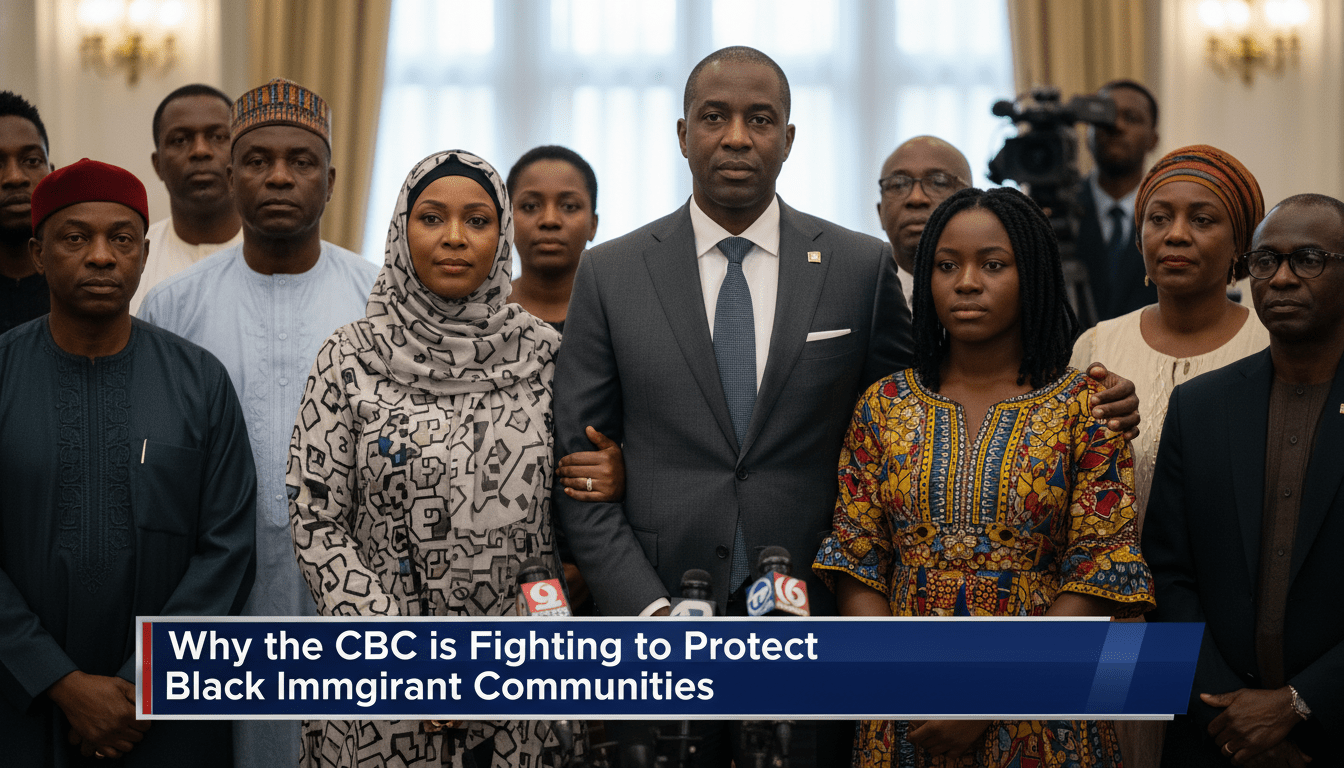
Why the CBC is Fighting to Protect Black Immigrant Communities
By Darius Spearman (africanelements)
Support African Elements at patreon.com/africanelements and hear recent news in a single playlist. Additionally, you can gain early access to ad-free video content.
The Current Crisis and the CBC Demand
The Congressional Black Caucus (CBC) issued a strong message to the administration in March 2026. They demanded an immediate end to federal operations that target Black immigrant communities. Lawmakers describe these actions as “de-franchising.” This term refers to the systematic removal of legal rights and social standing from Black non-citizens (usfca.edu). The current political climate under the second Trump administration has become increasingly tense. Federal agents have launched widespread raids and enforcement actions that specifically impact people of African and Caribbean descent.
The CBC Chair, Yvette D. Clarke, stated that the current tactics are a “violent campaign” against the Black diaspora (tminstituteldf.org). The administration has used its power to surveil and criminalize these communities. These actions have led to fear and instability across the country. Families are being torn apart by aggressive enforcement measures. The CBC argues that these operations do not improve public safety. Instead, they target people based on their race and national origin. This demand is a significant moment in the long history of Black political advocacy in the United States.
Disproportionate Deportation Impact
Analyzing the gap between population share and deportation rates for Black immigrants.
Operation PARRIS and the Minnesota Raids
One of the most controversial initiatives is known as Operation PARRIS. This stands for “Post-Admission Refugee Reverification and Integrity Strengthening.” It began in January 2026 under the direction of Homeland Security Secretary Kristi Noem (washingtonpost.com). The operation focused on over 5,600 refugees living in Minnesota. Most of these individuals are from Somali and other East African communities. The administration justified this sweep as a way to fight fraud. However, critics point out that these residents were already lawfully admitted and vetted (apnews.com).
Federal judges have stepped in to block the operation twice. They cited “dystopian” conditions and warrantless home arrests. Despite these court orders, federal agents have continued to use aggressive tactics. Earlier in 2026, a National Guard shooting during an immigration raid in Minnesota sparked massive civil unrest. This event highlighted the lethal nature of modern enforcement. The CBC argues that the government is using administrative “re-verification” as a weapon. They claim it is a tool to relitigate the legal status of settled residents (washingtonpost.com).
The Impact of the 2026 Visa Bans
In addition to raids, the administration implemented a sweeping visa ban in January 2026. This policy suspended immigrant visas for nationals from 75 different countries. The CBC highlighted a disturbing trend in this list. African nations account for 70% of the restricted countries (cis.org). This effectively blocks 90% of African immigrant visa applicants. It also prevents 85% of applicants from sovereign Caribbean nations like Haiti and Jamaica from entering the United States. These bans separate families and weaken the kinship resilience tradition and unity that defines the diaspora.
The administration claims the ban is necessary for security and economic reasons. They argue that these nations extract wealth from the American economy (cis.org). However, the timing of the ban has caused international outrage. It coincides with the preparations for the 2026 FIFA World Cup. Many fans from Africa and the Caribbean find themselves unable to travel for the event. The CBC maintains that these bans are not about security. They view them as a deliberate attempt to exclude Black people from the American story. This policy reflects a broader strategy of isolationism and racial exclusion.
Historical Echoes: Marcus Garvey and Early Control
The current targeting of Black immigrants follows a long and painful history. In the early 20th century, federal authorities used deportation to silence radical leadership. A key figure in this history is Marcus Garvey. He was a Jamaican-born leader who founded the Universal Negro Improvement Association (nypl.org). Garvey advocated for Black economic independence and global unity. His message was powerful and reached millions of people across the African diaspora. This made him a target of the federal government.
The FBI, under J. Edgar Hoover, used bureaucratic technicalities to remove Garvey. In 1927, he was deported on a mail fraud charge (nypl.org). This tactic allowed the government to dismantle his movement without addressing his political message. The CBC points to this history when discussing Operation PARRIS today. They argue that “re-verification” is just a modern version of the same old tricks. The goal remains the same: to use the legal system to neutralize Black voices and leadership. Understanding this history is vital for shaping political dynamics in the modern era.
The Haitian Refugee Crisis and CBC Advocacy
The CBC became a central advocate for Black immigrants during the 1970s and 1980s. This period was marked by the Haitian refugee crisis. Thousands of Haitians fled political violence and poverty on small boats. The U.S. government responded with a policy of “interdiction at sea” (usfca.edu). This meant the Coast Guard intercepted these boats before they could reach American shores. Once intercepted, the refugees were often sent back without a chance to claim asylum. This treatment was very different from how Cuban refugees were handled at the time.
The government welcomed Cubans as political refugees from communism. Meanwhile, it labeled Haitians as “economic migrants” who did not deserve protection (ccrweb.ca). The CBC and other civil rights groups challenged this double standard. They argued that the distinction was based on race rather than legal merit. This struggle shaped the CBC’s approach to immigration policy. They realized that Black immigrants faced a unique set of challenges. This history led to the CBC’s current focus on protecting Temporary Protected Status (TPS) for vulnerable populations (ccrweb.ca).
Solitary Confinement Rates in Detention
Black Immigrants
Other Immigrants
*Black detainees are six times more likely to be placed in solitary confinement (icij.org).
Crimmigration and the 1996 Legislative Shift
Modern enforcement relies heavily on laws passed in the mid-1990s. The Violent Crime Control and Law Enforcement Act of 1994 and the Illegal Immigration Reform and Immigrant Responsibility Act (IIRIRA) of 1996 changed everything. These laws fused the criminal justice system with immigration enforcement (georgetown.edu). This created what experts call “crimmigration.” It expanded the list of “deportable offenses” to include minor, non-violent crimes. For non-citizens, a single mistake could lead to mandatory detention and fast-track deportation (cambridge.org).
These laws have a disproportionate impact on Black communities. Because Black people are over-policed, they are more likely to have contact with the criminal justice system. This creates a “prison-to-deportation pipeline” (georgetown.edu). Black immigrants are often flagged for removal based on minor infractions that would not result in jail time for citizens. This system creates a form of involuntary servitude where legal status is tied to perfect behavior. The CBC demands a total reversal of these policies to ensure fairness and equity.
The Tragedy of Enforcement Lethality
The human cost of these policies is often measured in lives lost. The CBC cited the death of Nurul Amin Shah Alam as a tragic example of “callous” enforcement. Alam was a refugee who was released by agents in severe weather conditions in Buffalo, New York (washingtonpost.com). He died from exposure shortly after his release. This case illustrates the lack of care and protection provided to vulnerable immigrants. The CBC argues that the administration treats Black bodies as disposable in its pursuit of enforcement goals.
Furthermore, the fatal shooting of two U.S. citizens, Renee Good and Alex Pretti, during federal raids in Minnesota has fueled the fire. These deaths occurred during the unrest following the Lakanwal shooting in late 2025. The administration used the Lakanwal incident, which involved an Afghan national, to justify “Operation Metro Surge” (apnews.com). However, the resulting violence has claimed the lives of innocent people. The CBC maintains that these aggressive tactics create a climate of fear that endangers everyone. They believe that the government must be held accountable for the loss of life during these operations.
Racial Bias in Detention and Abuse
Life inside immigration detention centers is often more difficult for Black migrants. Research from Freedom for Immigrants shows a clear pattern of abuse. While Black migrants make up only 6% of the detention population, they account for 28% of all abuse-related reports (icij.org). They are nearly twice as likely to experience physical abuse from staff compared to other groups. This disparity points to a deep-seated racial bias within the enforcement agencies themselves. Guards often penalize Black detainees more harshly for minor behaviors.
Language barriers also play a significant role in this abuse. Guards frequently speak only English or Spanish. Many African immigrants speak French, Arabic, or other regional languages. When instructions are not understood, guards often file “disobedience” charges (ucla.edu). This leads to higher rates of solitary confinement. Studies show that Black immigrants are 22% more likely to be isolated for disciplinary infractions (icij.org). This cycle of punishment and isolation is a key part of the “de-franchising” process that the CBC is fighting to stop.
Harsher Outcomes for Black Immigrants
| Metric | Black Immigrant | Overall Average |
|---|---|---|
| Deportation Probability (Conviction) | 76% | 45% |
| Asylum Denial Rate (Haiti) | 86% | Varies |
| Abuse-Related Reports | 28% | 6% (Pop. Share) |
*Data compiled from SOURCE-5, SOURCE-19, and SOURCE-22.
Systemic Bias and the Path Forward
The CBC’s demand to cease these operations is about more than just changing a few policies. It is a call to recognize the humanity and rights of all members of the Black diaspora. The “prison-to-deportation pipeline” is a direct result of systemic bias in both the criminal justice and immigration systems. The CBC wants to decouple these two systems. They believe that immigration status should not be used as a secondary punishment for criminal history. This is essential for the struggle for black liberation in the 21st century.
The current administration shows no signs of slowing down its enforcement efforts. President Trump has championed mass deportations as a centerpiece of his second term (washingtonpost.com). However, the CBC and its allies continue to push back through legislation and public pressure. They are focusing on protecting programs like Temporary Protected Status and ending operations like PARRIS. The fight to protect Black immigrant communities is a continuation of the long struggle for civil rights. It requires constant vigilance and a deep understanding of the history that brought us to this moment.
The Future of the Black Diaspora
The outcome of this conflict will shape the future of the Black diaspora in America. If the administration continues its current path, the “machinery of exclusion” will only grow stronger. This would mean more families separated and more communities living in fear. However, the CBC’s formal demand has brought national attention to these issues. It has forced a conversation about the racial dynamics of immigration policy. This visibility is the first step toward meaningful change.
Community organizers and legal experts are also playing a crucial role. They provide support to those targeted by raids and fight the administration in court. The resilience of the Black community has always been its greatest strength. By standing together, the diaspora can resist the efforts to de-franchise its members. The CBC remains committed to this cause. They will continue to demand that the administration treat Black immigrants with the dignity and respect they deserve. The road ahead is difficult, but the history of advocacy provides a roadmap for the future.
About the Author
Darius Spearman is a professor of Black Studies at San Diego City College, where he has been teaching for over 20 years. He is the founder of African Elements, a media platform dedicated to providing educational resources on the history and culture of the African diaspora. Through his work, Spearman aims to empower and educate by bringing historical context to contemporary issues affecting the Black community.
