

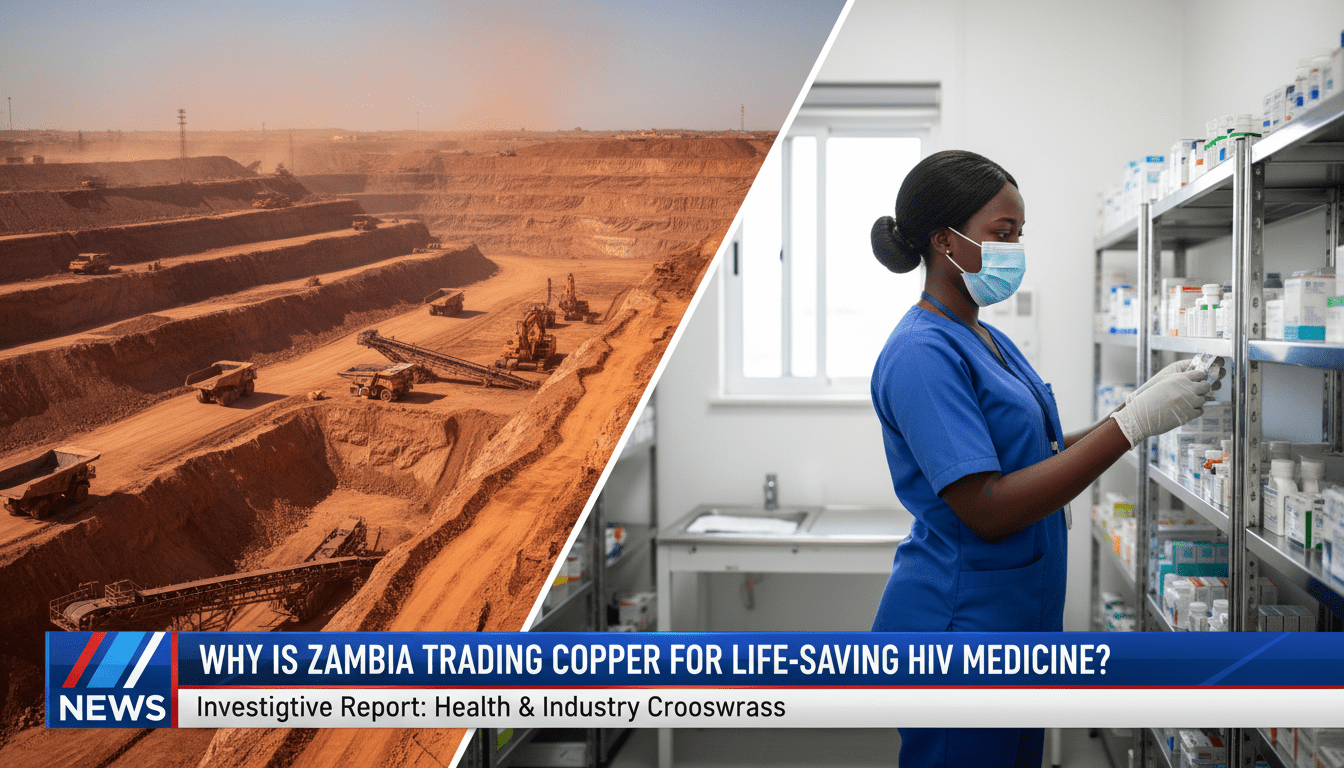
Why Is Zambia Trading Copper for Life-Saving HIV Medicine?
By Darius Spearman (africanelements)
Support African Elements at patreon.com/africanelements and hear recent news in a single playlist. Additionally, you can gain early access to ad-free video content.
The New Transactional Nature of Global Health Aid
A leaked memorandum from the United States State Department has sent shockwaves through the global health community. This document suggests a major change in how the United States handles foreign assistance. Reports indicate that the administration under Donald Trump is considering a plan to tie health aid to mineral access. Specifically, the United States may withhold critical HIV/AIDS funding from Zambia unless the country grants American companies special access to its copper and cobalt mines (theguardian.com). This strategy represents a shift from humanitarian partnership to what critics call a transactional “quid pro quo” model.
For over two decades, the relationship between these two nations centered on saving lives. However, the new proposal suggests using “sticks” to pressure the Zambian government. The memo prepared for Secretary of State Marco Rubio highlights the need to secure minerals for the American electric vehicle industry. This move has sparked accusations of “biomedical imperialism.” This term describes a situation where wealthy nations use life-saving medicine as leverage to extract natural resources from developing countries (thetasalli.com, theguardian.com). It raises serious questions about whether health is a human right or a bargaining chip.
HIV Treatment Progress in Zambia
Number of people receiving life-saving ARV therapy
A History of Extraction and Economic Struggles
To understand the current crisis, one must look at the history of mining in Zambia. Industrial copper production began in the country in 1908. For decades, foreign companies from the United States and South Africa controlled these resources. By 1969, Zambia was one of the wealthiest nations in Africa because of its copper (wikipedia.org). In that year, President Kenneth Kaunda issued the Matero Declaration. This move nationalized the mines to ensure that mineral wealth benefited the Zambian people instead of foreign owners (scielo.org.za).
This period of national control lasted until the late 1990s. During this time, the global price of copper fell and debt began to pile up. Organizations like the World Bank and the IMF stepped in. They pushed for “Structural Adjustment Programs.” These programs forced Zambia to sell its state-owned mines back to private foreign companies (sarpn.org). Many observers believe this political strategy weakened the ability of the government to fund its own public services. By the time the HIV crisis hit its peak, the Zambian healthcare system was already struggling from years of budget cuts (cgdev.org).
The return to private ownership made the Zambian economy vulnerable to global market swings. While the mines produced great wealth, little of it stayed in the country to build hospitals or schools. This economic history created a dependency on foreign aid. When the HIV/AIDS epidemic reached emergency levels, Zambia had few resources to fight it alone. This background explains why the current threat of withholding aid is so powerful. The country is essentially being asked to choose between its economic sovereignty and the lives of its citizens (theguardian.com).
The Rise of PEPFAR and the Medical Safety Net
In 2003, the United States launched the President’s Emergency Plan for AIDS Relief, known as PEPFAR. This program was a massive commitment to fight the HIV epidemic in Africa. Since its start, the United States has invested over $6.7 billion in the Zambian health response (usembassy.gov). This investment changed everything for the nation. In 1997, life expectancy in Zambia was only 46 years. By 2023, that number rose to 66 years because of access to medicine (wikipedia.org).
Today, over 1.2 million Zambians rely on free antiretroviral therapy provided through this partnership. The program created a massive network of clinics and laboratories. It also trained thousands of healthcare workers. For many years, PEPFAR was seen as a symbol of American generosity. It was a clear example of how federalism – or the sharing of power between international and local entities can produce results. However, the current situation suggests that this safety net is now being used as a tool for political leverage (theguardian.com).
The success of PEPFAR created a deep reliance on American funding. Zambia currently allocates about one-third of its national budget to debt repayment. This leaves very little money for health. If the United States follows through with its plan to cut funding, the Zambian government cannot easily fill the gap. This dependency is the core of the “biomedical imperialism” argument. Critics argue that providing life-saving aid should not create a permanent state of submission to the donor nation’s interests (thetasalli.com).
The Proposed 53% Funding Cut
Comparing past 5-year funding to the 2026 proposal
*The 2026 proposal represents a drastic reduction in annual support.
The Race for Critical Minerals and Green Energy
The push for Zambian minerals is driven by the global transition to green energy. Copper, cobalt, and lithium are essential for building electric vehicle batteries and solar panels. Zambia is the second-largest producer of copper in Africa (theguardian.com). The United States is currently in a race with China to secure these materials. China has spent years building infrastructure in the “Copperbelt” in exchange for mining rights. Now, the United States is attempting to use its influence in the health sector to catch up (theguardian.com, brookings.edu).
The administration under Donald Trump views these minerals as a matter of national security. American companies want to reduce their dependence on Chinese supply chains. However, using health aid as a weapon in this competition is a new tactic. This approach is sometimes called “medical extractivism.” It suggests that African lives are less important than the “clean energy” goals of the West. While the United States seeks a “green” future, the tactics used to achieve it are described by some as a new form of colonialism (theguardian.com).
Mining is also a very resource-intensive industry. For example, mining lithium requires vast amounts of water. This often depletes local supplies in the same communities that are losing healthcare funding. The irony is that the “Green New Deal” infrastructure in the West may be built at the expense of the health and environment of the Zambian people. This situation mirrors historical patterns where African resources were taken to build the wealth of other nations (brookings.edu).
The Controversy of Pathogen Data Sharing
The proposed deal involves more than just rocks and minerals. It also includes demands for “biological data.” The United States wants Zambia to share the genetic sequence data of pathogens and sensitive health records for 25 years (theguardian.com). This data is incredibly valuable for pharmaceutical companies. It allows them to design new vaccines and drugs using computers. This process is called “reverse vaccinology” (thetasalli.com).
The risk for Zambia is “bioprospecting” or “biopiracy.” Once a foreign company has the genetic blueprint of a local virus, they can patent the treatment. Zambia might then have to buy back the medicine created from its own biological data. This is why nations like Zimbabwe and Kenya have already rejected similar deals. They view the sharing of health data without guaranteed benefits as a violation of their national sovereignty. They see it as a continuation of the fight for freedom against external control (youtube.com, theguardian.com).
Activists argue that this data sharing is a one-way street. The United States gains the information needed to protect its own citizens and make profits for its companies. Meanwhile, the countries providing the data do not get a share of those profits or guaranteed access to the resulting vaccines. This dynamic reinforces the idea that African populations are being used as “raw materials” for Western science. It is a modern version of old experiments where data was taken without proper consent or fair return (thetasalli.com).
The Looming Fiscal Cliff and Human Cost
If the negotiations fail, the consequences for the Zambian people will be immediate. Experts describe this as a “fiscal cliff.” A 53% cut in funding would lead to a breakdown in the supply chain for medicine. This would cause “stock-outs” where clinics run out of HIV pills and testing kits. For the 1.3 million people on treatment, even a short break in medicine is dangerous. It can lead to “viral rebound,” where the virus comes back stronger than before (theguardian.com, theguardian.com).
There is also the threat of drug resistance. When people stop and start HIV medicine, the virus can mutate. This makes standard, cheap drugs ineffective. Patients would then need much more expensive “third-line” treatments. Zambia cannot afford these medications on its own. It is estimated that a major funding pause could lead to 40,000 deaths within the first three months. The human cost of using health aid as a “stick” is measured in thousands of lives lost (theguardian.com).
The uncertainty is already causing panic among patients and healthcare workers. Citizens have staged “die-in” protests to show what will happen if the aid stops. They argue that their lives should not be traded for copper or cobalt. This situation highlights the extreme power imbalance between a wealthy donor and a developing nation. It also shows the importance of the significance of reparations and economic justice in addressing historical inequalities (theguardian.com).
The “Green” Demand for Zambian Wealth
Copper
Essential for the U.S. electrical grid.
Cobalt
Key for long-range EV batteries.
Lithium
The “white gold” of the energy shift.
Pathogens
Biological data for drug patents.
Global Health Diplomacy or Modern Extortion?
The international community is watching this standoff closely. For decades, global health was treated as a humanitarian field. Even when nations disagreed on politics, they usually cooperated on fighting diseases like AIDS or malaria. This new “Rubio Compact” changes the rules. It suggests that health assistance is no longer a gift of goodwill. Instead, it is an investment that must provide a direct return to the donor nation (theguardian.com).
Critics point out that this model undermines the credibility of the United States. While the United States claims to be a partner in development, these tactics look more like extortion. Other world powers, such as China, are likely to use this controversy to their advantage. They may offer aid without the same “biomedical” strings attached, even if their own deals have other costs. This geopolitical game puts the health of millions of people in the middle of a power struggle (theguardian.com, theguardian.com).
The move also threatens to destroy twenty years of health progress. If the trust between healthcare workers and international donors is broken, it will be hard to rebuild. Public health relies on trust. If people believe that their health data is being sold or that their medicine depends on mining deals, they may stop visiting clinics. This could lead to a resurgence of the epidemic that PEPFAR worked so hard to control (thetasalli.com).
Conclusion: The Choice Facing Zambia
The headline “Mineral Deal Tied to HIV Aid” is the result of a long history of resource extraction. Zambia finds itself at a crossroads. On one hand, the government must protect its natural resources and biological data for future generations. On the other hand, it has a duty to keep its people alive today. The United States is placing a heavy burden on a nation that is already struggling with debt and poverty (theguardian.com, sarpn.org).
This controversy forces the world to ask a difficult question. Is global health a shared responsibility or a commodity to be traded? The answer will determine the future of millions of lives in Africa. As the green energy transition moves forward, the demand for minerals will only grow. If the United States continues to use health aid as leverage, the term “biomedical imperialism” will likely become a common part of the political conversation. For now, the people of Zambia can only wait and hope that their lives are not the price of the world’s move to clean energy (theguardian.com).
About the Author
Darius Spearman is a professor of Black Studies at San Diego City College, where he has been teaching for over 20 years. He is the founder of African Elements, a media platform dedicated to providing educational resources on the history and culture of the African diaspora. Through his work, Spearman aims to empower and educate by bringing historical context to contemporary issues affecting the Black community.
