

Will the Court Erase Black Votes in Louisiana?
By Darius Spearman (africanelements)
Support African Elements at patreon.com/africanelements and hear recent news in a single playlist. Additionally, you can gain early access to ad-free video content.
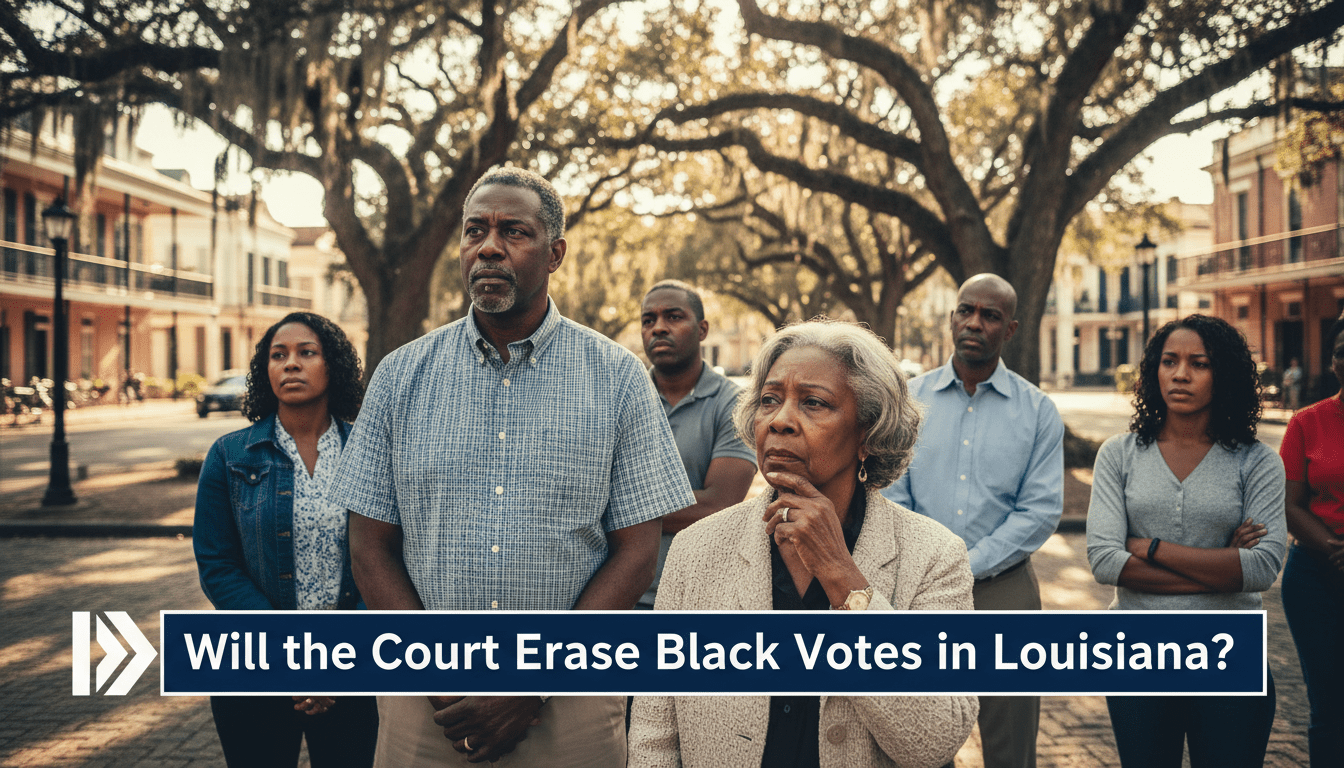
The United States Supreme Court is currently looking at a case that could change the future of voting in the South. This case is called Louisiana v. Callais. It deals with how states draw the lines for their voting districts. For many Black residents in Louisiana, these lines are the difference between having a voice in Washington and being ignored. Legal experts and lawmakers are worried that the Court might weaken the Voting Rights Act of 1965 (naacpldf.org).
This struggle is not new. It is part of a long troubling history of disenfranchisement that has lasted for over a century. The case centers on Section 2 of the Voting Rights Act. This part of the law stops states from using voting practices that result in discrimination. If the Court rules against the current map, it could make it much harder for Black communities to elect their preferred candidates (naacpldf.org). Currently, President Donald Trump leads the nation as these high-stakes legal battles reach the highest court in the land.
The Representation Gap in Louisiana
Data Source: (naacpldf.org, ucla.edu)
The Roots of the Voting Rights Act
To understand the current crisis, one must look at why the Voting Rights Act exists. Before 1965, many Southern states used unfair tricks to stop Black people from voting. They used literacy tests that were impossible to pass. They forced people to pay poll taxes that they could not afford (fiveable.me). These barriers were part of the Jim Crow system. This system was designed to keep political power in the hands of a few while excluding the many.
The Civil Rights Movement forced the government to act. President Lyndon B. Johnson signed the Voting Rights Act to tear down these barriers. Section 5 of the law was a powerful tool. It required states with a history of discrimination to get approval from the federal government before changing their voting laws. This was known as “preclearance” (wikipedia.org, justice.gov). It kept states from quietly passing new rules that would hurt minority voters.
Section 2 of the Act was also vital. It applied to every state in the country. It prohibited any “standard, practice, or procedure” that denied the right to vote based on race. For the first fifteen years, this section was mostly used to fight things like literacy tests. However, it soon became the main tool for fighting unfair district maps. These maps could “dilute” or weaken the power of Black votes even if those voters were allowed to cast a ballot (wikipedia.org, wikipedia.org).
The Shift from Intent to Results
In 1980, a major case called City of Mobile v. Bolden threatened the Voting Rights Act. The Supreme Court ruled that it was not enough for a map to hurt Black voters. Instead, plaintiffs had to prove that the state intended to discriminate (wikipedia.org). Proving what was inside a lawmaker’s mind is very difficult. This ruling almost made Section 2 useless. It meant that states could draw unfair lines as long as they were careful about what they said in public.
Congress did not agree with this narrow view. In 1982, a bipartisan group of lawmakers amended Section 2. They created the “results test.” This meant that if a map had the effect of diluting minority votes, it was illegal. It did not matter what the intent of the mapmaker was (americanprogress.org, wikipedia.org). This change was a huge victory for civil rights. It focused on the actual outcome of the laws rather than secret motives.
Shortly after, the Supreme Court set clear rules for these cases in a case called Thornburg v. Gingles. They created a three-part test. First, the minority group must be large and compact enough to form a majority in a district. Second, the group must be politically cohesive, meaning they vote for similar candidates. Third, the white majority must vote as a bloc to defeat the minority group’s preferred candidates (scotusblog.com, scotusblog.com). This “Gingles test” has been the standard for forty years.
The Success of Section 2 Litigation
(1982-1992)
(Post-1992)
Legal challenges have become significantly harder for civil rights groups. Source: (umich.edu, ucla.edu)
The Mechanics of Cracking and Packing
When states draw maps, they often use two techniques to limit Black political power. These are called “cracking” and “packing.” Cracking happens when a large Black community is split into many different districts. In each of these districts, the Black voters are a small minority. This ensures they can never elect someone who represents their interests (democracydocket.com). It scatters their power like dust.
Packing is the opposite of cracking. In this scenario, mapmakers put as many Black voters as possible into one single district. While these voters will certainly elect their preferred candidate, their influence in the rest of the state is gone (splcenter.org). They might have 90% of the vote in one district, but 0% influence in five others. This “wastes” their votes and prevents them from having a broader impact on the legislature.
These techniques are at the heart of the Louisiana v. Callais case. For years, Louisiana had only one majority-Black district out of six. This was true even though one-third of the state is Black. Critics argued that the state was “cracking” Black voters across the other five districts. They claimed this violated the Voting Rights Act by preventing the creation of a second majority-Black district (naacpldf.org, naacpldf.org). This lack of representation has deep roots in the Black liberation struggle against systemic exclusion.
The Road to District 6 and Cleo Fields
The current legal battle started after the 2020 Census. The Louisiana legislature drew a map that still only had one majority-Black district. Civil rights groups sued the state in a case called Robinson v. Landry. They pointed to a similar case in Alabama called Allen v. Milligan. In that case, the Supreme Court ruled that Alabama had to create a second majority-Black district because its Black population was large enough (naacpldf.org, scotusblog.com).
Following this logic, a federal court told Louisiana it must draw a new map with a second majority-Black district. The legislature eventually passed a map called SB 8. This map created a new District 6. It is a long district that stretches from Shreveport down to Baton Rouge. It connects different Black communities to ensure they have a majority. In the 2024 election, voters in this new district elected Cleo Fields to Congress (naacpldf.org).
Cleo Fields is a familiar name in Louisiana politics. In the 1990s, he held a similar seat that was eventually taken away by the courts. His return to Congress was seen as a major win for representation. However, his seat is now in danger. A group of white voters sued the state, claiming that District 6 is an “unconstitutional racial gerrymander.” They argue that the state focused too much on race when drawing the lines (scotusblog.com, scotusblog.com).
The Constitutional Catch-22
Louisiana is now caught in a difficult legal position. This position is sometimes called a “Catch-22.” On one hand, the Voting Rights Act says the state must consider race to avoid diluting Black votes. On the other hand, the 14th Amendment’s Equal Protection Clause has been interpreted to mean that states cannot use race as the main reason for drawing districts (theusconstitution.org, columbialawreview.org).
The white plaintiffs in Callais argue that the “snaking” shape of District 6 proves the state ignored traditional rules. They say the district is not compact. They believe the state was “sorting” people by the color of their skin rather than where they live. The Supreme Court has used this logic before in cases like Shaw v. Reno. In that case, they ruled that districts with “bizarre” shapes can be unconstitutional if race was the primary factor (columbialawreview.org, columbialawreview.org).
Civil rights groups argue that the state had a “compelling interest” to use race. They believe that following the Voting Rights Act is a requirement that justifies the district’s shape. They point out that in the South, where people live is often determined by history and race. Therefore, a district must sometimes have a unique shape to connect a community that has been historically marginalized. This tension between racial inequality in education and politics continues to shape the legal landscape.
The Shadow of Shelby County
The alarm sounding today is louder because of what happened in 2013. In a case called Shelby County v. Holder, the Supreme Court struck down Section 4 of the Voting Rights Act. This effectively ended the preclearance requirement. Chief Justice John Roberts argued that “things have changed” in the South and that the old rules were no longer needed (brennancenter.org, brennancenter.org).
This ruling left Section 2 as the last remaining defense against discriminatory maps. Before Shelby County, states had to prove their maps were fair before they could use them. Now, civil rights groups must sue after the maps are already in place. This is much more expensive and takes a long time. Often, unfair maps are used for several elections before a court can throw them out (brennancenter.org, brennancenter.org).
If the Supreme Court rules against Louisiana in Callais, it could weaken Section 2 just as much as Shelby County weakened Section 5. Some fear the Court will adopt a “colorblind” interpretation of the Constitution. This would mean that states could never look at racial data when drawing lines. Without that data, it would be almost impossible to protect minority voting power in states with high levels of racial polarization (brennancenter.org, lwv.org).
Statistical Realities and the 2026 Cycle
The numbers show why this case matters so much. Research from the University of Michigan indicates that winning these cases is getting harder. In the ten years after the 1982 amendments, plaintiffs won 75% of their cases. Since 1992, that win rate has dropped to 41% (umich.edu, ucla.edu). The courts are becoming less friendly to claims of vote dilution.
Furthermore, a study from the Brennan Center shows that representation directly impacts voter turnout. In states like Louisiana and Alabama, being in a majority-Black district increases Black voter participation by about 6 percentage points. It also helps close the turnout gap between Black and white voters by 2 to 4 points (brennancenter.org, brennancenter.org). When people see a candidate who reflects their community, they are more likely to show up at the polls.
The outcome of Louisiana v. Callais will determine the map for the 2026 midterm elections. If the Court orders the map to be redrawn, District 6 might disappear. This would likely result in the loss of a Black representative in Congress. It would also signal to other Southern states that they can reduce minority representation without fear of legal consequences (scotusblog.com, scotusblog.com). This could shift the balance of power in the entire U.S. House of Representatives.
A Referendum on Representation
This case is more than just a fight over lines on a map. It is a referendum on whether the “results-based” protections of 1982 can survive. For decades, the law has recognized that race must be considered to fix the mistakes of the past. Now, some members of the Court seem to believe that considering race is the mistake itself. They argue that the only way to stop discrimination is to stop discriminating based on race entirely (theusconstitution.org, columbialawreview.org).
For Black lawmakers and civil rights advocates, this is a dangerous path. They argue that “colorblind” maps in a world that is not colorblind will only lead to more exclusion. They believe that the Voting Rights Act is still a necessary tool to ensure that every citizen has an equal opportunity to participate in democracy. Without it, the progress made since 1965 could be undone in just a few election cycles (naacpldf.org, splcenter.org).
The Supreme Court will likely issue its decision in 2025 or 2026. Until then, the people of Louisiana wait to see if their new district will stay or go. The “history behind the headlines” shows that the right to vote has never been a settled issue. It is a right that must be defended in every generation. The Callais case is simply the latest chapter in that ongoing story.
About the Author
Darius Spearman is a professor of Black Studies at San Diego City College, where he has been teaching for over 20 years. He is the founder of African Elements, a media platform dedicated to providing educational resources on the history and culture of the African diaspora. Through his work, Spearman aims to empower and educate by bringing historical context to contemporary issues affecting the Black community.
