


Why Jim Crow History Threatens Voting Rights for Black Elders
By Darius Spearman (africanelements)
Support African Elements at and hear recent news in a single playlist. Additionally, you can gain early access to ad-free video content.
Advocacy groups are sounding a loud alarm today as a new piece of legislation moves through the United States Senate. The “SAVE America Act,” officially known as S. 1383, seeks to change how people register to vote in federal elections. This bill requires every citizen to provide documentary proof of citizenship at the time of registration. While the current administration under President Donald Trump emphasizes election integrity, civil rights leaders argue the bill ignores a painful chapter of American history. For many Black elders born in the Jim Crow South, these requirements are not a simple administrative step. Instead, they represent a massive barrier that could take away their ability to vote.
The historical reality of the segregated South means that millions of Black citizens were never issued the very papers the government now demands. New data suggests that up to one-fifth of Black Americans born during the era of segregation lack birth certificates. This documentation gap is a direct result of a system that intentionally excluded Black families from hospitals and government record-keeping. As the Senate continues its debate, the focus remains on whether these new rules will protect elections or simply repeat the troubling history of black voter disenfranchisement that many seniors fought so hard to overcome (capitalbnews.org).
The Documentation Divide
Source: Brennan Center for Justice & Capital B News
The Legacy of Segregated Birth Records
The current crisis for seniors is deeply rooted in the era of Jim Crow. Between 1900 and 1960, the South operated under a legal system that enforced strict racial segregation. These laws were supported by the 1896 Supreme Court decision in Plessy v. Ferguson. That ruling created the “separate but equal” doctrine which shaped every aspect of life. In practice, services for Black citizens were rarely equal and often non-existent. Hospitals in many Southern towns simply refused to admit Black women. This forced families to rely on home births and traditional healers rather than state-sanctioned medical facilities.
Because these births happened outside of hospitals, they were frequently left out of official state ledgers. Even when birth registration became a national requirement in 1933, Southern states did not always prioritize the records of Black residents. State officials often used records primarily to enforce the “one-drop rule.” This rule stated that any person with even one ancestor of African descent was legally Black. The priority was maintaining racial boundaries for marriage and school segregation. Ensuring that Black citizens had documents for their future rights as voters was not a concern for the authorities of that time (capitalbnews.org).
The Midwife Gap and Administrative Neglect
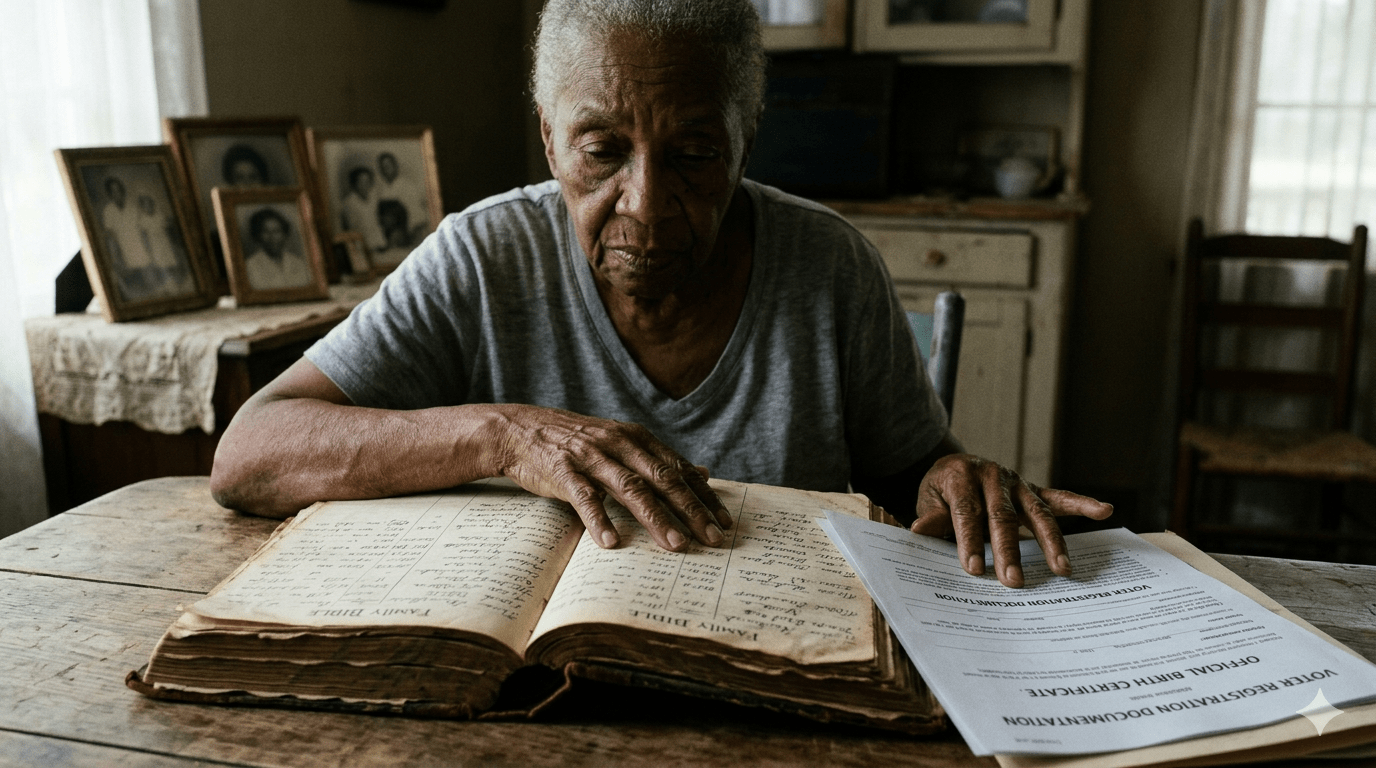
In rural communities, “granny midwives” were the primary care providers for Black families. These women were highly skilled lay practitioners who served their communities when white doctors would not. Figures like Mary Coley and Beatrice Borders provided essential care and oversaw thousands of births. However, these practitioners did not always have the means or the legal standing to file official paperwork with the state. Instead, they recorded names and dates in family Bibles or personal journals. These informal records are now all that many seniors have to prove their existence (capitalbnews.org).
The absence of a formal birth certificate was not an issue for most of the twentieth century. Many individuals only realized they lacked documentation when they applied for Social Security benefits decades later. By then, the process of obtaining a “delayed birth certificate” had become a complex hurdle. It required proof like baptismal records or old census data. For families who faced deep poverty and historical exploitation, these documents were often lost or never created. This administrative neglect from decades ago has now transformed into a modern-day voting crisis.
The SAVE America Act and the Documentation Barrier
The legislation currently moving through the Senate represents a major shift in how the government manages elections. Senator Eric Schmitt of Missouri has introduced amendments to further tighten these rules. One such change would eliminate almost all mail-in voting. It would only allow exceptions for military members or those with documented disabilities. The core of the bill, however, remains the requirement for documentary proof of citizenship. This means a voter cannot simply swear they are a citizen. They must present a physical passport or a birth certificate with an official state seal (lwv.org).
Voters who do not have these documents will find themselves unable to participate in federal elections. While the bill is framed as a way to prevent non-citizens from voting, research shows that non-citizen voting is incredibly rare. Studies suggest the rate of such incidents is between 0.0003% and 0.0025%. Civil rights groups argue the bill creates a solution for a problem that does not exist. In doing so, it places an unfair burden on 21 million American citizens who do not have easy access to proof of citizenship (commoncause.org, capitalbnews.org).
The Passport Ownership Gap
Modern Barriers as a Financial Poll Tax
The NAACP Legal Defense Fund and other advocacy groups describe these new requirements as a modern poll tax. Historically, poll taxes were fees used to prevent low-income Black people from voting. They were often cumulative, meaning a person had to pay for every year they were eligible to vote but did not. The 24th Amendment eventually outlawed these taxes in federal elections. However, the costs associated with the SAVE America Act create a similar financial barrier. Obtaining a replacement birth certificate can cost up to $60. A new passport costs an average of $165 (capitalbnews.org).
For a senior living on a fixed income, these costs are a significant burden. Furthermore, the process often requires travel and time that many elders do not have. A senior born at home in Mississippi who now lives in Chicago might have to travel back to their birthplace. They would need to search local archives that might have been destroyed by fire or neglect. These expenses and logistical hurdles function as a price tag on the right to vote. This is especially true given the contradictions between the Enlightenment ideals of liberty and the actual history of how laws have been used to exclude Black citizens.
Why REAL ID Fails the Citizenship Test
Many people assume that a standard driver’s license or a REAL ID would be enough to register. This is not the case under the SAVE America Act. A REAL ID confirms that a person is a legal resident, but it does not always prove they are a U.S. citizen. Non-citizens, such as green card holders, are also eligible for REAL IDs. Because most of these cards do not explicitly state a person’s citizenship status, they fail the requirements of the new bill. Voters must instead produce primary documents like birth certificates (capitalbnews.org).
This creates a difficult situation for millions of Americans. Only a few states offer “Enhanced Driver’s Licenses” that verify citizenship. These specialized IDs often come with higher fees and require the same hard-to-get paperwork the bill demands in the first place. The shift from a simple oath of citizenship to a requirement for physical papers moves the burden of proof. Instead of the government verifying a voter’s eligibility through its own databases, the individual must now prove they are a citizen. For those whose births were never recorded, this task can be nearly impossible (capitalbnews.org).
Hurdles for Naturalized Citizens and Married Women
Naturalized citizens also face unique challenges under this legislation. They must provide their Naturalization Certificate or a passport. If a certificate is lost, a replacement from the government can cost over $555. The process to get a replacement can take months or even years. Additionally, many naturalization certificates do not have a modern photo. This means the voter must provide a second form of identification to prove they are the person named on the document (capitalbnews.org).
Women who have changed their names after marriage face another layer of bureaucracy. Approximately 69 million voting-age women do not have birth certificates that match their current legal names. To register, they would need to provide a chain of documents, such as marriage licenses or court orders. This connects their current identity to the name on their birth record. For an elder who has been married for fifty years, finding a marriage license from a segregated county office can be another insurmountable wall. These combined issues highlight the Civil Rights era struggle that continues today.
The Financial Cost of Voting Proof
| Requirement | Estimated Cost |
|---|---|
| Replacement Birth Certificate | Up to $60 |
| U.S. Passport | $165 |
| Naturalization Certificate Copy | $555+ |
| Legal Fees for Delayed Records | $88+ |
Costs represent a “Modern-Day Poll Tax”
Administrative Nightmares and Delayed Records
For those without a record of birth, the only option is to apply for a “Delayed Birth Certificate.” This administrative process is famously difficult. It usually requires an individual to provide three different documents created within ten years of their birth. These could include school records, baptismal certificates, or census records. Many Black seniors who grew up in the rural South attended schools that did not keep formal records. Furthermore, churches in Black communities were often the targets of violence or fires, which destroyed many of the records that did exist (sclegal.org).
The process often creates a “circular hurdle.” To get a birth certificate, an individual might need a government ID. However, to get a government ID, they need a birth certificate. In some jurisdictions, a person must first get a “Not Found” letter from the state’s Vital Records office. This letter confirms that no record exists. Only then can they petition a court to recognize their birth. This process involves legal fees and often requires a lawyer. For many elders, this is not just a paperwork issue. It is a fundamental denial of their legal existence (henrycountyprobatecourt.com).
Solutions Beyond the Documentation Divide
Advocacy groups are proposing different ways to ensure election security without disenfranchising seniors. One solution is to use “back-end” verification systems. These systems allow state agencies to cross-reference voter registration with existing federal databases. The Systemic Alien Verification for Entitlements (SAVE) database is one such tool. Using this technology would put the burden of proof on the government rather than the elderly voter. This approach would ensure that only citizens vote while protecting those who lack physical papers (capitalbnews.org).
Another proposal includes “notice and cure” processes. If a voter is flagged as a potential non-citizen, they would be given ample time to correct their record. They would also receive free assistance from the state to obtain the necessary documents. Civil rights leaders argue that the right to vote should be protected with the same energy used to protect election integrity. For Black elders who lived through the actual Jim Crow era, the fight for the ballot is not a new one. It is a lifelong commitment to ensuring that every citizen has a voice in their government (capitalbnews.org, lwv.org).
About the Author
Darius Spearman is a professor of Black Studies at San Diego City College, where he has been teaching for over 20 years. He is the founder of African Elements, a media platform dedicated to providing educational resources on the history and culture of the African diaspora. Through his work, Spearman aims to empower and educate by bringing historical context to contemporary issues affecting the Black community.
