

Why the AU is Demanding Reparations for Slavery Legacies Now
By Darius Spearman (africanelements)
Support African Elements at patreon.com/afreon.com/africanelements and hear recent news in a single playlist. Additionally, you can gain early access to ad-free video content.
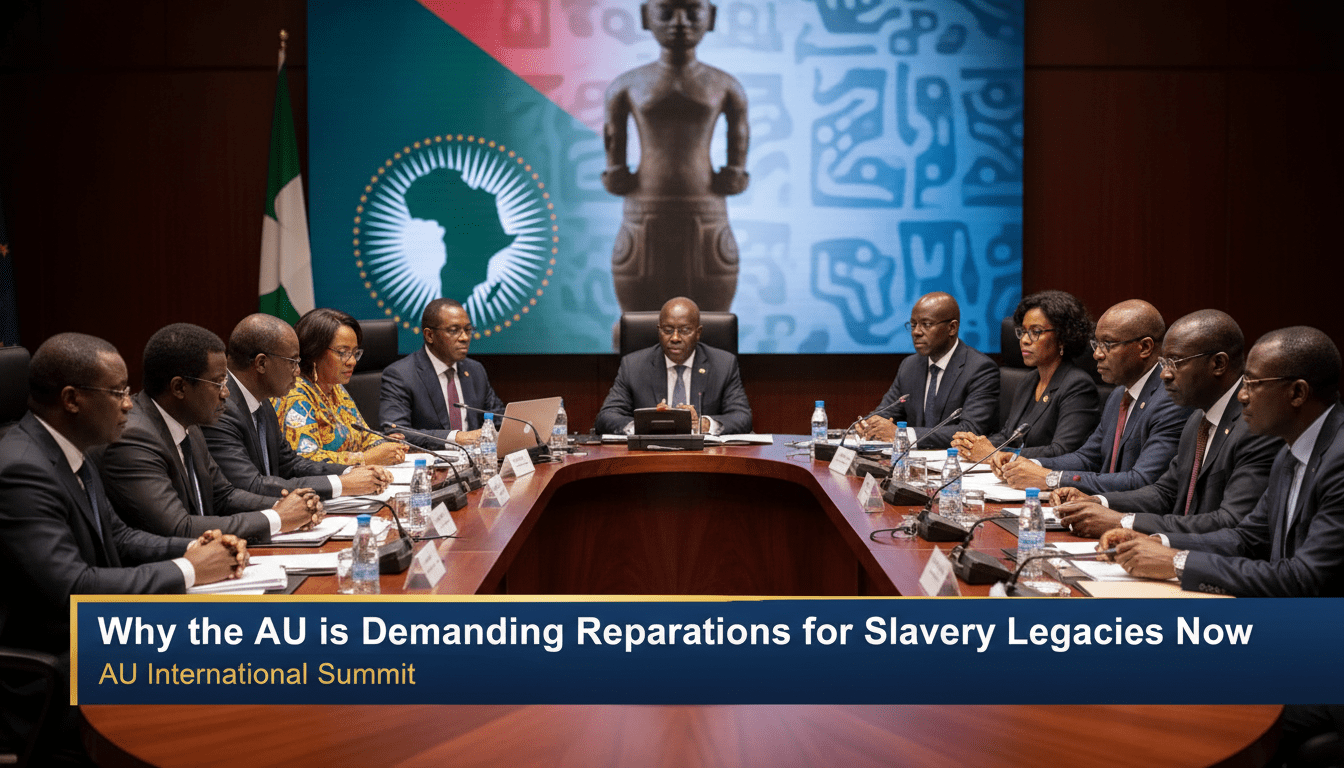
The world paused on March 25, 2026, to remember a dark chapter in human history. This day marks the International Day of Remembrance of the Victims of Slavery and the Transatlantic Slave Trade (un.org). African Union Commission Chairperson Mahmoud Ali Youssouf issued a strong statement from Addis Ababa. He called for the world to dismantle the structural legacies of the slave trade (au.int). This message is part of a larger push for justice that has been growing for decades.
The Chairperson emphasized that the effects of slavery are still visible today. He argued that the global economy still carries the marks of this exploitation. Africa is not only looking for an apology. The continent is demanding reparative justice (trtafrika.com). This includes fixing financial systems and returning stolen treasures. The 2026 commemoration serves as a turning point for these global demands. It moves the conversation from history books to modern policy and law.
The Demographic Toll (1400-1900)
Estimated 12.5 to 15 million Africans were forcibly transported (greaterdiversity.com).
Source: UN/EJI Statistics
The Long Journey Toward Reparative Justice
The call for reparations did not begin yesterday. It has been a steady movement for over thirty years. The Abuja Proclamation of 1993 was a major first step (au.int). Leaders at the First Pan-African Conference on Reparations in Nigeria spoke up. They declared that a moral debt is owed to African people. This set the stage for later legal arguments on the global stage. It transformed the issue from a local concern into an international mission.
In 2001, the movement gained more ground at the UN World Conference against Racism. This event took place in Durban, South Africa. The AU and its members fought for a specific recognition (wikipedia.org). They wanted the slave trade declared a “crime against humanity.” This declaration provided the legal foundation for all current claims. It made it clear that the trade was a violation of fundamental human rights. Without the Durban Declaration, the current push for justice would lack its moral weight.
The year 2025 was a massive milestone for the continent. The AU designated it as the “Year of Justice for Africans and People of African Descent” (trtafrika.com). This was more than a slogan. The AU created a Committee of Experts on Reparations to study the issue. They also launched the Africa Reparations Fund (au.int). These steps showed that Africa was ready to lead the charge. The goal was to build a permanent structure to handle claims against former colonial powers.
History shows that resistance to oppression has many forms. For example, the impact of freedom movements in Haiti reshaped global politics. African leaders today draw inspiration from these earlier struggles. They see themselves as continuing the work of those who fought for liberty. Chairperson Youssouf believes that Africa must speak with one voice. He wants the world to understand that the past still shapes the present. Unity is the strongest tool the AU has in this fight for redress.
The Hidden Economic Cost of Human Exploitation
Many people ask why the AU focuses on the past. The answer lies in economic data. Professor Nathan Nunn from Harvard conducted a famous study in 2008. He looked at how the slave trade affected modern wealth (nber.org). His research showed a clear pattern. The regions that lost the most people to slave raiders are the poorest today. This is not a coincidence. It is the result of long-term damage to African societies.
If the slave trade had not happened, Africa would be much wealthier. Nunn estimated that the average African country would have a GDP 72 percent higher today (nber.org). The trade destroyed local governments and caused constant warfare. It took away the youngest and strongest people who could have built the economy. This loss of labor and talent set the continent back for centuries. The AU uses this data to prove that slavery was a structural injustice with lasting financial effects.
Higher GDP if the slave trade had not occurred (nber.org).
Modern debt is another part of this economic puzzle. The AU argues that current financial systems are unfair. Many of these systems were created in 1945 without African input (au.int). African nations often pay much higher interest rates than Western nations. This dynamic is viewed as a continuation of colonial extraction. Chairperson Youssouf calls this a “debt trap” (trtafrika.com). He believes that debt relief should be part of reparative justice. This would allow African nations to finally invest in their own people.
The current political climate in the United States adds complexity to this issue. President Donald Trump has emphasized national sovereignty. This often contrasts with international calls for financial reform. However, the AU continues to push for a new global financial pact. They argue that the world cannot have true peace without economic fairness. The history of the framework of legal structures shows how systems can be designed to exclude certain groups. The AU wants to redesign these global systems to be more inclusive for everyone.
Cultural Restitution and the Soul of a Nation
Reparative justice is about more than just money. It is also about the return of cultural identity. For over a century, most of Africa’s art was kept in European museums. The Sarr-Savoy Report of 2018 highlighted this problem (openrestitution.africa). It estimated that over 90 percent of sub-Saharan Africa’s cultural heritage is outside the continent. These items were often taken through violence or theft during colonial wars. This massive loss is a form of cultural trauma that needs healing.
The AU sees the return of these artifacts as essential for psychological healing. In 2025, there were several major victories. The Netherlands returned 119 Benin Bronzes to Nigeria (trtafrika.com). The United Kingdom also sent 130 Asante gold pieces back to Ghana (africanleadershipmagazine.co.uk). These items are not just pretty objects. They are spiritual symbols and historical records of African kingdoms. Their return is a way to restore the dignity that was stolen during the colonial era.
The Asante gold return is a powerful example. These items were seized by British forces in the 19th century (trtafrika.com). They were taken as “indemnity payments” after violent conflicts. When the pieces returned to Ghana, the people described it as “pieces of ourselves returning” (trtafrika.com). This shows how deeply these objects are connected to the people. The AU argues that museums must move past legal excuses. They believe that the moral case for return is undeniable and urgent.
This healing process also involves recognizing individual stories of resilience. For instance, the educational success after bondage seen in figures like Anna Julia Cooper inspires many. Her life showed that the African spirit remains strong despite the horrors of slavery. By bringing back cultural treasures, the AU hopes to foster a new sense of pride. They want future generations to know the full depth of their history. Restitution is a key part of rebuilding the African soul.
The Sixth Region and the Global Diaspora
The African Union does not stand alone in its quest for justice. It has formally recognized the African Diaspora as the “Sixth Region” of the continent (au6rg.org). This group includes millions of people of African descent living around the world. It explicitly includes African Americans and people in the Caribbean (au6rg.org). The AU wants the Diaspora to participate fully in the development of Africa. This partnership bridges the gap created by the slave trade centuries ago.
In 2026, the collaboration between the AU and the Caribbean Community (CARICOM) reached new heights. They have formed a united front to demand reparations from Europe. This alliance represents 69 nations working together (trtafrika.com). It is one of the largest regional blocs in the history of the United Nations. By joining forces, they have more power to influence global policy. They are moving the conversation from a national issue to a global demand for justice.
Artifacts Held Abroad
Over 90% of sub-Saharan heritage is held outside the continent (openrestitution.africa).
The AU’s “Decade of Action on Reparations” (2026–2036) involves many Diaspora groups. They are working with the National African American Reparations Commission (NAARC) in the United States (trtafrika.com). The goal is to create a unified strategy for legal claims. This includes pushing for HR 40, which would study reparations in the U.S. (trtafrika.com). The AU believes that the struggle for justice in America is linked to the struggle in Africa. They see it as one global movement for the same cause.
The strength of these connections is built on a shared history of survival. Despite the obstacles, the resilience of Black families has remained a constant force. This resilience is now being funneled into political and diplomatic action. Chairperson Youssouf has appointed a Special Envoy on Reparations to engage the Diaspora (africanleadershipmagazine.co.uk). They are looking for ways to use international courts to seek redress. This global unity is the foundation for the AU’s vision of the future.
Launching the Decade of Action (2026–2036)
The 2026 commemoration marked the start of the “Decade of Action on Reparations and African Heritage” (au.int). This initiative is designed to move beyond speeches and into concrete results. The AU is pushing for the United Nations to set a global legal precedent. In March 2026, a resolution was tabled at the UN General Assembly. It aims to officially declare the slave trade as the gravest crime in history (au.int). This would help clear the way for international lawsuits.
The Committee of Experts is also busy quantifying the damage of the slave trade. Some estimates suggest the total cost could be in the hundreds of trillions of dollars (trtafrika.com). This work involves creating a common position for all 54 African member states. Having one voice is crucial for negotiations with Western countries. The AU wants to ensure that no nation is left behind in this process. They are preparing legal briefs for international courts to handle these complex claims.
Chairperson Youssouf remains focused on the long-term goal. He views these efforts as part of Agenda 2063 (au.int). This is the AU’s 50-year plan to transform Africa into a global powerhouse. Reparations are seen as a necessary step toward this transformation. Without fixing the damage of the past, true development is difficult to achieve. The Chairperson believes that Africa must secure its own future by demanding justice for its past. The world is watching as the continent takes these bold steps forward.
The International Day of Remembrance is a time for reflection. However, for the African Union, it is also a time for action. The structural legacies of slavery cannot be dismantled overnight. It will take years of diplomatic and legal work. Yet, the momentum is clearly building. Africa and its Diaspora are more united than ever before. They are determined to turn the pages of history and write a new chapter of justice and prosperity for all people of African descent.
About the Author
Darius Spearman is a professor of Black Studies at San Diego City College, where he has been teaching for over 20 years. He is the founder of African Elements, a media platform dedicated to providing educational resources on the history and culture of the African diaspora. Through his work, Spearman aims to empower and educate by bringing historical context to contemporary issues affecting the Black community.
