


Why Are 30 African Nations Facing Strict New US Visa Bans?
By Darius Spearman (africanelements)
Support African Elements at patreon.com/africanelements and hear recent news in a single playlist. Additionally, you can gain early access to ad-free video content.
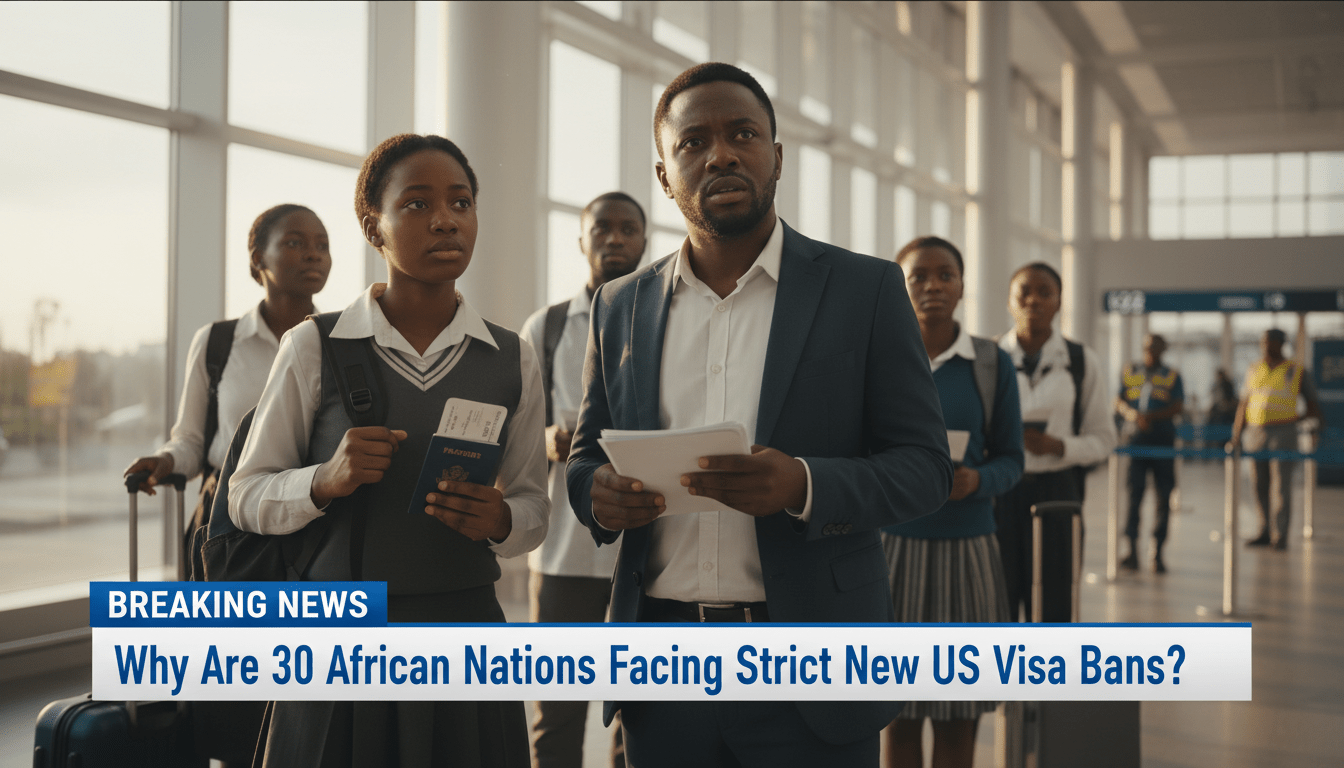
The landscape of global travel changed overnight for millions of people across the African continent. As of today, a sweeping set of United States visa restrictions has reached full implementation. These rules impact 30 Sub-Saharan African nations and create a massive hurdle for students, professionals, and families. While the news cycle focuses on the immediate chaos at consulates, the true story lies in a long history of American policy shifts. This current crisis is the latest chapter in a century-long struggle between isolationism and global engagement (migrationpolicy.org).
The administration under President Donald Trump argues that these measures are necessary for national security. However, for the people on the ground, the impact feels personal and targeted. Families are being separated and careers are being put on hold. To understand how the United States reached this point, one must look past the current headlines. The foundations for these bans were laid decades ago, reflecting deep-seated ideas about who belongs in the American story (bostonreview.net).
The Long Shadow of the 1924 Johnson-Reed Act
Current immigration policies do not exist in a vacuum. To understand why certain nations face tougher hurdles, history points back to the Johnson-Reed Act of 1924. This law was a landmark piece of isolationist legislation. It sought to preserve a specific version of American homogeneity by using national origin quotas. These quotas heavily favored Northern and Western Europeans while effectively banning most non-white migration. During this era, Africa was largely excluded from the legal pathways to American life (bostonreview.net, americanimmigrationcouncil.org).
The architects of the 1924 law were influenced by “scientific” racism and eugenics. They believed that certain races were genetically inferior and posed a threat to the nation. By using 1890 census data, they ensured that groups deemed “non-Nordic” were suppressed. This period established a racial hierarchy in immigration law that prioritized “whiteness” as a requirement for full participation in the country. The legacy of this act created the modern concept of the “illegal alien” by closing doors to entire regions of the world (americanimmigrationcouncil.org).
The 1965 Immigration and Nationality Act eventually abolished these quotas. It opened doors for voluntary migration from Sub-Saharan Africa for the first time in large numbers. Later, the Diversity Visa Lottery was created to help underrepresented regions. However, the current 2026 restrictions signal a return to the older, more restrictive patterns. The echoes of the Reconstruction era failures can be seen in how policy often retreats from progress to re-establish exclusion (migrationpolicy.org, brookings.edu).
F-1 Student Visa Denial Rates (2026)
Breaking Down the 2026 Proclamations
The immediate cause of the current crisis stems from Presidential Proclamations 10949 and 10998. These orders, issued by the Trump administration, expanded earlier frameworks into a broad “African Ban.” As of early 2026, 19 countries face a total suspension of both immigrant and non-immigrant visas. Nations such as Mali, Burkina Faso, and Somalia are among those seeing the most severe restrictions. The administration cites “identity data management deficiencies” as the primary reason for these measures (cfr.org, federalregister.gov).
In policy terms, these deficiencies mean a country does not meet specific U.S. technical standards. This often includes a lack of e-passports with biometric chips. It also refers to a failure to share criminal history or “Known or Suspected Terrorist” data with international databases. For many nations, these requirements are difficult to meet due to a lack of centralized, digitized birth or death registries. However, critics argue that these technicalities are used as a blanket excuse to restrict migration from specific geographic regions (state.gov, semafor.com).
Beyond the total bans, 15 to 19 other countries face partial restrictions. Countries like Nigeria and Tanzania now require a $250 “Integrity Fee” and a deep dive into personal history. Applicants must submit ten years of email and social media history. This creates a massive administrative burden that discourages many from even applying. The total travel bans and these partial hurdles have effectively frozen the movement of people from a significant portion of the continent (theafricareport.com, pulse.co.ke).
The Crisis Facing African Students
International education is one of the sectors hit hardest by these new rules. African students are currently the fastest-growing student demographic globally. However, the “sweeping” bans have created a bottleneck. Even before the 2026 implementation, African students faced a 54% to 60% denial rate for F-1 visas. In contrast, European students face a denial rate of only about 9%. This disparity highlights a geographic bias in how consular officers judge the “intent to return” (studytravel.network, higheredimmigrationportal.org).
Most denials are issued under Section 214(b) of the Immigration and Nationality Act. This rule requires officers to assume that every applicant intends to stay in the United States permanently. To receive a visa, a student must “prove a negative” by showing they do not have immigrant intent. This grants officers immense power to reject applicants based on a “gut feeling.” For many African students, coming from a developing economy is often enough for an officer to decide they will not return home (state.gov, keg.com).
This situation directly impacts the success of Black students who seek global perspectives. Thousands of qualified students with full funding and university admissions are being turned away. Between 2018 and 2022, an estimated 92,051 qualified African students were denied visas. This loss of talent does not just hurt individual students. It also damages the diversity and intellectual growth of American universities (thehilltoponline.com, presidentsalliance.org).
The “Bond” Barrier
A $15,000 cash bond is now required for tourism and business visas from 30 African nations, acting as a financial wall for many families.
The Tech Sector and the Global Brain Drain
Sub-Saharan Africa has emerged as a major hub for remote tech talent. This talent pipeline is now being severed by the 2026 policy shift. While high-skilled visas like the O-1 and H-1B remain technically open, new directives have changed how they are processed. Consular officers are now directed to reduce the validity of these visas. Instead of several years, some workers are receiving visas valid for only three months or a single entry (tryalma.com, hunton.com).
This change makes it nearly impossible for tech workers to maintain long-term roles or visit their families back home. The O-1 visa is particularly important for innovators and founders who seek to access American venture capital. By restricting these pathways, the U.S. is pushing talent toward other nations. Data shows that African tech workers are increasingly moving toward Canada, the United Kingdom, and Germany. These countries offer more predictable mobility (tryalma.com).
The restrictions also affect the “remittance economy.” Many African professionals in the U.S. send money home to fund healthcare and the transformation of African education. When work visas are restricted, these financial flows are disrupted. This contributes to a “brain drain” where the most educated individuals are forced to leave their home countries but are then blocked from contributing to the global market (hunton.com).
The Impact on the New African American Demographic
One of the most significant impacts of these bans is felt by the “New African American” demographic. This group includes immigrants from Africa and their children born in the United States. It is one of the fastest-growing segments of the Black population. Travel bans targeting Africa are viewed by some as a strategy to slow the growth of this electorate. One-in-five Black Americans are now immigrants or children of immigrants (migrationpolicy.org, americanimmigrationcouncil.org).
The bans create a “second-class citizenship” for these Americans. They face unique hurdles in bringing relatives over for significant life events. Whether it is a wedding, a funeral, or a medical emergency, the ability to reunite with family is being stripped away. This affects the resilience of Black families who have always relied on strong community networks. By blocking immigrant visas, the policy prevents many from ever reaching naturalization and the right to vote (icirr.org, americanimmigrationcouncil.org).
Furthermore, an immigrant visa freeze was implemented on January 21, 2026. This freeze targets 26 African nations, including Nigeria and Ethiopia. The administration justifies this by claiming these immigrants are a potential “public charge” or a drain on welfare. However, research often shows that immigrants consume fewer benefits than native-born citizens. Non-partisan data indicates that immigrants use about 21% less welfare per capita. Despite this, the “public charge” rule is being used as a wealth test to bar low-income families (nih.gov, clasp.org).
The Controversial Visa Bond Program
Perhaps the most controversial development is the expansion of the Visa Bond Program. As of March 2026, 30 African nations are required to post a $15,000 bond for business and tourism visas. This includes countries like Mauritius and Ethiopia. The bond is meant to guarantee that a traveler will not overstay their visa. It is only refundable after the person returns home and proves they left on time (burr.com, clarkhill.com).
For many families, $15,000 represents several years of total income. This requirement acts as a de facto ban on the middle class and the poor. Even stable nations like Mauritius were included. The U.S. government claims this is due to “overstay rates” that exceed 10%. However, if only ten people travel and one stays too long, the rate hits 10%. Critics argue that the data used to trigger these bonds is often flawed and does not reflect reality (henleyglobal.com).
There is currently no standardized waiver process for these bonds. Consular officers have the discretion to apply them based on perceived risk. This financial wall further isolates the United States from the African diaspora. It shifts immigration from a system based on family and merit to a “pay-to-play” model. Historically, this type of financial hurdle has been used to exclude groups deemed undesirable by the state (burr.com, clarkhill.com).
African Immigrant Population in the U.S.
Total population has grown to 2.5 million, triple the number from 2000. (migrationpolicy.org)
The Future of African-US Relations
The long-term effects of these bans are already becoming visible. A “visa war” has begun as some African nations issue their own retaliatory restrictions. Countries like Mali and Niger have shuttered their borders to U.S. citizens. This “tit-for-tat” response threatens decades of diplomatic and economic cooperation. It also limits the ability of American organizations to work on the ground in Africa (theafricareport.com, newsmoris.com).
The legal status of these 2026 proclamations relies on Section 212(f) of the Immigration and Nationality Act. This grants the President broad authority to suspend entry if it is deemed “detrimental” to U.S. interests. While groups like the NAACP and the ACLU are challenging these rules in court, the bans are currently considered “settled law.” Unless Congress acts or a higher court intervenes, the barriers will likely remain in place (justice.gov, americanimmigrationcouncil.org).
Ultimately, these policies reflect a struggle over the identity of the United States. Is the nation a global partner or an isolated fortress? For the African diaspora, the answer to that question has immediate consequences. The history behind these headlines shows that the fight for fair immigration is not just about paperwork. It is about the fundamental right to move, work, and stay connected to family across borders (bostonreview.net).
About the Author
Darius Spearman is a professor of Black Studies at San Diego City College, where he has been teaching for over 20 years. He is the founder of African Elements, a media platform dedicated to providing educational resources on the history and culture of the African diaspora. Through his work, Spearman aims to empower and educate by bringing historical context to contemporary issues affecting the Black community.
