


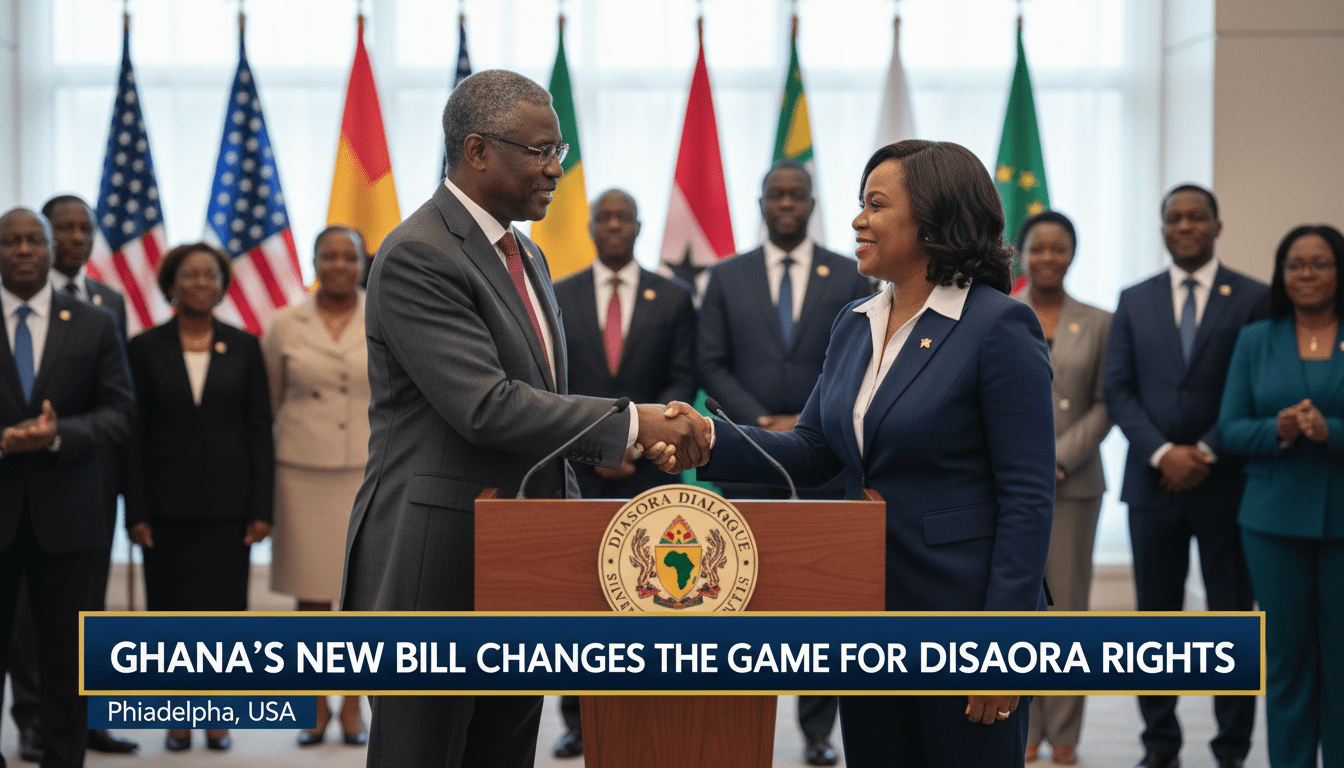
Ghana’s New Bill Changes the Game for Diaspora Rights
By Darius Spearman (africanelements)
Support African Elements at patreon.com/africanelements and hear recent news in a single playlist. Additionally, you can gain early access to ad-free video content.
The relationship between African nations and their children abroad is entering a bold new era. In March 2026, two major events signaled that the African diaspora is no longer an afterthought in the halls of power. From the historic streets of Philadelphia to the tech hubs of Silicon Valley, leaders are rewriting the rules of engagement. These changes aim to move beyond simple money transfers and toward full political and economic partnership. The goal is to ensure that those who support the continent from afar have a seat at the table where decisions are made.
President John Dramani Mahama of Ghana recently made a landmark announcement at a “Diaspora Dialogue” in Philadelphia. He expressed his firm readiness to sign a new bill that will allow Ghanaians living abroad to hold public office without giving up their other citizenships (modernghana.com). This move addresses decades of complaints regarding what many call “fractional citizenship.” At the same time, the African Diaspora Investment Symposium (ADIS26) in California reached its final day. Leaders there finalized the “African Diaspora Investment and Development Act” to boost funding for small businesses across Africa (africandiasporanetwork.org). These developments show a unified effort to harness the power of millions of people across the globe.
The End of Fractional Citizenship in Ghana
For a long time, Ghanaians living in the United States or Europe faced a difficult choice. They could keep their foreign passports to navigate their daily lives abroad, or they could serve their home country in high-level roles. Under old laws, dual citizens were barred from being members of Parliament or holding sensitive security positions. This restriction was based on “loyalty concerns” from a time when the government feared outside influence (modernghana.com, constituteproject.org). Many felt this was unfair because these same people were sending billions of dollars home every year to support the economy.
President Mahama’s commitment in Philadelphia marks a turning point in this struggle. He noted that the expertise and financial power of the diaspora are now strategic assets that Ghana cannot afford to ignore (modernghana.com). The new Diaspora Participation Bill removes the requirement for dual citizens to renounce their foreign citizenship before they can participate in political administration. This change allows the nation to tap into a massive pool of talented doctors, engineers, and administrators who live abroad. By doing so, Ghana is finally treating its diaspora as full citizens rather than just a source of emergency funds.
Ghana Remittance Growth (1979-2025)
Remittances now rank as the second largest source of foreign exchange for Ghana (myjoyonline.com).
A Thirty-Year Struggle for the Vote
The path to this moment has been long and filled with legal hurdles. The 1992 Constitution of Ghana originally granted the right to vote to all citizens aged 18 and over in Article 42 (constituteproject.org). However, the government did not create a way for people living outside the country to actually cast their ballots. For years, the diaspora watched from the sidelines during every election. This was particularly frustrating because many families depend on the modern challenges faced by African American families and their counterparts in the global African community to survive and thrive.
In 2006, the Representation of the People Amendment Act (ROPAA) was passed to fix this issue. Yet, for twenty years, the law sat on the shelf without being used. Officials often claimed they lacked the “logistics” or the “Constitutional Instrument” to make it work (npp-usa.org). Critics argued that political parties were simply afraid that the diaspora vote might change the outcome of close elections. President Mahama’s new stance suggests that the time for excuses is over. By providing the necessary legal framework, Ghana is preparing to allow online voting and registration at embassies for future elections (modernghana.com).
Silicon Valley Meets the African Diaspora
While Ghana handles political rights, a different kind of revolution is happening in the world of finance. The African Diaspora Investment Symposium (ADIS26) recently concluded in Santa Clara, California. This event brought together tech leaders from Silicon Valley and innovators from across the African continent. The focus was on moving “beyond remittances.” Instead of only sending money for family needs, the goal is to direct capital into businesses that create jobs (africandiasporanetwork.org). This shift recognizes the diaspora as venture capitalists who can fuel the next wave of African innovation.
The symposium celebrated the finalization of the African Diaspora Investment and Development Act, also known as the AIDA Act. This legislation was introduced in the United States Congress by Representatives Sheila Cherfilus-McCormick and Jonathan Jackson in 2025 (house.gov, house.gov). It aims to reduce the high cost of sending money to Africa. Currently, fees often take a large chunk of the money sent home. By using new financial technology, the act seeks to lower these costs so more money can reach small and medium-sized enterprises. This is vital because these businesses are the backbone of the African economy.
Bridging the Missing Middle in Funding
One of the biggest problems for African entrepreneurs is the “Missing Middle” in funding. This refers to businesses that are too big for small micro-loans but too small for major bank loans. These enterprises often need between $10,000 and $1 million to grow, but they find it almost impossible to get that money (africandiasporanetwork.org). The AIDA Act and the African Diaspora Innovation Fund (AfDIF) were created specifically to solve this problem. They provide “catalytic capital” that helps these businesses scale up and hire more people.
This approach connects the tech wealth of Silicon Valley with the growing tech hubs in Africa, sometimes called “Silicon Savannah” in Kenya or “Silicon Lagoon” in Nigeria. By creating a direct pipeline for investment, the diaspora can help build the infrastructure for artificial intelligence, healthcare, and green energy on the continent. This is a move toward embracing African-centric education and economic systems. It ensures that African problems are solved by African-led businesses with the support of their global family.
Loyalty and the Global African Family
The debate over dual citizenship often comes down to the question of loyalty. In the past, some leaders feared that a person with two passports might have a divided heart. However, the modern view is that loyalty is shown through action rather than just a legal document. President Mahama argued that the diaspora has shown its “enduring patriotism” by keeping the economy afloat during hard times (modernghana.com). Whether it is through paying for education or investing in new startups, the diaspora has proven its commitment to the success of the nation.
This new perspective is also opening doors for African Americans who want to connect with their roots. Through initiatives like the “Year of Return” and “Beyond the Return,” Ghana has created a pathway for those without direct Ghanaian parentage to become citizens (diasporadigitalnews.com). Since 2016, hundreds of people from the U.S. and the Caribbean have been granted citizenship by presidential concession. This process recognizes that the bond of the global African family is strong. It allows people to trace their roots to shared leadership and find a sense of belonging that was taken from their ancestors centuries ago.
Legislative Support from the United States
It is important to note the role of United States policy in these developments. President Donald Trump currently leads the U.S. government, and his administration has seen various shifts in trade and aid strategies. Within this context, the AIDA Act represents a bipartisan push to align U.S. interests with the growth of the African private sector (house.gov). By providing tax incentives for diaspora members to invest, the U.S. is helping to foster a more stable and prosperous Africa.
The act also demands more transparency in how money is moved across borders. Hidden fees and high transaction costs have historically acted like a tax on the poor. By forcing providers to be clear about their charges and encouraging competition from fintech companies, the law helps keep more money in the hands of the people who need it. This legislative support is a crucial piece of the puzzle. It shows that both the home country and the host country are beginning to recognize the economic weight of the diaspora (house.gov).
Diaspora Influence by the Numbers
Data sources: SOURCE-4, SOURCE-14, Research Notes.
The Future of Political Administration
As President Mahama prepares to sign the Diaspora Participation Bill, the focus moves to implementation. The Electoral Commission of Ghana must now do the hard work of setting up systems to capture the votes of citizens abroad (modernghana.com). This will likely involve a mix of embassy-based voting and secure online platforms. The success of this bill will depend on whether the government can build a system that people trust. If they succeed, it could serve as a model for other African nations looking to integrate their own diasporas.
This political inclusion is the final piece of the puzzle. For years, the diaspora had economic power but no political voice. Now, they are being invited to participate in the “architectural planning” of the continent’s future. This means they can help shape policies on education, healthcare, and trade directly. By ending the era of “fractional citizenship,” Ghana is sending a message that every citizen matters, no matter where in the world they happen to live. This is a significant step toward a more unified and powerful global African community.
Conclusion: A New Chapter in African History
The events of March 2026 are more than just news headlines. They represent a fundamental shift in how the African world operates. The old model of the diaspora as a source of charity is being replaced by a model of strategic partnership. In Ghana, this means full political rights and a chance to serve in government (modernghana.com). In the world of business, it means moving capital into high-growth startups and closing the “Missing Middle” funding gap (africandiasporanetwork.org). These changes are designed to create a future where the continent and its diaspora rise together.
As these bills are signed and these investment acts are implemented, the impact will be felt for generations. The African diaspora is moving from the sidelines into the center of the action. By legalizing political participation and creating structured investment frameworks, leaders are ensuring that the talent and wealth of the global African family are fully utilized. The road ahead will require hard work and constant vigilance, but the foundation for a new era of prosperity has been laid. The story of Africa is being rewritten, and this time, the whole family is helping to hold the pen.
About the Author
Darius Spearman is a professor of Black Studies at San Diego City College, where he has been teaching for over 20 years. He is the founder of African Elements, a media platform dedicated to providing educational resources on the history and culture of the African diaspora. Through his work, Spearman aims to empower and educate by bringing historical context to contemporary issues affecting the Black community.
