

Why the Djibouti Migrant Crisis is a Repeating Tragedy
By Darius Spearman (africanelements)
Support African Elements at patreon.com/africanelements and hear recent news in a single playlist. Additionally, you can gain early access to ad-free video content.
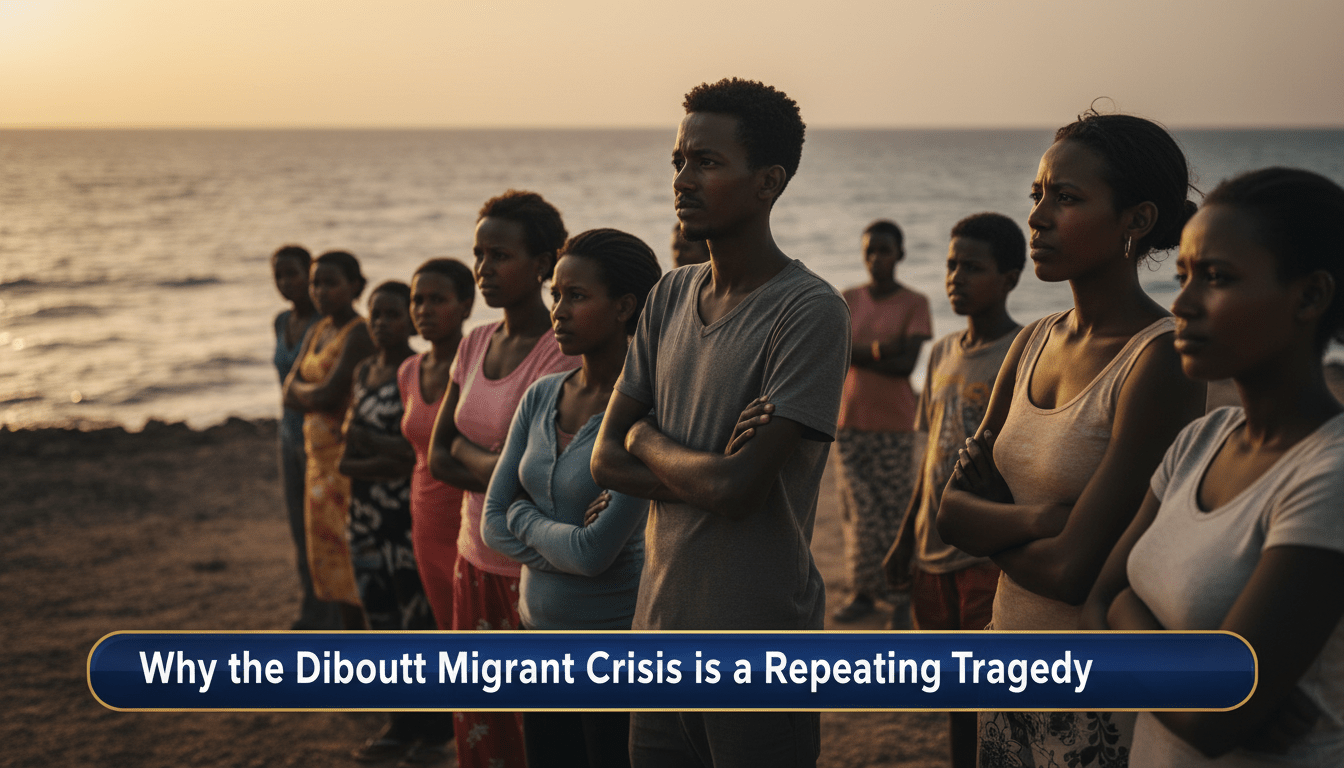
The waters off the coast of Djibouti have claimed more lives in a recurring cycle of grief. On March 24, 2026, a boat carrying over 300 people capsized in the dangerous Bab el-Mandeb Strait. At least nine people died and dozens more are still missing (aa.com.tr). This event is not a random accident. It is part of a long history of movement, struggle, and survival in the Horn of Africa. To understand this tragedy, one must look at the deep roots of the Eastern Migratory Route.
The victims were mostly Ethiopian nationals seeking a better life. They were traveling toward the Arabian Peninsula when their vessel failed. Survivors describe a terrifying scene of waves and darkness. The Bab el-Mandeb Strait is known as the Gate of Tears for a reason. Its name comes from a history of shipwrecks and sorrow (worldatlas.com). This narrow passage is a bottleneck for world trade and a graveyard for those with the fewest options. It connects the Red Sea to the Gulf of Aden, making it a strategic but deadly crossing point.
Escalating Fatalities on the Eastern Route
Annual deaths recorded by the Missing Migrants Project (migrationdataportal.org, iom.int).
The Ancient Origins of the Eastern Route
Movement across the Red Sea is not a new phenomenon. Trade networks between Ethiopia, Somalia, and the Arabian Peninsula have existed since at least the 12th century. In those early times, traders moved gold, spices, and ivory across these waters. However, these same paths were also used for the East African slave trade (britannica.com). This history created a foundation for the migration patterns seen today. The routes used by ancient merchants are the same ones used by modern smugglers.
The East African slave trade lasted for over a millennium. It involved moving people from the African interior to the Middle East and Asia. While different from the Trans-Atlantic trade, it was still a system of extreme brutality. Many people died during the long treks across land before they even reached the coast. Some historical records suggest that four out of five captives perished on the journey (britannica.com). This history of forced movement and high mortality still haunts the region today. It reminds us that the struggle for economic justice and freedom has deep roots in the soil and sea.
Modern mass migration began to surge in the 1990s. This shift happened after the collapse of the Siad Barre regime in Somalia in 1991. When the state fell apart, millions of people fled to escape war and starvation (wikipedia.org). This created a permanent class of refugees who had to find new ways to survive. The instability spread across the region, pulling in people from neighboring Ethiopia as well. What was once a path for labor and trade became a desperate escape route for survival.
The Collapse of Stability and the Rise of Smuggling
Siad Barre was the military leader of Somalia for over twenty years. His government started with promises of unity and progress. However, his rule eventually became violent and divided people along clan lines. When he was finally pushed out of power, a vacuum remained. This led to decades of civil war and the total breakdown of the Somali state (wikipedia.org). People lost their homes and their safety. They began to look toward the Gulf nations for any chance at a future.
As more people fled, a new industry emerged to exploit them. Migration became a business worth millions of dollars. Criminal networks began to organize the movement of people across borders (iom.int). These smugglers treat human beings like cargo. They often pack hundreds of people into boats that are not safe for the open sea. By 2016, this industry was estimated to be worth more than $15 million every year (iom.int). The commodification of people has made the journey much more dangerous than it was in the past.
Smugglers often use violence to maintain control. In many cases, they force migrants into the water before reaching the shore. They do this to avoid being caught by the Djiboutian Coast Guard (iom.int). In October 2024, at least 45 people died when they were pushed into the sea by smugglers (iom.int). This level of cruelty shows that the industry values profit over human life. The historical legacy of involuntary servitude has evolved into a modern form of human trafficking.
Regional Conflict as a Push Factor
Instability in Ethiopia is a major reason why so many people are on the move. Ethiopia has faced several internal conflicts in the last few years. The war in the Tigray region between 2020 and 2022 was devastating. It resulted in hundreds of thousands of deaths and millions of people losing their homes (cfr.org). Even after a peace deal was signed, tension remained high. The destruction of farms and businesses left many young people with no way to make a living.
Other regions like Amhara and Oromia are also seeing violence. In the Amhara region, clashes between the federal government and local militias escalated in 2023. This led to states of emergency and drone strikes in civilian areas (gazettengr.com). In Oromia, a long-standing insurgency has led to ethnic-based violence. These conflicts create a sense of hopelessness. When families cannot farm their land or open their shops, they feel they must leave to survive (lawfaremedia.org). The strength and resilience of these communities are being tested by constant war.
Current global politics also play a role in these regional struggles. Under President Donald Trump, international security aid often focuses on border control. This funding helps African nations militarize their borders to stop migration. However, this does not stop people from leaving. It only forces them to take more dangerous paths. When safe routes are closed, people turn to the Bab el-Mandeb. They choose the risk of drowning over the certainty of violence or hunger at home (developingworldpolitics.com).
The Changing Face of the Diaspora
The demographics of migration on the Eastern Route are shifting rapidly. In the past, most migrants were young men looking for manual labor. Now, more women and children are making the journey. There was a 109 percent increase in women and girls transiting through Djibouti in 2025 compared to the year before (reliefweb.int). This change is driven by a high demand for domestic workers in Gulf nations like Saudi Arabia. Many women see migration as their only way to provide for their children.
For many women, the journey is a search for self-liberation. They may be fleeing forced marriages or abusive situations at home. However, the path they take is full of peril. Women on this route face a high risk of gender-based violence and exploitation by smugglers (reliefweb.int). Despite these dangers, the “pull factor” of jobs in the Middle East remains strong. The chance to earn money and send it back to their villages outweighs the fear of the sea. These women are becoming the primary breadwinners for their kinship groups.
The decision to migrate is often a family investment. Families will sell their ancestral land or livestock to pay smuggling fees. These fees usually range from $200 to $500 (iom.int). This creates a “debt trap” for the migrant. If they do not succeed, their entire family will be ruined financially. This pressure makes it impossible for many to return home, even when things get bad. They are stuck in a cycle of seeking stability while facing constant danger.
A 16-mile chokepoint where 395,100 movements occur annually (migrationdataportal.org, worldatlas.com).
The Harsh Reality of the Kafala System
When migrants finally reach the Gulf nations, their struggle is not over. Most work under a legal framework called the Kafala system. This system binds a worker’s legal status to a single employer (dialoguemigration.com). It gives employers an incredible amount of power over their employees. Many workers have their passports taken away so they cannot leave. This practice often leads to conditions that resemble modern-day slavery.
Labor conditions under the Kafala system are often brutal. Domestic workers may be required to work 15 to 18 hours every day. They frequently face wage theft, where employers refuse to pay them for months at a time (dialoguemigration.com). If a worker tries to leave an abusive situation, they are labeled as “absconded.” This makes them criminals in the eyes of the law. Instead of receiving protection, they face arrest and deportation. The promise of economic stability often turns into a nightmare of exploitation.
This system also prevents “circular labor.” In the past, African workers often moved back and forth across borders for seasonal work. They would earn money and then return to their home communities to invest. Today, the high cost of the journey and the lack of legal rights make this impossible. Migration has become a one-way trip with no safety net. The history of labor in the diaspora shows that Spanish frontier or modern Gulf border, the exploitation of Black labor remains a global issue.
Climate Change as a Silent Driver
Beyond war and politics, the environment is forcing people to flee. The Horn of Africa is one of the most vulnerable regions to climate change. It has been battered by the worst droughts in 40 years followed by sudden, violent floods (reliefweb.int). These extreme weather events have destroyed the livelihoods of millions. Pastoralists who depend on livestock have watched their herds die by the thousands. Farmers have seen their crops wither in the sun.
In 2023 alone, an estimated 3 million people in the region were displaced by climate disasters (reliefweb.int). When traditional ways of life disappear, people have no choice but to look elsewhere. Many of these displaced people eventually find their way to the coast of Djibouti. They are climate refugees, even if the law does not always recognize them as such. The lack of rain in Ethiopia directly leads to more boats in the Bab el-Mandeb Strait.
Industrialized nations in the Global North contribute most to climate change. Yet, it is the people in the Global South who pay the highest price. This creates a cycle of injustice. The same countries that produce the most carbon emissions are also the ones closing their borders to the victims of climate change. This disconnection between global cause and local effect is a central part of the migration crisis. The tragedy off Djibouti is a symptom of a planet out of balance.
Conclusion
The maritime tragedy off the coast of Djibouti is a reminder of the high cost of inequality. At least nine people died in March 2026 because they had no safe way to seek a better life. The history of the Eastern Route shows that this is a long-standing pattern. From ancient trade and the slave trade to modern-day conflict and climate change, the drivers of migration are complex. They are deeply rooted in the history and economy of the region.
As long as there is conflict in Ethiopia and a lack of jobs in the Horn of Africa, people will continue to cross the “Gate of Tears.” Smugglers will continue to profit from their desperation. The international community often focuses on border security, but this does not address the root causes. Without safe and legal pathways for migration, the Bab el-Mandeb will remain a graveyard. The headlines we see today are the result of centuries of history that still demand a just resolution.
About the Author
Darius Spearman is a professor of Black Studies at San Diego City College, where he has been teaching for over 20 years. He is the founder of African Elements, a media platform dedicated to providing educational resources on the history and culture of the African diaspora. Through his work, Spearman aims to empower and educate by bringing historical context to contemporary issues affecting the Black community.
