


Why Millions Join No Kings ICE Enforcement Protests Now
By Darius Spearman (africanelements)
Support African Elements at patreon.com/africanelements and hear recent news in a single playlist. Additionally, you can gain early access to ad-free video content.
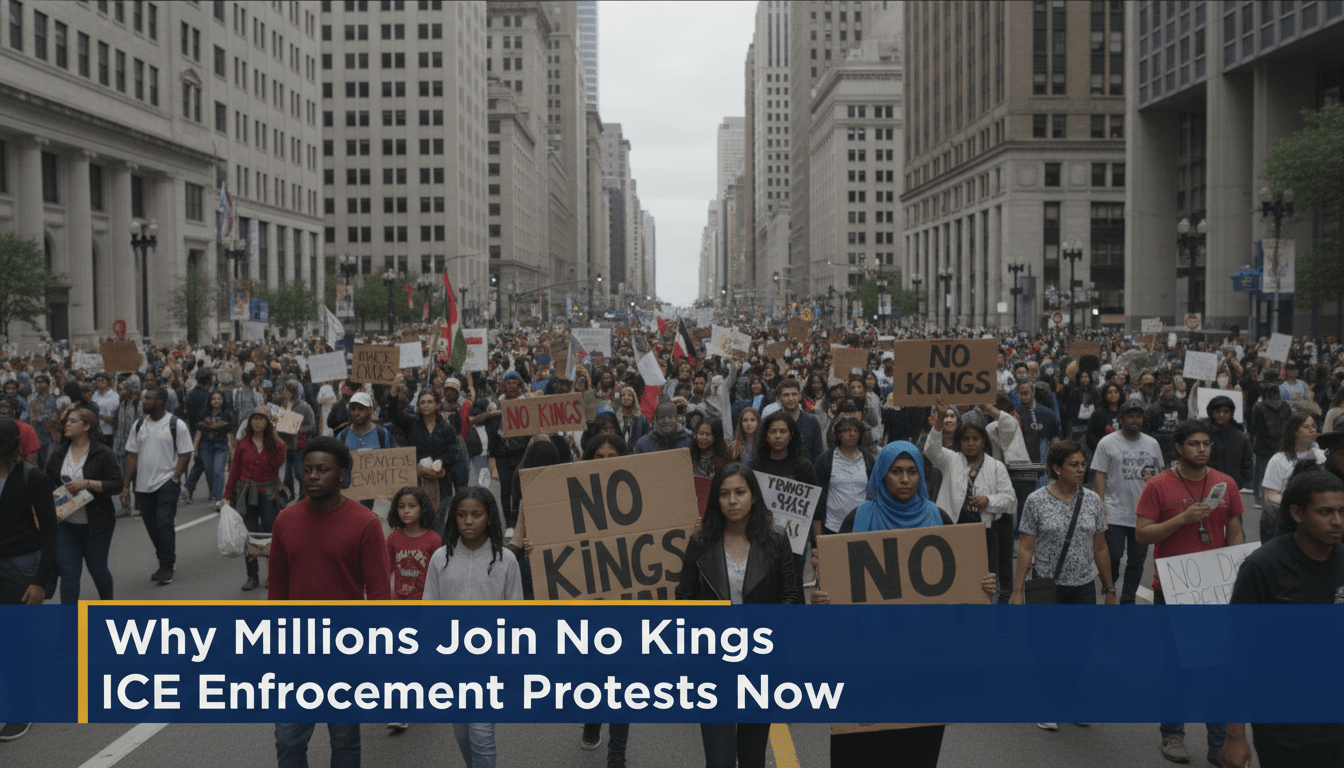
The streets of the United States are currently witnessing a massive wave of civil unrest that experts call a unique period of history. On March 28, 2026, over 8 million people marched in thousands of locations across the country (brookings.edu). This event became the second-largest protest in American history. People from all walks of life gathered under a single, powerful banner: “No Kings.” These demonstrations are a direct response to a massive surge in federal immigration enforcement. This surge has led to violent conflicts between federal agents and state governments.
The Brookings Institution notes that this era is defined by a breakdown in traditional legal boundaries. Viral footage of federal agents engaging in combat-like maneuvers in American cities has sparked global outrage. These agents often operate in tactical gear with their faces covered (brookings.edu). They use unmarked vehicles to transport individuals away from their homes and workplaces. This level of militarized action has not been seen on domestic soil in decades. Consequently, the public is questioning the limits of federal power and the role of the executive branch.
The Post-9/11 Roots of Federal Policing
To understand the current crisis, one must look back to the early 21st century. U.S. Immigration and Customs Enforcement, known as ICE, was created in 2003 (britannica.com). This agency was born out of the Homeland Security Act of 2002. It was the largest reorganization of the federal government since World War II (wikipedia.org). At that time, the primary goal was to protect the nation from foreign terrorism. The government combined the enforcement arms of the former Immigration and Naturalization Service and the U.S. Customs Service.
However, the mission of the agency began to change over the next two decades. What started as a national security effort shifted toward interior enforcement. Programs were created to allow the federal government to use local police for immigration checks (nilc.org). This created an early version of the state and national power conflict that defines the present day. These programs turned local officers into extensions of federal authority. As a result, the boundary between local community safety and federal immigration control began to disappear.
ICE Detainee Levels (2026 Peak)
Source: Brookings & Federal Records (brookings.edu, syr.edu)
Racial Profiling and Community Trust
The expansion of ICE authority relied heavily on programs like 287(g) and Secure Communities. Under the 287(g) program, the Department of Homeland Security can deputize local law enforcement officers (nilc.org). These officers gain the power to interrogate and detain individuals for immigration violations. Civil rights groups argue that this encourages “pretextual” arrests. For example, an officer might stop a driver for a minor issue like a broken taillight. The real goal is often to check the person’s immigration status.
These partnerships have led to a significant increase in racial profiling. In many neighborhoods, immigrant residents are now afraid to report crimes to the local police. They fear that any contact with law enforcement could lead to deportation. This erosion of trust makes entire communities less safe. This shift mirrors patterns seen during the mass incarceration era where policing focused on specific demographics. Advocates point out that these programs prioritize federal quotas over the actual safety of the residents they serve (cato.org).
The 2024 Ruling and the No Kings Movement
The slogan “No Kings” is not just a random phrase. It has deep roots in a 2024 Supreme Court decision regarding presidential immunity. In that ruling, the court decided that a president has absolute immunity for core constitutional acts (substack.com). Dissenting justices warned that this decision could place the president above the law (brookings.edu). By early 2026, many Americans felt those warnings were coming true. The phrase “No Kings” became a rallying cry against what many see as executive overreach.
Protesters argue that this immunity trickles down to agents on the ground. When federal agents use lethal force, they often face very little accountability. The “No Kings” movement suggests that the president is using law enforcement as a personal tool (wikipedia.org). This fear intensified after federal agents were deployed to “Blue” states against the wishes of local governors. The demonstrations highlight a fundamental concern about the survival of American democracy. People are marching to demand that no one, including the president, be treated as if they are royalty.
Operation Metro Surge and the Twin Cities
The current unrest reached a boiling point with the launch of Operation Metro Surge in late 2025. This policy involved deploying thousands of federal agents to major cities (brookings.edu). In the Twin Cities of Minneapolis and Saint Paul, between 3,000 and 4,000 agents arrived in a massive show of force. These agents did not work with local police. Instead, they operated independently, creating chaos in the streets. The choice of Minneapolis was highly symbolic for the administration. It was the site of the 2020 racial justice movement, and the federal government sought to demonstrate its dominance there.
During this operation, agents reportedly engaged in aggressive tactics. They broke into private homes without judicial warrants. They also used facial recognition technology to scan neighborhoods (globalrefuge.org). This level of surveillance has deeply affected the Somali community in Minneapolis. As one of the largest refugee populations in the country, they became a primary target of the surge. The federal government used the pretext of fraud investigations to disrupt local businesses and social services. Consequently, the local economy in these diverse neighborhoods has suffered significantly.
Non-Criminal Arrest Spike
Increase Since Jan 2025
Data based on 2,000% to 2,450% surge reports (syr.edu)
The Human Cost: Renee Good and Alex Pretti
The national protests were fueled by the deaths of two U.S. citizens at the hands of federal agents. Renee Nicole Macklin Good was a 37-year-old mother of three. On January 7, 2026, she was shot by an ICE agent while she was in her vehicle (brookings.edu). Federal officials claimed she tried to run over the officers. However, viral bystander video showed a different story. The footage suggested she was not a threat at the time of the shooting. Her death became a major catalyst for local mobilization in Minnesota.
A few weeks later, another tragedy occurred. Alex Jeffrey Pretti was an intensive care nurse at a Veterans Affairs hospital. He was killed while filming a federal arrest and trying to help a bystander who had been shoved (brookings.edu). Pretti was known as a kindhearted person who cared for veterans. His death brought together healthcare workers and veterans in a shared demand for justice. These fatal shootings of citizens forced many people to realize that federal enforcement tactics could affect anyone. Black women activists and local leaders have been at the forefront of demanding an end to this violence.
The 10th Amendment and State Resistance
In response to Operation Metro Surge, several states are fighting back using the 10th Amendment. This part of the Constitution reserves powers to the states that are not given to the federal government. Minnesota Attorney General Keith Ellison is leading a group of 21 states in a federal lawsuit (brookings.edu). They argue that the federal government is “commandeering” local resources. This means the federal government is trying to force state officials to help with federal programs against their will.
The conflict has moved from the courtroom to the physical world. Some governors have issued executive orders banning federal agents from using city property as staging areas. There have been standoffs where local police refused to grant federal agents access to municipal buildings. A U.S. District Judge even found that ICE had violated nearly 100 court orders in Minnesota alone (syr.edu). This legal battle represents a major constitutional crisis. It is a fight over whether the federal government can override the sovereignty of individual states.
The Impact of the One Big Beautiful Bill Act
The massive scale of Operation Metro Surge is funded by a piece of legislation known as the “One Big Beautiful Bill Act” or OBBBA. Signed into law on July 4, 2025, this act provided $45 billion for immigration enforcement and detention (aa.com.tr). It redirected funds away from social services and toward militarized policing. The law also removed many legal protections for immigrant children. It introduced high fees for people applying for asylum or work permits, making it harder for the most vulnerable to seek help.
Furthermore, the act stripped food assistance and Medicaid eligibility for many immigrants with humanitarian status. This includes people who have lived and worked in the United States for many years. The funding allowed for the creation of thousands of new detention beds. Consequently, the number of people in ICE custody reached an all-time high of over 70,000 (brookings.edu). This massive investment in enforcement has transformed the way the government interacts with immigrant communities. It has moved the country toward a model of mass deportation rather than public safety.
Americans are 20% more likely to believe ICE actions make cities less safe (brookings.edu)
Surveillance and Federal Overreach
Modern technology has played a huge role in the current enforcement surge. Federal agencies have used advanced federal surveillance tactics to track individuals in their daily lives. This includes the use of drones and high-tech tracking software. Agents have been accused of using these tools to monitor political activists as well as immigrant residents. This level of monitoring has created a climate of fear that extends beyond the immigrant community. Many citizens now worry that their own movements are being recorded by the government.
The Brookings Institution reports that these tactics have eroded the transparency of law enforcement. When agents wear masks and drive unmarked cars, it is impossible for the public to identify them. This lack of identification makes it very difficult to report misconduct. Over 30 states have introduced laws to ban federal agents from hiding their identities (brookings.edu). These states want to restore a level of accountability to policing. They argue that secret police forces have no place in a free society. The tension between secret federal operations and state transparency laws continues to grow.
Conclusion: A Breaking Point in History
The “No Kings” protests signify a major turning point in the history of the United States. It is not just about immigration policy anymore. The movement is about the fundamental nature of American democracy and the balance of power. While high deportation numbers have occurred in the past, the direct militarization of cities is new. The fatal shootings of citizens like Renee Good and Alex Pretti have shown that the stakes are incredibly high. People are no longer willing to accept federal actions that ignore local laws and human rights.
As the conflict between state governors and the federal government intensifies, the future remains uncertain. The $45 billion allocated for this surge suggests that the administration does not plan to stop anytime soon. However, the 8 million people who took to the streets on March 28 show that the public is not silent. This unique period of history will be remembered for how the nation decided to handle the power of its leaders. Whether the “No Kings” movement succeeds in changing policy remains to be seen. What is clear is that the current path has led to a historic crisis of trust and authority.
About the Author
Darius Spearman is a professor of Black Studies at San Diego City College, where he has been teaching for over 20 years. He is the founder of African Elements, a media platform dedicated to providing educational resources on the history and culture of the African diaspora. Through his work, Spearman aims to empower and educate by bringing historical context to contemporary issues affecting the Black community.
