


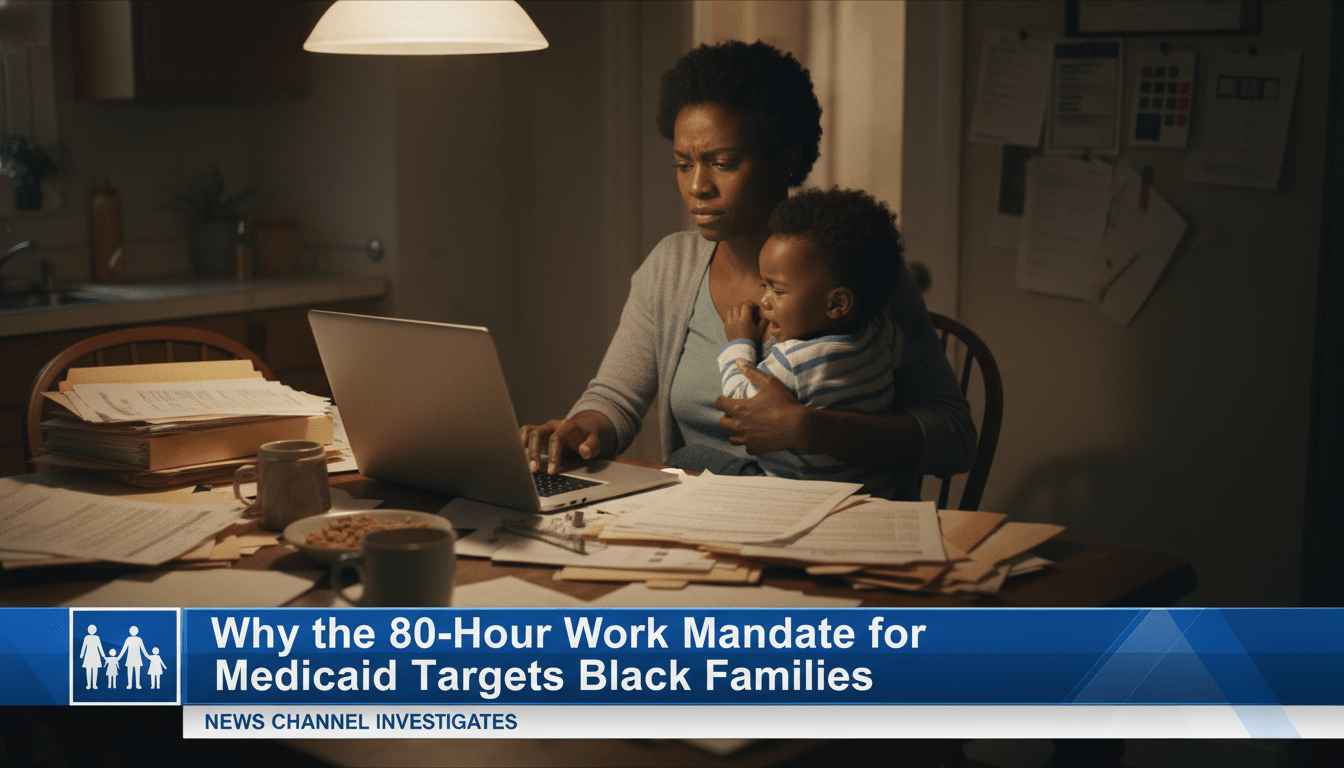
Why the 80-Hour Work Mandate for Medicaid Targets Black Families
By Darius Spearman (africanelements)
Support African Elements at patreon.com/africanelements and hear recent news in a single playlist. Additionally, you can gain early access to ad-free video content.
The United States is currently facing a massive shift in how it supports its citizens. President Donald Trump and his administration have moved forward with the One Big Beautiful Bill Act of 2025 (gwu.edu). This law is also known as the OBBA. It introduces some of the strictest rules for public help in modern history. The most controversial part is a new 80-hour monthly work requirement for Medicaid (gwu.edu). This change has caused a major legal battle across the country. Civil rights groups are sounding the alarm about how these rules hurt Black families.
These groups argue that the rules do not truly help people find jobs. Instead, the rules create a mountain of paperwork. This paperwork often leads to people losing their healthcare even if they are working. For many in the Black community, this is a familiar story. It is a story of “weaponized red tape” that makes life harder for those who have the least (newsfromthestates.com). The fight for fair economic treatment has moved from the streets to the courtrooms. This article looks at the history and the hard facts behind these new headlines.
Projected Medicaid Loss (2026-2034)
Low Estimate
4.6 Million
High Estimate
5.2 Million
Source: Commonwealth Fund / CBO (commonwealthfund.org)
The Racial Roots of the American Safety Net
The history of the American safety net has always been tied to race. When the Social Security Act passed in 1935, it left many people out on purpose. Specifically, it excluded domestic and agricultural workers (hbs.edu). At that time, about 65 percent of the Black workforce worked in those two fields (naacp.org). Southern politicians wanted to keep it this way. They wanted to make sure Black workers stayed dependent on low-wage labor in the South. This was a clear political move to protect the racial hierarchy of the time (hbs.edu). This legacy is rooted in the post-Civil War era where new forms of control replaced old ones.
Historians call this the “Southern Strategy.” By keeping federal aid out of the hands of Black workers, states could control the labor market. Even when programs expanded in the 1960s, the narrative began to shift. During the 1970s and 1980s, politicians began using the “Welfare Queen” stereotype (epi.org). This was a racialized image of a person who refused to work and lived off the government. It was used to justify cutting benefits for everyone. It created the idea that being poor was a personal failure rather than a result of systemic barriers (stateofthesouth.org).
This history shows that work requirements are not a new idea. They have often been used to decide who is “deserving” of help. In 1996, President Bill Clinton signed the Personal Responsibility and Work Opportunity Reconciliation Act (epi.org). This law replaced older welfare programs with work-based ones. It introduced the first modern work rules for what we now call SNAP. These rules targeted “Able-Bodied Adults Without Dependents” (usda.gov). This set the stage for the current 80-hour mandate we see today in the OBBA (gwu.edu).
The 80-Hour Mandate and the OBBA Expansion
The OBBA of 2025 has taken these old ideas and made them much stricter. Under this law, adults aged 19 to 64 must prove they work at least 80 hours a month to keep Medicaid (gwu.edu). This rule applies in states that expanded Medicaid under the Affordable Care Act. If someone cannot prove they are working, volunteering, or in school for those 80 hours, they lose their healthcare. There are very few exceptions. For example, some caregivers and people with certain disabilities might be exempt. However, the burden of proof is on the individual (kff.org).
The law also changes the Supplemental Nutrition Assistance Program, or SNAP. It raised the age limit for work requirements from 54 to 64 (chn.org). It also removed exemptions that used to help veterans and homeless youth. Furthermore, it made it much harder for states to get waivers. States used to get waivers for areas with high unemployment. Now, those areas must have over 10 percent unemployment to qualify (chn.org). This is a very high bar that many struggling communities never reach. It means many people in high-poverty areas will be forced to meet work rules even when jobs are not available (epi.org).
The impact of these changes is expected to be massive. Experts believe between 4.6 million and 5.2 million people could lose their health insurance by 2034 (commonwealthfund.org). Most of these people will lose coverage because of “administrative churn.” This is when people are still eligible but cannot keep up with the reporting rules. In the past, similar rules in Arkansas led to thousands losing coverage (urban.org). Most of those people were actually working but could not navigate the online reporting systems (kff.org).
Transportation Hurdles and the Commute Gap
One of the biggest problems with the 80-hour mandate is transportation. To work 80 hours a month, a person must be able to get to a job. For many Black families, this is not easy. Statistics show that 24 percent of Black households do not own a car (cbcfinc.org). For white households, that number is only 7 percent. This creates a massive “commute gap” that makes it hard to keep a steady job. In many cities, public transit is not reliable. Black workers are five times more likely to rely on buses and trains than white workers (stateofthesouth.org).
This problem is even worse in rural areas and outer suburbs. Many low-income families have been pushed out of city centers due to rising costs. They now live in “transit deserts” where there are no buses or trains (stateofthesouth.org). In these places, a simple commute to a minimum-wage job can take hours. If a person does not have a car, they may spend more money on transportation than they earn at the job. The 80-hour rule does not account for these geographic realities. It assumes that every person has a way to get to work every single day (cbcfinc.org).
For a person living in a rural area without a vehicle, the mandate is nearly impossible to meet. They are stuck in a trap. They need a job to keep their food and health benefits. However, they cannot get to a job because they lack a car. This is a primary reason why civil rights groups say the law has a “disparate impact” (justice.gov). It places a much heavier burden on Black citizens who have been historically excluded from wealth-building opportunities like car ownership.
The Vehicle Access Gap
Black Households (24%)
White Households (7%)
Percentage of households with ZERO vehicle access (cbcfinc.org)
Degree Inflation and Labor Market Barriers
Another major hurdle is the current state of the labor market. Even if a person can get to a job, they may not be hired. Structural racism still plays a large role in hiring (workingnation.com). For example, people with criminal records face huge challenges. They receive 60 percent fewer callbacks for interviews (epi.org). Because of over-policing, Black men are disproportionately likely to have a record. This historical narrative shifted toward policing and punishment in the late 20th century, and it still affects families today.
There is also the problem of “degree inflation.” This is when employers require a college degree for jobs that do not really need one (hbs.edu). Positions like administrative assistants or supervisors used to be open to people with high school diplomas. Now, about 67 percent of those job postings ask for a four-year degree (hbs.edu). Only 16 percent of people currently in those roles actually have a degree. This creates a wall that blocks many qualified workers. Since Black students often have less access to higher education, they are blocked from these “middle-skill” jobs (hbs.edu).
The OBBA work mandate does not recognize these barriers. It treats unemployment as a choice rather than a result of a broken system. If a person cannot find a job due to degree inflation or a background check, they still lose their SNAP and Medicaid. The law does not give credit for the hours spent searching for work unless it is in a state-approved program (usda.gov). These programs often have very few slots and long waiting lists. This leaves many people with no way to fulfill the 80-hour requirement (epi.org).
The Digital Divide and Reporting Challenges
Meeting the work requirement is only half the battle. The other half is reporting those hours to the government. The OBBA requires people to report their hours through digital portals (gwu.edu). This is a major issue because of the “digital divide.” About 40 percent of Black households do not have high-speed internet at home (medium.com). In comparison, only 28 percent of white households lack this access. Without a reliable computer or internet connection, keeping up with monthly reporting is very difficult.
Many low-income families rely on their smartphones for everything. However, many government websites are not mobile-friendly. They can be hard to navigate and often crash. If a person misses a reporting deadline because their internet was cut off, they lose their benefits (propel.app). This happened frequently during the Arkansas Medicaid experiment. People who were working lost their insurance because they could not figure out how to use the website (urban.org). The expiration of the Affordable Connectivity Program in 2024 has made this even worse by removing internet subsidies for the poor (medium.com).
Furthermore, many families lack “digital literacy.” They may not know how to upload pay stubs or scan documents. For an elderly person or someone with a learning disability, these tasks are overwhelming. The system is designed for speed and efficiency, but it leaves behind those who are not tech-savvy. This is another layer of red tape that acts as a gatekeeper. It prevents the most vulnerable people from getting the food and medical care they need to survive (jhsph.edu).
Kinship Care and the Definition of Caregiving
The rules around caregiving also create problems for many Black families. The OBBA allows for some exemptions for people who care for children or sick relatives. However, these definitions are very narrow (masslegalhelp.org). They usually only count the legal “assistance group.” This often excludes “kinship care” arrangements. In the Black community, it is very common for grandmothers, aunts, or cousins to raise children (mplp.org). This highlights the importance of strong kinship bonds that have sustained families through hard times.
If an aunt is raising her niece but does not have legal guardianship, she may not qualify for a caregiver exemption. She would still be required to work 80 hours a month while also providing full-time childcare. Similarly, if several adults live together and share the care of an elderly parent, only one can usually claim the exemption (ohio.gov). This does not reflect how many families actually live. It ignores the multi-generational households that are common in minority communities (mplp.org).
The OBBA also removed exemptions for parents of children older than 13 (chn.org). This means a single mother with a 14-year-old child must meet the full work requirement. This can be very difficult if she cannot find childcare for the hours she is at work. If she stays home to make sure her teenager stays out of trouble, she risks losing her food stamps. The law forces parents to choose between their child’s safety and their family’s health (epi.org).
SNAP Participation Drop After Work Rules
Black Adults
-23%
White Adults
-16%
Historical drop in SNAP participation when work rules are applied (gwu.edu)
The Legal Battle: Equal Protection and Disparate Impact
Civil rights organizations are not taking these changes lying down. A coalition of 22 state Attorneys General has filed lawsuits against the OBBA (newsfromthestates.com). They argue that the law violates the Equal Protection Clause of the 14th Amendment. This clause says that the government must treat everyone equally under the law (justice.gov). The lawsuits claim that the 80-hour mandate is unconstitutional because it targets certain groups of people more than others.
The legal theory they are using is called “disparate impact.” This means that even if a law does not mention race, it is still discriminatory if it has an unequal effect. Since Black families face more transportation and employment hurdles, the law hurts them more (justice.gov). The National Center for Law and Economic Justice (NCLEJ) is leading one of these major cases. They argue that the Trump administration bypassed the proper steps to implement these rules. They say the government failed to consider how many people would lose their health coverage (gwu.edu).
The Department of Justice under the Trump administration has tried to push back. They have attempted to limit “disparate impact” liability in federal rules (justice.gov). They argue that the law is “race-neutral” because it applies to everyone. However, civil rights advocates say this is a way to hide systemic bias. If the law stands, it could change the nature of the American safety net forever. It would move from a system based on need to one based on compliance with complicated rules (newsfromthestates.com).
Conclusion: The Future of the Safety Net
The fight over the OBBA is about more than just 80 hours of work. it is about the fundamental promise of the American government. For almost a century, the safety net was seen as a “floor” that no one should fall below (newsfromthestates.com). Now, that floor is being replaced with a ladder that many people cannot climb. The combination of strict work rules, digital reporting, and narrow exemptions is a major threat to millions of families (gwu.edu).
The outcome of the legal battles in 2026 will be a turning point. If the courts uphold the 80-hour mandate, we will likely see a significant rise in poverty and uninsured rates. Black families will bear the brunt of this shift due to the historical and structural factors discussed here (cbcfinc.org). It is important to look beyond the headlines and understand the deep history of these policies. Only by seeing the full picture can we understand the real cost of these new barriers (stateofthesouth.org).
The resilience of the community has always been its greatest strength. As these new rules take effect, organizations are working to help people navigate the red tape. They are fighting for a future where healthcare and food are seen as basic rights, not rewards for paperwork. The history of the safety net is still being written, and the current headlines are just the latest chapter (naacp.org).
About the Author
Darius Spearman is a professor of Black Studies at San Diego City College, where he has been teaching for over 20 years. He is the founder of African Elements, a media platform dedicated to providing educational resources on the history and culture of the African diaspora. Through his work, Spearman aims to empower and educate by bringing historical context to contemporary issues affecting the Black community.
