

How Haiti Gang Attacks Threaten National Food Security Today
By Darius Spearman (africanelements)
Support African Elements at patreon.com/africanelements and hear recent news in a single playlist. Additionally, you can gain early access to ad-free video content.
The recent violence in Haiti has reached a terrifying new level of cruelty. In the last twenty-four hours, reports indicate that at least seventy people lost their lives in a massive gang assault (telesurenglish.net). This attack targeted the town of Jean-Denis within the Artibonite region. Another thirty individuals suffered injuries during the raid (rnddh.org). This tragedy is the latest event in a long history of state collapse and rising criminal power. The nation continues to wait for more robust international support while the humanitarian crisis deepens every day.
To understand why this is happening, one must look at the history behind the headlines. The current violence is not random or sudden. It is the result of decades of political decisions and foreign influence. For example, the Haitian Revolution established a legacy of resistance that still shapes the Caribbean. However, modern gangs have turned that history into a tool for terror. They now control major parts of the country and its resources. This latest massacre shows that the state is struggling to protect its citizens from these paramilitary groups (harvard.edu).
The Historical Roots of State-Sponsored Violence
The story of Haitian gangs begins with the era of the Duvalier dictatorship. From 1957 to 1986, François “Papa Doc” Duvalier ruled the nation with an iron fist. He created a personal militia known as the Tonton Macoute (harvard.edu). This group bypassed the traditional military to maintain his power through fear. They terrorized the population to ensure that the regime remained unchallenged for decades. When the dynasty fell in 1986, these armed men did not simply vanish. Many former members became local security for the political elite or joined criminal networks (harvard.edu).
This historical blueprint created a culture where political leaders used armed groups as private security. These groups were often used to suppress dissent or influence elections. This pattern continued long after the Duvaliers were gone. It established a dangerous precedent where the line between the state and criminal actors was blurred. Over time, these groups evolved from neighborhood protectors into sophisticated paramilitary organizations. They became a permanent fixture in the political landscape of the nation (harvard.edu). This history of nation-centered power shows how the state traded security for political survival.
Annual Death Toll from Gang Conflict
The Disbanding of the Army and the Security Vacuum
A major turning point occurred in 1995 under President Jean-Bertrand Aristide. After years of military coups, Aristide officially disbanded the Haitian Armed Forces (wikipedia.org). This move was intended to prevent further military takeovers of the government. However, it created a massive security vacuum throughout the provinces. Without a national army, the country lacked the ability to police its rural regions. Political factions began to arm young men to act as unofficial security (wikipedia.org). These groups became known as “Chimères,” a term meaning ghosts or mythical monsters (nacla.org).
The term Chimères was often used by elites to criminalize the urban poor. It functioned as a linguistic weapon to stigmatize political activists from disadvantaged areas. While these groups were initially political supporters, they soon became predatory. They filled the space left by the absent military and police. This transition from political mobilization to pure criminality took years to fully develop. By the time the government realized the danger, the gangs were already too strong. This vacuum allowed criminal leaders to build their own local empires without state interference (nacla.org).
The Artibonite Region as a Strategic Target
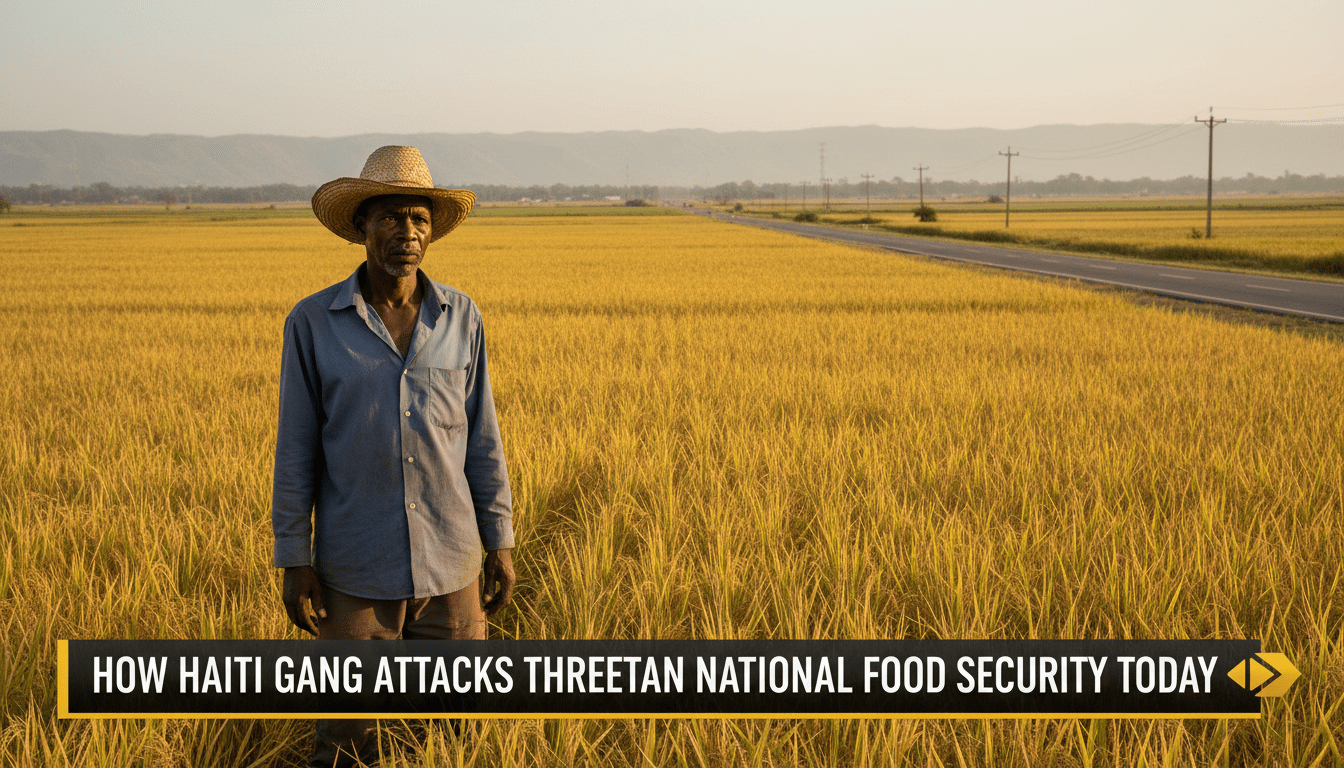
The Artibonite region is the agricultural heart of the nation. It is often called the rice basket or the granary of the country. This area produces approximately eighty percent of the rice consumed by the population (un.org). Therefore, control over this region is vital for national survival. The “Gran Grif” gang has targeted this area to control the food supply. By seizing the Artibonite, they can effectively starve the capital of Port-au-Prince. This strategic move allows them to extort farmers and control irrigation systems (un.org).
The fall of the Artibonite to gang control has triggered a national food crisis. Many farmers have abandoned their land due to the constant threat of violence. Consequently, domestic rice production has dropped to its lowest level in over a decade (un.org). Gang members use the Artibonite River for tactical movements and to launch attacks on nearby towns. This was seen during the recent massacre in Jean-Denis where seventy people were killed. The destabilization of this region severs the food supply chain for the entire nation. It transforms a criminal issue into a humanitarian disaster (un.org).
The Rise of Gran Grif and Political Patronage
The gang responsible for the latest attack is known as Gran Grif. This group represents a newer and more predatory evolution of Haitian gangs. It was founded around 2016 by a former legislator named Prophane Victor (un.org). He allegedly created the group to secure his election and control the Artibonite region. Initially, Gran Grif operated as a political tool for its founder. However, it became increasingly autonomous under the leadership of Luckson Elan (un.org). The gang no longer takes orders from the political elites who once supported them.
Gran Grif is now notorious for using tactics of extreme terror. They engage in mass rape and the systematic extortion of local residents. They also kidnap travelers along National Road Number One, which is a critical transit route. United Nations experts report that Prophane Victor provided funds and weapons to the gang for years (un.org). Although Victor is now under international sanctions, he remains at large. This illustrates the persistent lack of accountability for those who arm criminal groups. The gang now funds itself through kidnapping and illegal taxing of the population (un.org).
The 2021 Assassination and the Viv Ansanm Coalition
The current crisis accelerated rapidly after the assassination of President Jovenel Moïse in 2021. This event left a massive power vacuum at the highest level of government. Gangs took this opportunity to seize control of critical infrastructure like ports and fuel terminals. By 2023, former rival gang federations joined forces to form a coalition (globalinitiative.net). This coalition is known as “Viv Ansanm,” which means “Living Together” in Haitian Kreyòl. It brought together the G9 and G-Pep groups to wage war against the state (un.org).
The name Viv Ansanm is deeply ironic given the violence they commit. The coalition launched coordinated attacks in early 2024 to force the resignation of the government. They targeted prisons, the national airport, and various government buildings. This unity among criminals was driven by the threat of international intervention. They realized that working together would make them more powerful than the national police. Today, this coalition controls more than ninety percent of the capital city (un.org). Their campaign of violence has led to thousands of deaths and massive displacement of civilians (rnddh.org).
The “Iron River” of Weapons from the United States
A major factor fueling the violence is the constant flow of illegal weapons. Most of the firearms used by Haitian gangs originate from the United States (csis.org). They are often purchased in Florida and smuggled through shipping containers. This “Iron River” includes military-grade equipment such as sniper rifles and machine guns. These weapons allow gangs to outgun the Haitian National Police nearly ten to one. Small-arms traffickers exploit shipping loopholes to bypass screening at American ports (csis.org). This creates a situation where historical exploitation is mirrored by modern arms trafficking.
The availability of high-powered weaponry has transformed gangs into quasi-state powers. They use these tools to enforce their control over neighborhoods and transit routes. Despite the 2021 assassination being linked to actors in Florida, the weapons flow continues. This is a significant social justice issue for the African Diaspora. It shows how lax regulations in the United States directly destabilize Caribbean nations. The Haitian National Police cannot match the firepower of the gangs they are supposed to fight. As a result, many officers are forced to abandon their posts or live inside their stations (csis.org).
Homicide Rate per 100,000
The Failure of Governance and the 2026 Timeline
As of March 2026, the political situation in Haiti remains extremely unstable. The Transitional Presidential Council dissolved in February after failing to hold elections. Currently, Prime Minister Alix Didier Fils-Aimé serves as the acting head of state (un.org). He holds the executive authority with support from the international community. However, he faces the massive challenge of restoring security in a broken nation. Elections are tentatively scheduled for August and December of 2026. Many people doubt that fair elections can occur while gangs control most of the country (un.org).
The international community has attempted to help through the Multinational Security Support mission. This mission is led by Kenya and was authorized by the United Nations (un.org). However, it is not a traditional UN peacekeeping force. It relies on voluntary contributions, which has led to chronic funding and staffing shortages. Only about a thousand officers are currently on the ground. This is far below the number needed to challenge the Viv Ansanm coalition. A new “Gang Suppression Force” is expected to begin deployment in April 2026. This force aims to provide a more stable and robust response to the crisis (un.org).
The Human Cost of a Collapsing Nation
The human toll of this ongoing conflict is staggering and heart-breaking. Over five thousand people were killed in 2024 alone (rnddh.org). Since 2021, nearly twenty thousand lives have been lost to gang violence. More than one point four million Haitians are now internally displaced within their own country. This is one of the highest displacement rates in the world due to crime. Half of the population faces acute hunger as gangs block food routes (rnddh.org). These statistics represent real families torn apart by a crisis they did not create.
The massacre in the Artibonite is a reminder that no one is safe. Gangs are no longer just fighting for territory in the capital. They are strangling the ability of the nation to feed itself. This man-made famine is a direct result of the state trading security for political power. The international community must provide more than just promises of support. Without a real change in security and governance, the cycle of violence will continue. The history behind these headlines shows that the people of Haiti deserve a future free from fear (rnddh.org).
About the Author
Darius Spearman is a professor of Black Studies at San Diego City College, where he has been teaching for over 20 years. He is the founder of African Elements, a media platform dedicated to providing educational resources on the history and culture of the African diaspora. Through his work, Spearman aims to empower and educate by bringing historical context to contemporary issues affecting the Black community.
