


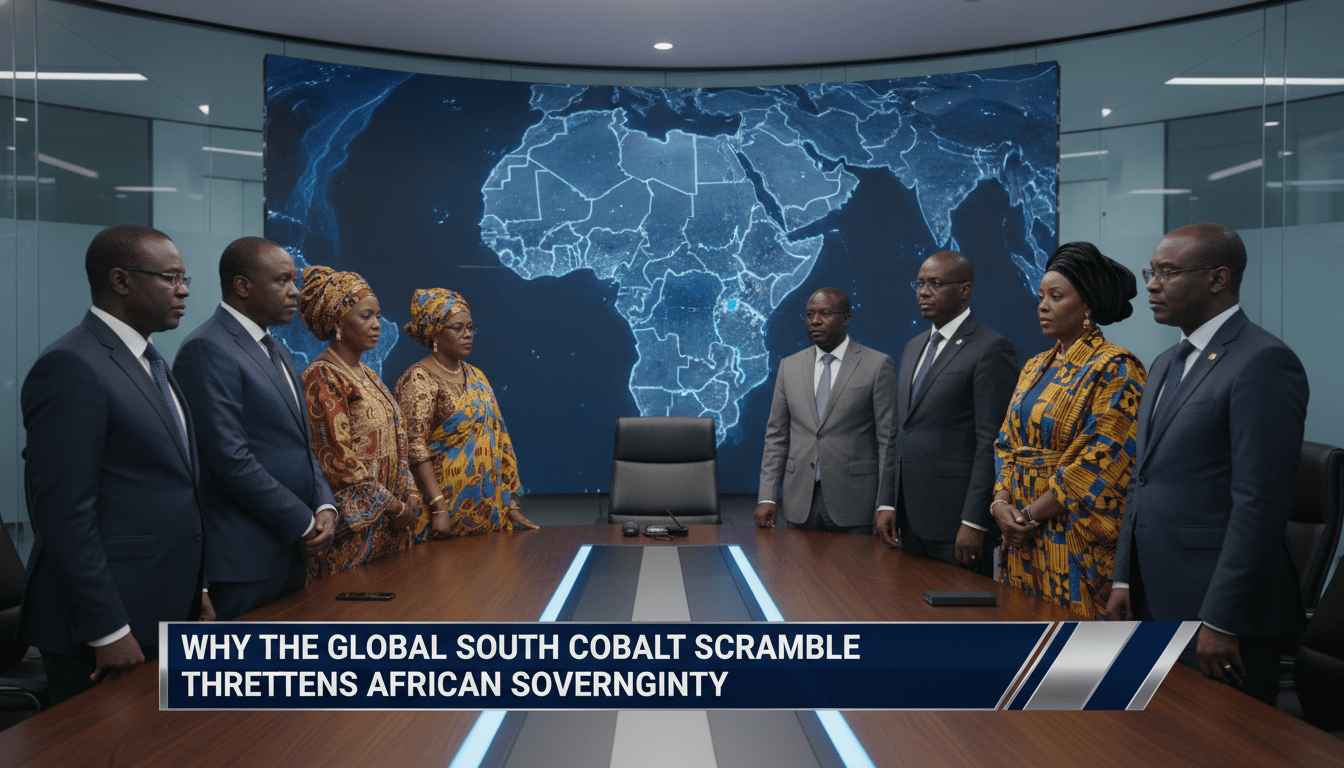
Why the Global South Cobalt Scramble Threatens African Sovereignty
By Darius Spearman (africanelements)
Support African Elements at patreon.com/africanelements and hear recent news in a single playlist. Additionally, you can gain early access to ad-free video content.
Reports from Addis Ababa highlight a growing crisis on the African continent. During the 39th African Union Summit in early 2026, leaders expressed deep concern over a “New Scramble for Africa.” This term describes the aggressive push by foreign powers to control critical minerals. International analysts warn that Western nations are moving toward a corporate acquisition model. This model targets essential resources like cobalt and lithium. African leaders are now calling for unified resistance to protect their resource sovereignty. They want to ensure that the wealth of the land benefits the people who live on it (mg.co.za, finalcall.com).
The current situation mirrors events from over a century ago. History seems to repeat itself as global powers look to Africa for raw materials. The continent holds the keys to the future of technology and energy. However, the benefits of these resources often leave the continent. This creates a cycle of poverty and exploitation. Many see this as a continuation of historical patterns. The struggle for control over African soil is once again a central theme in global politics. People across the diaspora are watching closely as these events unfold (waronwant.org, gtwaction.org).
The Ghost of the Berlin Conference
To understand the present, one must look at the past. The original “Scramble for Africa” began in the late 19th century. Between November 1884 and February 1885, fourteen nations met in Berlin, Germany. They wanted to divide the African continent among themselves. Not a single African representative was invited to this meeting. The European powers established the “Principle of Effective Occupation.” This rule required nations to have a physical presence to claim land. This led to a violent rush into the interior of Africa. Colonial powers wanted to secure resource-rich territories before their rivals could (chapman.edu, waronwant.org).
King Leopold II of Belgium claimed the Congo Free State as his personal property. He focused on extracting ivory and rubber. His regime used forced labor and extreme violence to meet quotas. This period resulted in an estimated 10 million deaths. The Congo became a “resource heartland” for external powers. Colonial rulers also used “divide and rule” tactics. They split ethnic groups to prevent unified resistance. These historical actions created the borders and instabilities seen today. These artificial boundaries continue to complicate efforts for true resource sovereignty (waronwant.org, socialistaction.org).
The Corporate Acquisition Model in the 21st Century
Modern Western policies have shifted. Analysts at the Addis Ababa summit point to the 2025 US National Security Strategy. They also cite the EU Critical Raw Materials Act. These policies favor a corporate acquisition model. This model moves away from traditional foreign aid. Instead, it focuses on securing supply chains for Western companies. A major example is the December 2025 deal between the United States and the Democratic Republic of Congo. This agreement gives American firms the “right of first offer” on mining projects. In exchange, the U.S. provides security assistance (finalcall.com, devex.com).
Critics argue that this deal undermines Congolese sovereignty. It forces the nation to change its mining laws. The DRC must give preferential treatment to foreign interests. This mirrors the concessions made during the colonial era. The agreement was made with little input from the Congolese people. Activists state that this treats the country as a “rule-taker” rather than a “rule-maker.” The deal aims to block Chinese influence in the region. However, it may also block local Congolese investors from their own resources. This policy creates a new form of economic dependency (finalcall.com, issafrica.org).
Green Energy and the Mineral Demand
The transition to green energy drives the new scramble. Cobalt and lithium are essential for this transition. They are the building blocks of rechargeable batteries. These minerals power smartphones, tablets, and laptops. They are also vital for electric vehicle batteries. Lithium allows cars to travel long distances on a single charge. Cobalt provides stability and durability to these batteries. Without these minerals, a digital lifestyle would be impossible. Consequently, they are labeled as “critical minerals” by global powers (mg.co.za, issafrica.org).
Demand for these resources is skyrocketing. Cobalt demand may grow six-fold by the year 2040. Lithium demand could grow eight-fold in the same period. Africa holds 26.7 million tons of identified lithium. Global powers frame their involvement as “partnerships for the energy transition.” However, many African leaders call this “green-washed extractivism.” They argue that foreign companies take the profits. Meanwhile, the local communities suffer from environmental damage. This narrative masks the true cost of the green energy revolution (africaenergyindaba.com, miningindaba.com, gtwaction.org).
Human Rights and Labor in the Mines
The human cost of mining is severe. In the Democratic Republic of Congo, labor conditions are often hazardous. Human rights groups report widespread abuses in cobalt mines. As of 2025, about 40,000 children work in these mines. Some are as young as seven years old. They often clean ore with their bare hands. They have no protective gear to shield them from toxic dust. This exposure leads to serious health problems. The artisanal mining sector is particularly dangerous (mg.co.za, waronwant.org).
Forced labor is another major concern. Approximately 80,000 miners work under conditions of coercion. This includes debt bondage and physical threats. Industrial mining also leads to the displacement of entire communities. Families are often forced from their homes to make room for mine expansions. They rarely receive fair compensation for their losses. Artisanal miners dig tunnels hundreds of feet deep. These tunnels lack structural support and frequently collapse. Such accidents cause hundreds of deaths every year. These conditions are a reminder of rising labor movements struggling for dignity (mg.co.za, socialistaction.org).
China holds a massive 4:1 trade advantage over the U.S. in African markets.
Environmental Consequences of Mineral Extraction
Mining for “green” minerals has a heavy environmental footprint. Lithium extraction is incredibly water-intensive. Producing one ton of lithium uses over 500,000 gallons of water. This leads to severe droughts in farming regions. Cobalt mining can also unearth radioactive materials like uranium. This causes respiratory illnesses for residents who breathe in the dust. The local ecosystem suffers as a result of these industrial processes (mg.co.za, gtwaction.org).
Acid mine drainage is another serious threat. Sulfuric acid is used to process minerals. This acid often leaks into local rivers. It kills fish and makes the water unsafe for humans. Heavy metals like lead and zinc contaminate the soil. This reduces crop yields for local farmers. Long-term exposure to these toxins can cause DNA damage in children. The transition to clean energy in the West should not come at the expense of African environments. Protecting the land is part of maintaining cultural heritage for future generations (mg.co.za, gtwaction.org).
The Geopolitical Rivalry: USA vs. China
The scramble is fueled by competition between major powers. China currently dominates the African mineral sector. It uses a “minerals-for-infrastructure” model. China builds roads, railways, and dams in exchange for mining rights. This model provides immediate results for African governments. As of 2024, China has a 4:1 trade advantage over the United States in Africa. Most African minerals are refined in China. This gives China control over the global battery supply chain (mg.co.za, energychamber.org).
The United States is trying to catch up. President Trump has emphasized the importance of secure supply chains. The U.S. is financing projects like the Lobito Corridor. This rail project will link minerals from the DRC to the Atlantic coast. The U.S. model focuses on private-sector investment and transparency. However, it is often slower than the Chinese approach. This rivalry puts African nations in a difficult position. They must navigate the interests of two global giants while trying to protect their own interests (finalcall.com, devex.com, issafrica.org).
Unified African Resistance and the AGMS
In response to these pressures, the African Union is taking action. The 39th AU Summit saw the approval of the African Green Minerals Strategy (AGMS). This is a roadmap for the entire continent. The goal is to stop the export of raw, unprocessed minerals. African nations want to perform “local beneficiation.” This means refining minerals like lithium and cobalt within Africa. By doing this, they can keep more of the wealth on the continent (africaenergyindaba.com, issafrica.org).
Local beneficiation creates jobs for African workers. It allows countries to move up the value chain. Instead of exporting cheap “dirt,” they will export high-value battery components. The AU is also facilitating a coalition of mineral-producing countries. This group includes the DRC, Zimbabwe, and Zambia. They aim to negotiate with global powers as a single bloc. This is similar to how OPEC manages oil. Some countries have already started imposing export bans on raw minerals. Zimbabwe banned raw lithium exports in 2023 to force local investment (africaenergyindaba.com, energychamber.org, discoveryalert.com.au).
Africa loses significantly more wealth to foreign profit repatriation than it receives in aid.
The Impact on the African Diaspora
The “New Scramble” is a major concern for the global Black community. Many see it as a direct challenge to Pan-African goals. The prioritization of foreign corporate control over African agency is a familiar story. Activists like Maurice Carney emphasize that these deals often sideline the people. For many in the diaspora, this is about more than just economics. It is about sovereignty and the right to self-determination. The struggle for resources is linked to the struggle for dignity (finalcall.com, socialistaction.org).
Black consumers in the West are also connected to this issue. When someone buys a smartphone or an electric car, they may be using “blood minerals.” These are minerals mined by exploited labor in Africa. This creates a moral crisis for movements like Black Lives Matter. The global community must recognize that African lives are valuable. The continent should not be treated as a mere “feedstock” for the rest of the world. True partnership requires respecting resilient economic patterns and local leadership (finalcall.com, waronwant.org).
Decolonizing the Economic Order
The “Addis Ababa Declaration” marks a potential turning point. For the first time since the independence movements of the 1960s, African nations are leveraging their natural resource monopolies. They are no longer willing to be passive participants in the global economy. They want to be industrial producers. This shift requires overcoming colonial educational influences that favored raw material exports. The goal is to fund African infrastructure with African wealth (issafrica.org, energychamber.org).
The road ahead is difficult. Global powers will likely resist these changes. The “minerals-for-security” model is a powerful tool of influence. However, the call for unified resistance is growing louder. African leaders are demanding that their resources stay in their hands. They want to ensure that the “Green Revolution” is truly green for everyone. This means protecting the environment and the workers. It means ensuring that Africa is a sovereign player on the world stage. The world is watching to see if this new resistance will succeed (africaenergyindaba.com, issafrica.org).
Resource Sovereignty and the Future
The “New Scramble” for Africa is a complex issue. It involves history, technology, and global power plays. The minerals of the DRC and other nations are vital for the modern world. However, the current model of extraction is unsustainable. It relies on exploitation and environmental damage. African leaders are right to call for a new approach. They want a system that prioritizes local beneficiation and human rights. This is the only way to break the cycle of the past (mg.co.za, finalcall.com, issafrica.org).
The struggle for resource sovereignty is a central part of the African story. From the Berlin Conference to the Addis Ababa Summit, the theme remains the same. Who controls the land and its riches? The answer to this question will define the future of the continent. By standing together, African nations can force a change in the global economic order. They can move from being exploited territories to being industrial leaders. This is the promise of the African Green Minerals Strategy. It is a fight for the future of the entire diaspora (africaenergyindaba.com, gtwaction.org).
About the Author
Darius Spearman is a professor of Black Studies at San Diego City College, where he has been teaching for over 20 years. He is the founder of African Elements, a media platform dedicated to providing educational resources on the history and culture of the African diaspora. Through his work, Spearman aims to empower and educate by bringing historical context to contemporary issues affecting the Black community.
